


- Sand exports from Cambodia to Singapore have resumed after a nine-year ban, with Cambodian trade statistics showing that more than 694,000 tons of sand, valued at $3.47 million, were exported from June-September 2026.
- Sand mining is occurring along the Trapeang Rung River in Cambodia, in an area described as having “astonishing” biodiversity, drawing fears of lasting damage to seagrass beds, mangrove forests and the ecosystems and fisheries they support.
- Fishers in the area, who are already struggling with dwindling fish stocks and rising fuel prices, say their access to fishing grounds has been blocked by mining operations, and fear the dredging operation will do long-term damage to fisheries.
Editor’s note: *Cambodian fishers who spoke to Mongabay asked that pseudonyms be used, fearing reprisals.
BANGKOK, Thailand — Sand mining vessels were once a familiar sight to residents of Koh Sralao, a fishing village in Cambodia’s Koh Kong province. But it had been a decade since anyone had seen them.
That changed in June.
“I started seeing lots of sand-mining barges lined up, probably around 10, when I go out to fish,” said Rithy,* who spotted them in a nearby waterway.
The barges are part of a mining operation 10 kilometers (6 miles) upstream of Koh Sralao on the Trapeang Rung River, which provincial authorities say they’ve approved to extract sand for export to Singapore.
Official data show that since June, sand exports have been underway to the city-state, where a Mongabay investigation found it is likely being used in a government-backed reclamation project.
It comes a decade after the Cambodian government banned the trade in 2017, following dredging by politically connected companies that stripped hundreds of millions of dollars’ worth of sand from the surrounding estuaries, damaging ecosystems and livelihoods in the process. Now, communities, conservationists and activists are warning it could happen again.
For Rithy, the operation has already blocked his access to a stretch of river where he used to fish.
“It’s impossible to go now because they will destroy my nets,” he said. “Since the sand mining operation started, it has affected all of my catch.”
Rithy is among some 300 families in Koh Sralao who have sustained themselves for decades by catching crabs, fish and mollusks in the winding estuaries and dense roots skirting the village, which together make up one of mainland Southeast Asia’s largest mangrove forests. In 2023, researchers documented more than 70 fish species in its waters, including commercially important and threatened species.
But the resurgence of sand mining has fishers worried about more than just access. Rithy and several other Koh Sralao residents who spoke with Mongabay fear it could damage their vital fishing grounds.
A conservationist working in Cambodia who is familiar with the area shares their concerns. Asking not to be named for fear of reprisals from authorities, they told Mongabay that the operation could damage the estuary’s seagrass beds and sandy riverbeds that act as key habitats and breeding grounds for aquatic species.
Studies have linked sand mining to the destruction of nursery grounds and decreased fish survival rates.

One resident reported seeing oil slicks from the operation, which the conservationist said could kill fish and impact ecosystems “for long periods of time until they are able to recover.”
Cambodia’s Ministry of Mines and Energy and Singapore’s Ministry of National Development did not respond to Mongabay’s multiple requests to comment via their official email addresses.
Si Thu Phyo and Aye Moe Moe, two of four directors of Catalyst Marine and Resources, the company provincial authorities say they authorized to mine and export the sand, also did not respond to Mongabay’s requests for comment.
The return of sand mining comes as Koh Sralao’s families are already reeling from dwindling fish stocks, rising fuel prices and the fallout from last year’s conflict with Thailand, which closed the border 30 km (19 mi) away, forcing fishers to sell locally for less.
On a good day, Rithy earns $10 in profit, but too often he doesn’t break even.
“It’s not a good idea to sell sand to Singapore for development projects because it affects us here in this country and in this community. But right now, in this country you can’t say anything, you can’t do anything, you can’t protest, you can only watch,” he said.

Mining in, migration out
Koh Sralao’s fisheries have long been declining after years of habitat destruction from charcoal production, over fishing and pollution from shrimp farms.
The large-scale dredging before the 2017 ban only made matters worse, according to Furqan Asif, an environmental social scientist who lived in Koh Sralao during his doctoral research, saying the mining’s impact exacerbated existing migration out of the village.
“For everyone in these villages, fishing is such a critical lifeline,” Asif said.
His surveys of Koh Sralao in 2016 and 2017 found that 61% of households had at least one family member who had left. That trend continues today.
“I left home to work in the factory, because we couldn’t catch enough fish to survive,” Pich* told reporters as he mended his fishing net. His average daily earnings from fishing have fallen from $25 to about $7.50 in just a few years.
After a year working in a garment factory, he returned to Koh Sralao in September to care for his sick daughter. But with fisheries collapsing and sand mining resuming, he’s unsure how long he can stay.
“If in the future they come closer to our village of Koh Sralao and there’s no place to fish anymore, we might sell our house and try to find a place in the province to live,” he said.

A sanctuary for sand mining
The mining has unsettled not just residents, but conservationists too.
The Trapeang Rung River flows through four protected areas spanning Cambodia’s Cardamom Mountains, including the Koh Kapik Ramsar Site, a wetland of international importance, whose border lies just 3 km (1.9 mi) downstream of the mining site.
A conservationist working in Cambodia and familiar with the area told Mongabay that the “biodiversity found along this river is astonishing.”
They listed several threatened species inhabiting the estuary, including the Irrawaddy dolphin (Orcaella brevirostris), Indo-Pacific bottlenose dolphin (Tursiops aduncus), fishing cat (Prionailurus viverrinus) and the hairy-nosed otter (Lutra sumatrana), the world’s rarest otter species.
The Trapeang Rung connects to one of mainland Southeast Asia’s largest mangrove forests, where a 2023 survey recorded more than 700 unique species.

The conservationist warned that mining could harm the river’s biodiversity by damaging seagrass habitats and surrounding mangrove forests.
“Sand mining should not be allowed in protected areas, particularly in areas of high biodiversity value, such as the mangroves, wetlands and rainforests found along this river,” they said.
Khvay Atitya, spokesperson for the Ministry of Environment, did not respond to Mongabay’s request for comment.
Chris Hackney, a senior lecturer at Newcastle University in the U.K., told Mongabay that sand mining in coastal environments can drive saltwater intrusion, favoring salt-tolerant species, and disrupt feeding and breeding grounds for aquatic species.
“You’re removing material that those species either feed from or breed in,” he said.
A 2025 review of more than 60 scientific studies found that rivers respond to sand mining in complex, varied ways, including habitat loss, poorer water quality and altered food webs.

Questions over consultation
As with operations a decade ago, Koh Sralao’s residents who spoke with Mongabay said they were not informed before Catalyst began mining.
“Authorities often respond only after the damage becomes visible and people react strongly, instead of preventing it from the beginning,” wrote Lisa Mean, an activist with Mother Nature Cambodia, in an email to Mongabay.
The environmental group first exposed the sand export operation in July, and has since posted social media videos that have collectively garnered millions of views.
By contrast, 10 km (6 mi) away in Koh Kong Khnong, a village on the riverbanks of the sand extraction site, two fishers said they were consulted before operations began.
Dara* said authorities sought residents’ permission to mine, but no one objected publicly, believing they wouldn’t listen.
“[The river] doesn’t belong to us; it belongs to the government. If we say no, they’ll still do it anyway,” he said.
Khlem Yonviseth, director of the Koh Kong provincial department of mines and energy, and Chhit Ratanak, Koh Kong provincial spokesperson, did not respond to Mongabay’s request to comment via Telegram.
Yonviseth previously told Mongabay that dredging shallow channels helps reduce flood risk and eases the transportation of goods, and that deeper rivers allow fish, crabs, lobsters and shrimp to increase in numbers.
Since Catalyst began operations, Dara said the dredging has helped reduce flooding in the village by deepening the river, but he had also seen oil slicks, more turbid water and dead shrimp.
He said the company told them they would put some of their earnings into a community fund to build village infrastructure next year. But so far, they say they’ve received only two bags of rice, fish sauce and other cooking ingredients from Catalyst.
“For me, I just see this as a show,” he said.

Ships and sand continue to flow
Cambodia exported 694,000 metric tons of natural sand by sea to Singapore between June and September 2026, with a reported value of $3.47 million, according to data from Cambodia’s International Merchandise Trade Statistics.
Mongabay could not obtain Singapore’s official import data on sand from Cambodia for the same period. However, trade discrepancies in the material between the two countries sparked controversy a decade ago after U.N. Comtrade data showed $750 million worth went unaccounted for.
It is unclear how much of that sand has come from the Trapeang Rung River. But ship tracking and official trade data suggest Catalyst’s sand extraction and exports show no signs of slowing.
When reporters visited the company’s mining site in September, they saw claw-equipped vessels loading sand onto their barges.
Reporters also photographed Catalyst’s barges 25 km (15.5 mi) away off the coast of Koh Kong Krao, Cambodia’s largest island, transferring sand at sea to a 190-meter-long (623-foot-long) ship called Swan. Further offshore, they saw another similar-sized ship, identified as the PVT Coral using Automatic Identification System (AIS) data.
Both Swan and PVT Coral continued on to Singapore’s Tuas Port, where a previous Mongabay investigation found the sand was likely being used as part of a massive land reclamation project. Mongabay identified both ships as two of 14 that have made the same journey since June.
Singapore’s Maritime and Port Authority, which has said “sustainability is integral” to the Tuas Port construction, did not respond to Mongabay’s request for comment sent to its official listed email for media inquiries.
Mongabay’s emails sent to the companies listed as managing both the Swanand PVT Coral, ships both flagged to Panama, went unanswered, as did requests to comment for both Cambodia’s General Department of Customs and Excise and Singapore’s Ministry of Energy, Trade and Industry.

A double standard
Singapore, the region’s most prosperous country and one of the world’s biggest buyers of sand, has drawn criticism for damaging source countries’ environments and communities to expand its own land.
Now, the renewed sand imports from Cambodia have prompted environmentalists and politicians to call again for greater transparency and responsibility in Singapore’s sand sourcing.
In September, two MPs asked the Minister for National Development to disclose data on Cambodian sand imports and explain how the government prevents environmental harm in source countries.
The Minister did not directly answer, saying exporters must “comply with the laws and regulations of the source countries,” a response they’ve given parliamentarians several times.
“This idea that there’s a whole supply chain of extractivism behind the land that we get to enjoy is often unquestioned,” said a representative from Singaporean environmental group Birdseye Climate, who asked not to be named out of fear of reprisals from the authorities. “And then even if you begin to question, you face the barrier of not having any data at all.”
Madhumitha Ardhanari, a Ph.D. candidate at the Global Centre for Mineral Security and the Camborne School of Mines, says voluntary efforts by countries or companies have not been enough to make a real dent in the negative impacts of sand mining. Instead, she calls for the creation of an international body to designate high-impact areas off-limits to sand extraction.
“It’s done in places where there are water scarcity. It’s done for other resources. It’s just not done for sand, and I think that’s a double standard in how we treat this resource,” she said.
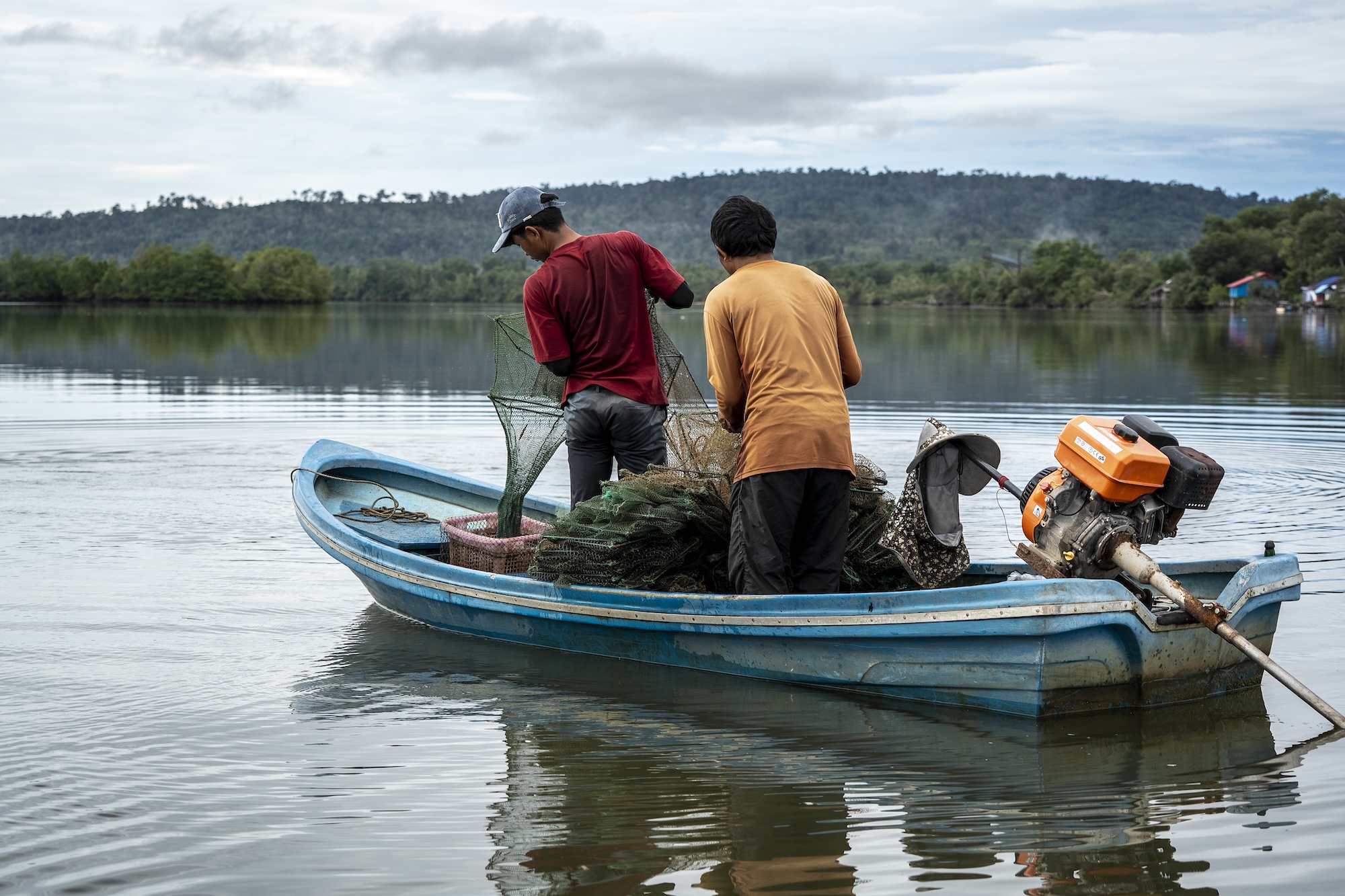
Banner image: Fishermen retrieve their nets from a river near their village in Koh Kong Knong, Koh Kong province, Cambodia, a few kilometers from a sand mining operation that began in June 2026. Image by Roun Ry.
Additional reporting by Phoung Vantha.
Global sand demand is outpacing nature’s ability to replenish it, UN says
Cambodia’s banned sand trade with Singapore appears to be back
Citations:
Koehnken, L., Rintoul, M. S., Goichot, M., Tickner, D., Loftus, M.-E., Acreman, M. C., … Conallin, J. (2020). Impacts of riverine sand mining on freshwater ecosystems: A review of the scientific evidence and guidance for future research. River Research and Applications, 36(3), 362–370. doi:10.1002/rra.3586
Kashvi, K., & Dar, S. A. (2025). Impacts of sand mining on riverine fisheries and aquatic ecosystems: A global review with emphasis on India. Asian Journal of Environment & Ecology, 24(5), 337–348. doi:10.9734/ajee/2025/v24i5715
FEEDBACK: Use this form to send a message to the editor responsible for this story. If you want to post a public comment, you can do that at the bottom of the page.
Cite this article
Andy Ball (2026). Singapore sand imports threaten an already sinking Cambodian fishing community, again. Mongabay Conservation news. DOI: https://doi.org/10.66709/news-335113

