


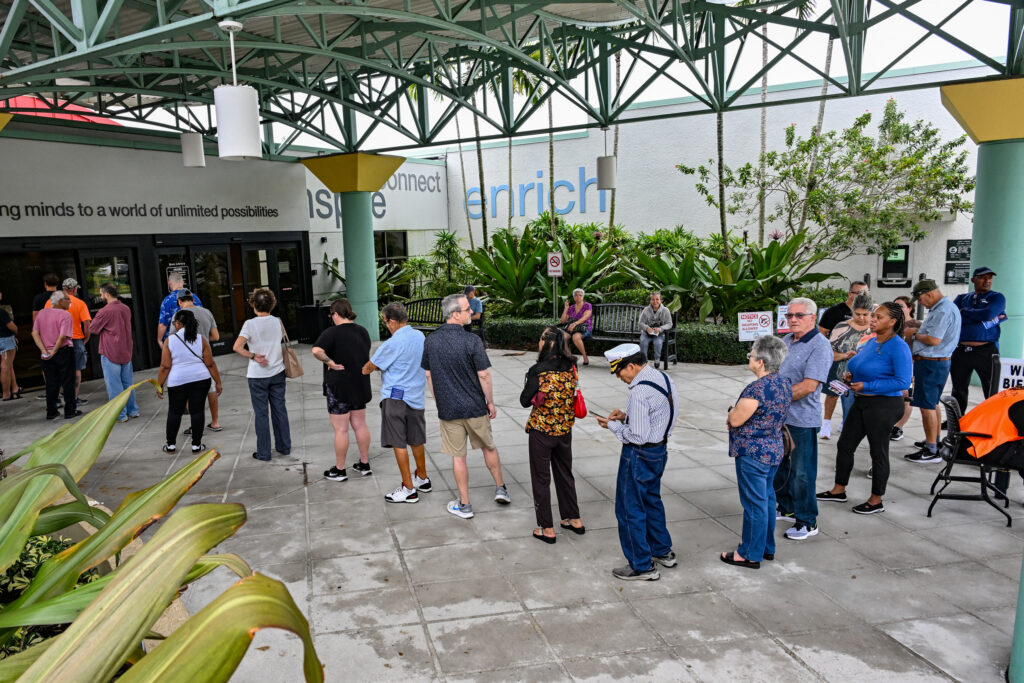
Republicans in Florida narrowly held off a nationwide repudiation Tuesday of their party and President Donald Trump, eking out slim victories in statewide races. But the GOP failed to flip congressional seats Democrats held and lost seats in the Legislature.
Voters elected Republican Byron Donalds as governor over Democrat David Jolly by a margin of a little over 1 percentage point and Republican Ashley Moody for the U.S. Senate over Democrat Angie Nixon by less than 3 percentage points. Both GOP candidates raised significantly more money than their Democratic challengers. Republicans also held onto three cabinet positions in similarly close races.
“Mr. President, I want you to hear from Florida that we are still red!” Donalds, a Trump-endorsed congressman representing the 19th district in southwest Florida, announced Tuesday night to cheering supporters gathered to celebrate his victory. Donalds is the first Black governor elected in Florida and first Black Republican governor in the nation.
It was possible but perhaps unlikely Republicans might take a more moderate approach on issues such as climate change after Democrats’ gains in Florida, said Aubrey Jewett, associate director of the School of Politics, Security and International Affairs at the University of Central Florida.
“They didn’t win, and so that stings. But on another level I think it gives perhaps Democrats a little bit of hope after all, because it really seemed that Florida had become a red state to such a degree that Democrats just didn’t really have any hope,” he said. “I emphasize though, a loss is a loss, and it stings. And I’m sure they’re disappointed that they lost, and they don’t have control of the executive branch. And they actually, in some ways, they came so close and didn’t win, it perhaps stings a little more.”
Democrats did maintain seats in four congressional districts where the boundaries were redrawn to favor Republicans, as part of a controversial redistricting effort this spring directed by Gov. Ron DeSantis, a term-limited Republican, and the GOP-controlled Legislature. Among the winning Democrats were Rep. Darren Soto, whose Hispanic-majority district in central Florida was redrawn to include conservative-leaning areas as far south as Lake Okeechobee.
Susannah Randolph, director of the Florida chapter of the Sierra Club, said the redistricting effort failed.
“That was very inspiring,” she said. “I think folks kind of saw through that scheme.”
Democrats also made gains in the Legislature, where Republicans maintained majorities in the Senate and House but lost super-majorities in both chambers, Jewett said. Democrats now will wield more influence as bills are shaped and voted on.
“Still the big picture is the Republicans have the majority, and they are in charge,” he said.
Republicans benefited from an infusion of campaign contributions and boast 1.5 million more registered voters in the state than Democrats. But for many years Florida was a must-win swing state, opting six times in a row for the prevailing presidential candidate, from Bill Clinton in 1996 to Trump in 2016. For much of the 20th century Democrats ruled the state. Randolph said Tuesday’s results suggest Florida could be a swing state again.
“That’s kind of up to the Florida Democratic Party,” she said. “If I were them I would be looking at the fact that Angie [Nixon] and Jolly got wildly outspent and had just hardly any resources and came as close as they did with a giant voter registration gap.”
DeSantis as governor dismissed the role of climate change in intensifying hurricanes and flooding and did little to address the emissions exacerbating the problem or hold polluters accountable. He focused his environmental policy instead on the Everglades and water quality.
Some voting locations in Florida were closed early this week because of heavy rain and flooding. Rachel Cleetus, climate program director for the Union of Concerned Scientists, said the situation demonstrated the urgency of the issue of climate change in the state.
“Florida is almost one of the most acute manifestations of this fossil fuel energy crisis affecting costs, as well as climate change is causing so much damage and the threats are growing for the state,” she said. “It’s just unmistakable that these issues are top-of-mind for voters.”
About This Story
Perhaps you noticed: This story, like all the news we publish, is free to read. That’s because Inside Climate News is a 501c3 nonprofit organization. We do not charge a subscription fee, lock our news behind a paywall, or clutter our website with ads. We make our news on climate and the environment freely available to you and anyone who wants it.
That’s not all. We also share our news for free with scores of other media organizations around the country. Many of them can’t afford to do environmental journalism of their own. We’ve built bureaus from coast to coast to report local stories, collaborate with local newsrooms and co-publish articles so that this vital work is shared as widely as possible.
Two of us launched ICN in 2007. Six years later we earned a Pulitzer Prize for National Reporting, and now we run the oldest and largest dedicated climate newsroom in the nation. We tell the story in all its complexity. We hold polluters accountable. We expose environmental injustice. We debunk misinformation. We scrutinize solutions and inspire action.
Donations from readers like you fund every aspect of what we do. If you don’t already, will you support our ongoing work, our reporting on the biggest crisis facing our planet, and help us reach even more readers in more places?
Please take a moment to make a tax-deductible donation. Every one of them makes a difference.
Thank you,
