


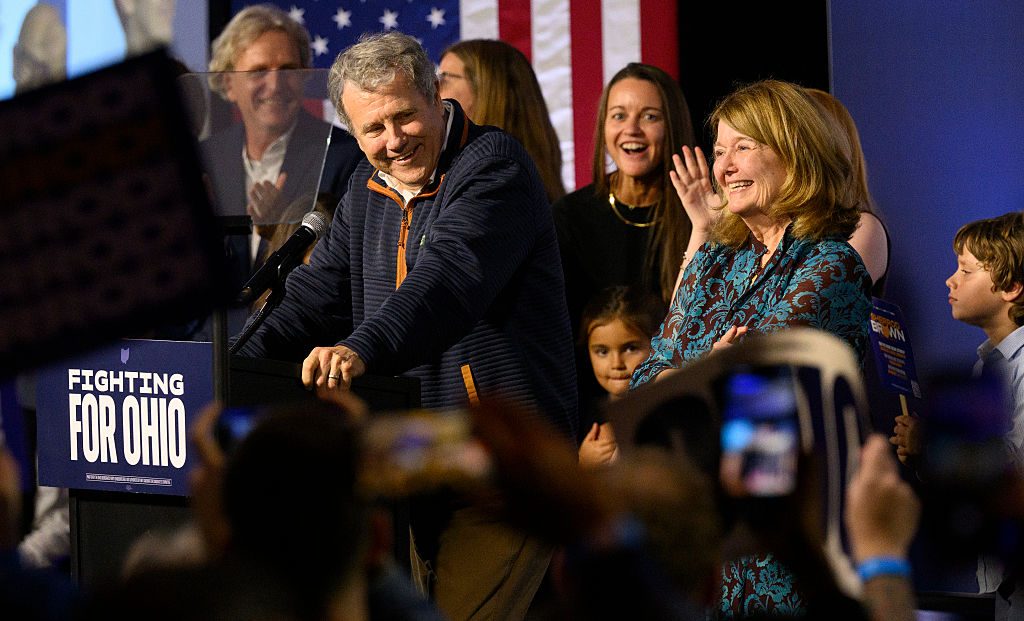
Democrat Sherrod Brown, seen celebrating his victory Tuesday night, outspent Republican Sen. Jon Husted by a more than 4-to-1 margin during the campaign. (Photo by Jeff Swensen/Getty Images)
Money won in the Senate battleground races – but not the kind that dominated the airwaves.
Hundreds of millions of dollars in spending from super PACs and other outside groups repeatedly failed to deliver victories in six key Senate races. Instead, the more reliable predictor was candidate fundraising: In every resolved race, the candidate who raised more direct contributions defeated an opponent who often benefited from substantially greater outside support.
Of seven Senate races the nonpartisan Cook Political Report rated as toss-ups in the days before Election Day, six were decided by the following morning – all in favor of Democrats, who claimed control of the Senate. The race in Alaska, which uses a ranked-choice system that may take weeks to resolve, remained the lone outstanding contest.
(function(){function e(){window.addEventListener(`message`,function(e){if(e.data[`datawrapper-height`]!==void 0){var t=document.querySelectorAll(`iframe`);for(var n in e.data[`datawrapper-height`])for(var r=0,i;i=t[r];r++)if(i.contentWindow===e.source){var a=e.data[`datawrapper-height`][n]+`px`;i.style.height=a}}})}e()})();
One possible explanation lies in the fundraising advantage Democrats built throughout the cycle. Democratic Senate nominees raised money at roughly 2.5 times the pace of their Republican counterparts through Sept. 30. The top nine individual fundraisers among Senate hopefuls through that date were Democrats. That list included James Talarico in Texas, Sen. Jon Ossoff in Georgia and former Sen. Sherrod Brown in Ohio – all of whom won their races.
Conversely, Republicans relied heavily on outside spending – which exceeded spending by the campaigns themselves for each of the Democratic and Republican nominees in the seven spotlighted Senate races.
The top three political donors during the cycle gave more than $705.9 million. More than 99.9% of that total ($705.8 million) went to support GOP candidates and causes, and more than 99% ($700.5 million) went to super PACs and other outside groups that can raise and spend unlimited amounts as long as they do not coordinate directly with campaigns. Elon Musk, the world’s richest person, led all donors by contributing more than $445 million.
Here’s a closer look at the money picture in each battleground Senate race, including the “total spend” for each candidate, based on OpenSecrets’ analysis of disclosure reports filed with the Federal Election Commission as of Nov. 4. That figure includes amounts spent both by campaign committees and by outside groups to either support that candidate or oppose the opponent. In four of the races – Texas, Ohio, Michigan and Maine – the candidate with the greater total spend lost the race.
Texas
James Talarico (D) def. Ken Paxton (R)
Total spend: Paxton $335 million, Talarico $275 million
Talarico led all candidates nationwide by raising $145 million. He outraised Paxton ($22.2 million) by a margin of more than 6.5 to 1. Talarico also spent $135 million — nearly eight times the $17.4 million spent by Paxton. Paxton’s massive advantage came in outside support: $318 million was spent on his behalf, including $222 million spent to oppose Talarico. FEC records show Musk made two donations totaling $158 million – $75 million on Sept. 9, and $83 million on Sept. 23 – to the Senate Leadership Fund, a super PAC supporting Republican candidates. On both occasions, the group then donated an identical amount the following day to Texas PAC, a pro-Paxton super PAC.
Ohio
Sherrod Brown (D) def. Jon Husted (R)
Total spend: Husted $277 million, Brown $222 million
Brown accounted for 77% of all money raised by candidates in the race and outspent Husted by a more than 4-to-1 margin at the campaign level. Brown pulled in $67.7 million to $19.5 million for Husted, and spent $63.3 million while Husted spent $15.3 million. Husted had $261 million in outside spending on his side, including $189 million opposing Brown. Conversely, $131 million was spent to oppose Husted and $27.5 million went toward backing Brown.
Michigan
Abdul El-Sayed (D) def. Mike Rogers (R)
Total spend: Rogers $225 million, El-Sayed $152 million
The Cook Political Report shifted its assessment of this race at the last minute from toss-up to leaning Democratic. El-Sayed more than doubled Rogers in both candidate fundraising and spending. He took in $53.4 million to Rogers’ $22.8 million and spent $50.7 million while Rogers spent $19.2 million. More than $154 million in outside money was spent to oppose El-Sayed – but a significant portion of that came during a bitter primary race against Rep. Haley Stevens (D). Two days before Election Day, Stevens endorsed Rogers.
Iowa
Joshua Turek (D) def. Ashley Hinson (R)
Total spend: Turek $135 million, Hinson $111 million
Turek was one of two candidates in the seven highlighted races to win with a greater total spend – an amount buoyed by $114 million in outside spending either to back him ($43.9 million) or to oppose Hinson ($70.1 million). Turek also raised $24 million to $14.1 million for Hinson, and outspent her $20.9 million to $13.9 million in direct campaign funds.
Maine
Troy Jackson (D) def. Susan Collins (R)
Total spend: Collins $106 million, Jackson $78.4 million
Jackson, a last-minute replacement after initial Democratic nominee Graham Platner dropped out amid a sexual assault allegation, entered the race in July and raised $26.6 million to $21.9 million for Collins, an incumbent seeking a sixth term. Jackson spent $25 million of his haul to $21.8 million by Collins. Also outraised in candidate campaign contributions during her prior Senate run in 2020, Collins had significant outside money backing her, with $84.1 million spent by independent groups to either support her or oppose Jackson. Jackson had $53.4 million in outside support either backing him or attacking Collins.
Kansas
Adam Hamilton (D) def. Roger Marshall (R)
Total spend: Hamilton $74 million, Marshall $42 million
Hamilton raised nearly four times more and his spending total was nearly triple that of Marshall – who had the smallest raising, spending and outside spending totals of any candidate across the seven highlighted races. Hamilton raised $19.1 million and spent $16.2 million to $5.2 million raised and $6.1 million spent by Marshall. Hamilton also benefited from $57.8 million in outside spending – $12 million backing him, and $45.7 million opposing Marshall. The Republican incumbent, meanwhile, had $35.9 million in outside money either supporting him or opposing Hamilton.
Alaska
Race not called
Total spend: Mary Peltola (D) $83.3 million, Sen. Dan Sullivan (R) $65.1 million
It may be a while before the winner is determined because of Alaska’s ranked-choice setup featuring four candidates – two of whom, including the incumbent, are named Dan Sullivan. Peltola has both outraised and outspent the more prominent Sullivan by margins of more than 3 to 1. She raised $36.2 million and spent $32.1 million compared with $11.5 million raised and $10.7 million spent by Sen. Sullivan. The state was flooded with super PAC money during the primaries, leaving the incumbent Sullivan with a slight edge in outside money: $54.4 million was spent either supporting him or opposing Peltola, compared with $51.3 million in Peltola’s corner.
