


Unlock the Editor’s Digest for free
Roula Khalaf, Editor of the FT, selects her favourite stories in this weekly newsletter.
US manufacturing is showing signs of a revival. After six months of expansion, factory activity surged to its strongest in more than four years in July. So far this year, production has edged higher, around 30,000 new jobs have been created, and just this month industrial titans Siemens, Amazon and SK Hynix unveiled hefty investment plans.
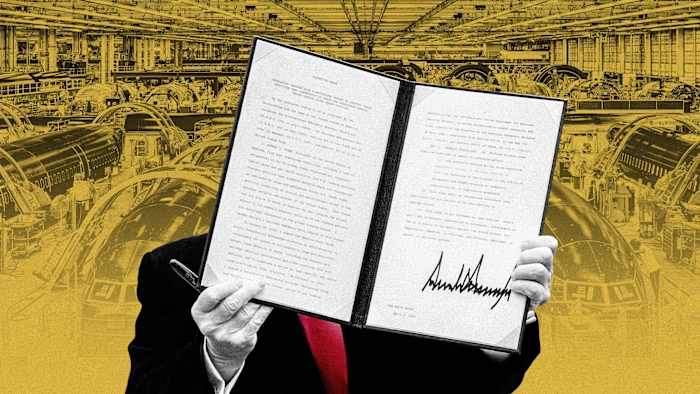
For the Maga movement this is evidence that President Donald Trump’s protectionism-powered “renaissance” of American manufacturing is taking shape. Speaking at a General Motors plant in Michigan in July, Trump said that his “historic tariffs” were reviving the nation’s industrial heartlands.
But this claim is a rather disingenuous reading of the data. American manufacturing is resurgent despite the president’s protectionist measures, not because of them. Nor does the boom look much like the one he promised.
For starters, since Trump’s second term began, uniquely strong demand conditions in two sectors have underpinned the expansion of industrial output, rather than a surge in tariff-related onshoring. The first is computer and electronic products, which includes the chips and servers feeding the ongoing AI frenzy. Next is aerospace, where aircraft backlogs — most notably at Boeing — are being filled and global conflict is swelling defence order books.
Demand for other components used to build data centres, such as transformers, cooling equipment and cement, has helped to prop up broader US industrial output.
Crucially, AI and aerospace inputs have benefited from significant carve-outs from the administration’s various tariff schemes. By contrast, sectors facing some of the highest duties — including textiles, furniture and wood — have contributed little to output, or have shrunk, according to data compiled by Scott Lincicome, vice-president at the Cato Institute. Indeed, since Trump’s second inauguration, manufacturers’ earnings reports have repeatedly cited the squeeze of duties on their profit margins, both directly and via their domestic supply chains.

There is another inconvenient data point for tariff backers. If tariffs were driving a broad reshoring boom, one would expect domestic production to displace imports. Instead, the manufacturing revival has dovetailed with a notable pick-up in purchases from abroad. The strength in US capital goods imports since January last year has been driven by demand for components linked to AI.
The timing of this year’s surge in manufacturing is perhaps most damning for the protectionists’ cause. The jump in production since January has coincided with a drop in the effective duty rate and the easing of trade uncertainty following the Supreme Court’s decision in February to strike down the bulk of Trump’s “liberation day” tariffs.
That’s not to say tariffs have delivered none of Trump’s vaunted benefits. The small gain in jobs this year may be linked to insulation from foreign competition in a few sectors. Tariffs have also compelled some companies to make commitments to build US factories. That said, eye-catching investment pledges often have a patchy record of panning out, and annual private expenditure on new factory construction has continued to fall since Trump’s return to the White House.
“The AI build-out, aircraft back-orders, tax deductions for capital expenditure in the One Big Beautiful Bill Act and even the Iran war are driving the recent US manufacturing surge,” says Lincicome. “Tariffs have mostly been a headwind.” Getting the narrative straight matters. Reports on Thursday suggested that the administration was mulling new duties on semiconductors. Doing so would only impede a sector that is helping to drive US manufacturing output.

Still, it is no surprise that the White House is using the topline data to promote its performance ahead of the midterms. The irony is that the manufacturing resurgence the administration is touting isn’t the one it advertised. Even with this year’s bounce, manufacturing employment is 82,000 below its level when Trump’s second term began. It has not brought back the labour-intensive production lines that the president’s team promised. Instead, it has been high-tech output, produced largely by machines drawing on foreign parts in industries that require skilled workers.
In other words, Trump’s tariffs are proving a blunt tool for reviving his nostalgic vision of manufacturing. America’s industrial strengths are proving resilient in spite of them — and would have been stronger still without them.
