


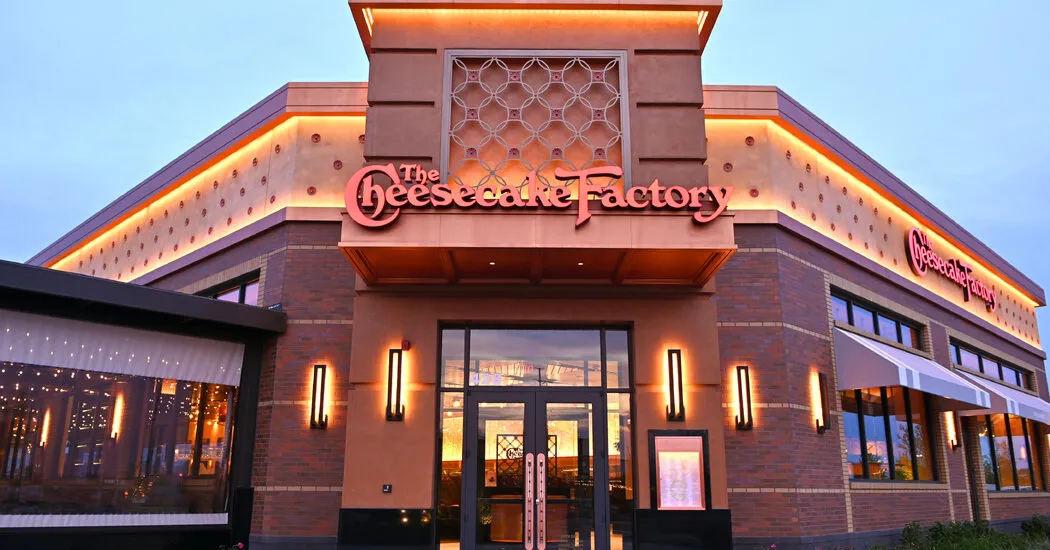
First, the man responsible for the way the Cheesecake Factory looks wants you to know he isn’t mad. And his feelings aren’t hurt.
Rick McCormack is the designer behind the eclectic décor of murals, towering columns and oversize amber light fixtures that gives each Cheesecake Factory the vibe of a postmodern suburban Versailles.
When he first learned that former President Barack Obama had told a political rally on Saturday that President Trump’s golden glow-up of the Oval Office looked like “Saddam Hussein opened a Cheesecake Factory,” he was surprised. And when the White House responded by denouncing Mr. Obama as an elitist — setting off an internet dumpster fire about class optics in America — Mr. McCormack just shook his head.
“I’m not emotionally attached to the Cheesecake Factory design, but don’t we have bigger issues in the country?” he said in an interview on Tuesday.
Then he thought about the bigger picture. Yes, like Cracker Barrel and Starbucks before it, the Cheesecake Factory has found itself an unwitting player in the culture wars. And yes, he said, the whole thing seems silly.
But on the positive side, the midterm dust-up has focused the attention of an entire nation — at least those following politics — on his true love, restaurant design.
“No design is universally loved,” said Mr. McCormack, 69. “I realize that. That is one thing I like about design. That makes the world of design go around.”
The Cheesecake Factory — which began in 1978 in an epicenter of elitism, Beverly Hills, Calif. — is a fortress, accustomed to absorbing attacks perhaps not as clever but equally forceful.
A writer for Vice once called it “the culinary embodiment of the Kardashians.” The Centers for Science in the Public Interest has assailed its portion sizes, calling its food “heart attacks disguised as dinner.”
The chain’s look, dreamed up by its founder and chief executive, David Overton, and refined over 16 years by Mr. McCormack, has long had its own band of critics.
“If you want a fully immersive ‘postmodern design hellscape’- themed dining experience, I highly recommend dinner at The Cheesecake Factory,” the game developer and commentator Max Krieger wrote in a 2017 rant on the digital platform X. “The interior is a world of aesthetic chaos that feels like a mix between a Fry’s Electronics, an overgrown Panera, and a laser tag arena.”
Whatever. It worked. The Cheesecake Factory has defined the term “upscale casual dining,” and has done such a good job reading the psyche and the appetite of the American diner that it reported on Tuesday that its revenue had risen to $1.03 billion, from $907.2 million a year earlier.
Sales from locations that had been open at least a year were up more than 15 percent over last year. (A competitor, Texas Roadhouse, reported 6 percent growth.) The Cheesecake Factory expects to add 26 new restaurants to its roster of 218 this year.
Mr. Overton grew up in Detroit, where his mother, Evelyn, sold cheesecakes to restaurants that she baked in the family’s basement, using a recipe she had clipped from a newspaper.
He moved to San Francisco, dropped out of law school and started playing drums for a rock band whose leader wrote the Jimi Hendrix hit “Hey, Joe.” In the early 1970s, he persuaded his parents and sister to move west and open a cheesecake bakery in North Hollywood called the Cheesecake Factory.
It wasn’t making much money, so Mr. Overton decided to turn it into a restaurant. In 1978, he opened a small spot a block from Rodeo Drive in Beverly Hills’ Golden Triangle.
He was such a novice that he served hash browns because he didn’t know how to make French fries. As business grew, he studied the menus at upscale restaurants like Wolfgang Puck’s Spago, trying veal dishes and figuring out how to make them with less-expensive chicken. He doubled down on portion sizes and sauces.
The menu kept growing into the 250-item behemoth it is today. (Ellen DeGeneres once called it “the only menu visible from space.”) Mr. Overton said it appealed to “palate of the common man.” “I’m not a gourmet,” he told the “Today” show. “I don’t like a lot of things, but what I like millions of people like, thank goodness.”
Mr. McCormack came along in 1992, and stayed until he opened his own design firm in 2008. He embraced Mr. Overton’s design sensibility, which drew on Victorian-era San Francisco and quirky ideas like the tall columns topped with palm fronds that he had seen at bathhouses. And, of course, each restaurant featured a glass case near the front filled with cheesecake.
“We were going for a little bit of an exotic or European feel,” Mr. McCormack recalled. Hand-painted plaster walls, limestone floors and booths in dark wood made it feel fancy.
“You’d see families coming in celebrating life’s milestones in a nice environment without having to spend every penny,” he said.
In the song “Childs Play,” the singer Drake calls it “a place for families that drive Camrys and go to Disney.”
This week, Mr. Trump and his allies hailed the Cheesecake Factory as America’s great middle-class restaurant and proof of how out-of-touch Mr. Obama is with the mainstream.
Democrats responded that Mr. Trump was the elitist, pointing out that the Cheesecake Factory isn’t exactly a bargain. Spaghetti and meatballs go for $25.95, and a burger close to $20. A slice of cheesecake is $10.95.
At a Cheesecake Factory in Atlanta on Tuesday night, many of the staff hadn’t heard about Mr. Obama’s remarks. But they laughed when they did.
One waiter, who asked not to be identified, pointed out that Cheesecake Factory stock was performing better than some of the market giants. (Indeed, the restaurant’s share price grew 122 percent this year, compared with 15 percent for Amazon’s, and 18 percent for Apple’s.)
Over the years, the maximalist design that marked the early restaurants has been toned down, a casualty of economics and scale. But the Atlanta restaurant still has the high ceilings, giant murals and that amber glow.
“It does kind of look like Trump Tower in here,” the waiter said.
