


Welcome to Foreign Policy’s Africa Brief.
The highlights this week: Benin’s failed coup highlights a network of pro-Russian actors across the continent, the dispute over Zambia’s fraught election continues, and the Tanzanian government suspends an independent newspaper.
Africa Brief will take a break for the next two weeks. Our regular programming will return on Wednesday, Sept. 16.
A coup thwarted in Benin last year has highlighted a network of pro-Russian actors in Africa, according to new details that have emerged from an ongoing extradition trial in South Africa.
The December mutiny, which was led by Lt. Col. Pascal Tigri and included the temporary seizure of the national broadcaster, collapsed within hours following military intervention from neighboring Nigeria. However, subsequent legal proceedings have shed light on how local pro-Russian influencers and movements work to achieve shared aims across African borders.
In its bid to prosecute those involved in the failed coup, Benin filed extradition requests for individuals in a number of African countries. This included Tigri, who fled to Togo—though his exact whereabouts remain unknown—and pro-Russian social media influencer Kemi Seba, who escaped to South Africa.
In April, South African police arrested Seba (whose real name is Stellio Gilles Robert Capo Chichi), who is wanted by Benin for “inciting” the coup. South African prosecutors allege that Russia funded and orchestrated an illegal escape plan for the 45-year-old Seba.
According to South African police, Seba was arrested with more than $18,000. Pretoria’s intelligence has suggested that the cash originated from Russia and was to be paid to Francois van der Merwe, a leader within the Afrikaner white nationalist group Bittereinders, to facilitate cross-border transport of Seba and his 18-year-old son from South Africa into Zimbabwe and on to Europe to carry out terror attacks, according to court documents revealed earlier this month. Seba and his legal team reject the accusations.
All three individuals—Seba, his son, and Merwe—were arrested together. Merwe had previously attended a September gathering of neofascists in St. Petersburg, Russia.
Despite growing up in France, Seba, who has about 1.5 million Facebook followers, has been a highly vocal critic of French neocolonialism in Francophone Africa on social media. He was stripped of his French nationality in July 2024 after he had previously been arrested for allegedly inciting anti-French and antisemitic sentiment. A month later, Niger appointed Seba as a special advisor to Nigerien President Abdourahamane Tchiani and gave him a diplomatic passport.
In December, on the day of the Benin coup attempt, Seba posted a video that he later deleted, which hailed the mutiny as a “day of liberation” and praised the fall of “a clan of predators preying on the economy and freedoms.” He has also widely praised Russia on social media.
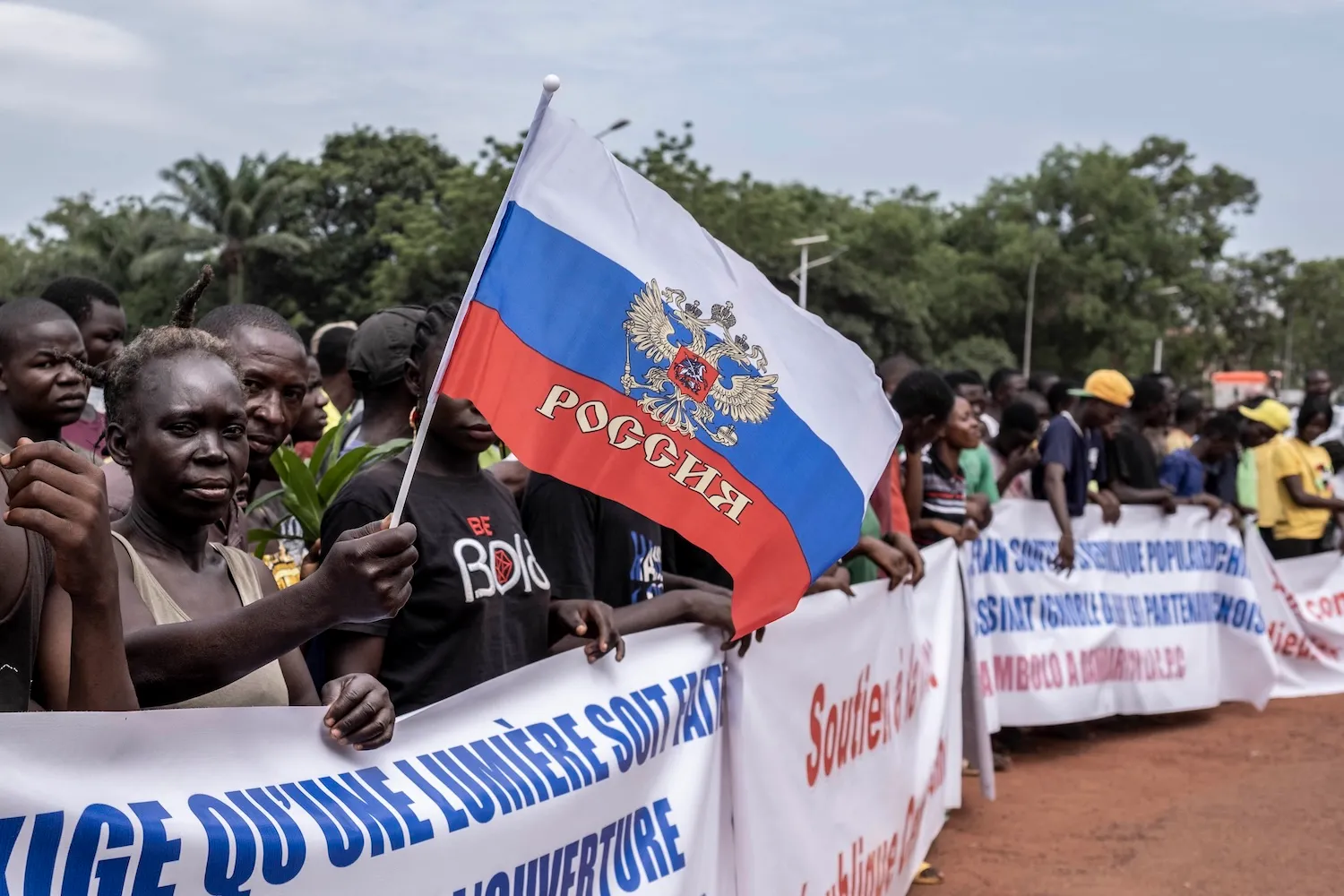
Russia has fostered close ties with Benin’s neighboring junta-led nations of Niger, Burkina Faso, and Mali. Analysts have suggested that Seba’s pro-coup posts were part of a highly coordinated network of African diaspora influencers that worked to amplify the putschists’ messaging to create a false impression of popular support for the coup.
This appears to be a trend not just in the Sahel, but also across Africa. In 2022, the U.S. State Department accused Russia’s defunct paramilitary Wagner Group of using Seba and other influencers to spread pro-Kremlin narratives. In some cases, fake journalists wrote hundreds of pro-Russian articles in more than a dozen African countries, from Senegal to the Democratic Republic of the Congo.
While it may be tempting to dismiss Benin’s coup plot and other destabilizing events in Africa as simply Russian orchestrated, Moscow seeds its influence by tapping into systemic problems with democratic backsliding. Benin’s mutineers cited then-President Patrice Talon’s cuts to health care, the cancellation of state-funded kidney dialysis, and crackdowns on political activities as reasons for their insurrection.
Last year’s failed putsch was the second coup attempt against Talon, who had been widely accused of dismantling one of West Africa’s once-vibrant democracies and jailing political opponents.
Talon stepped down this April after completing his two-term limit—but not before changing the constitution to extend presidential and legislative terms from five to seven years and creating a new Senate. Since his term ended, Talon has occupied the Senate presidency, Benin’s third-highest-ranking office.
Measures to suppress public dissent have expanded considerably in the eight months since the coup. Talon’s successor, President Romuald Wadagni, faced just one challenger after many opponents failed to secure enough of the required endorsements from lawmakers to run.
For now, Seba’s lawyers have filed for asylum for him in South Africa, saying that he fears for his life if sent to Benin. The extradition trial will continue on Sept. 23.
Friday, Aug. 28: The ratings agency Moody’s reviews its credit rating for Tanzania.
Sunday, Aug. 30: Guinea-Bissau holds a constitutional referendum that would increase presidential power.
Wednesday, Sept. 2: The Council of the European Union’s Africa Working Party holds a meeting in Brussels.
Zambia’s disputed election. Nearly two weeks after the country’s Aug. 13 presidential elections, Zambians are still contesting incumbent President Hakainde Hichilema’s victory against opposition leader Brian Mundubile.
On Monday, Zambian authorities closed the country’s courts, a day before the deadline for Mundubile to file a petition against the election outcome. Critics argued that this was a calculated move by the government to prevent Mundubile, who is in hiding due to alleged threats against him, from formally challenging the vote.
According to the official tally, Hichilema secured a second five-year term with 61 percent of the vote. The Christian Churches Monitoring Group found inflated turnouts in 30 constituencies, though election observers whom I spoke with said that despite the apparent ballot rigging, Hichilema would likely still have won.
Regardless, the optics of the vote—as well as the arrest of opposition politicians and the fatal shooting of Mutotwe Kafwaya, an opposition member and former cabinet minister, during an election night raid on Mundubile’s home—has damaged Hichilema’s legitimacy in what was one of Africa’s most resilient democracies. Zambian authorities claimed they acted on intelligence about a potential insurrection and that they recovered high-grade weapons during the operation.
“The securitization of Zambia has been something that’s been ongoing for a very long time—and the use of security apparatus and also the narrowing of the political space,” Menzi Ndhlovu, a lead analyst at Signal Risk, told Foreign Policy.
Expect any pressure from the international community to be limited as this plays out due to Zambia’s strategic importance in a fierce race between China and Western nations for critical minerals.
Tanzanian repression. The Tanzanian government suspended independent newspaper Mwanahalisi’s operations for six months starting last week after it reported that Vice President Emmanuel Nchimbi had rejected calls to resign following a falling out with President Samia Suluhu Hassan. (Nchimbi later resigned on Tuesday.)
Authorities claimed that the story lacked balance and care in editing, including an error in a photograph caption, which incorrectly identified the information minister as Nchimbi.
The move is the latest crackdown on civic space in Tanzania. Last month, security forces arrested 130 people for allegedly “inciting criminal acts” around the time of a planned July 7 protest, which the government banned. This follows last October’s demonstrations against Hassan’s reelection, when more than 500 Tanzanians were killed.
Despite the political climate, U.S.-backed Orion Critical Mineral Consortium is negotiating a deal to invest more than $500 million in a large nickel project in Tanzania.
Zimbabwe’s new senators. Last week, Zimbabwean lawmakers approved 10 new senators appointed by President Emmerson Mnangagwa, following a new constitutional amendment that expanded the country’s upper chamber from 80 to 90 members.
Most of the appointees are loyalists or political financiers for Mnangagwa’s ruling party, the Zimbabwe African National Union-Patriotic Front, including oil and mining tycoon Kudakwashe Tagwirei, who has long been linked to allegations of corruption and cronyism in Zimbabwean politics. Some analysts believe that Tagwirei is likely to become Mnangagwa’s handpicked successor.
The constitutional amendment, which was passed in June, also replaced direct elections of the president with parliamentary appointment and allows Mnangagwa to stay in office until 2030 by extending presidential terms from five to seven years. Last year, leaders in Cameroon, Chad, Ivory Coast, Djibouti, and Guinea-Bissau also changed laws to extend their terms or remove barriers to future reelection, according to a new Freedom House report.
Uganda’s succession plan. In Foreign Policy, Maurice Oniang’o details how Yoweri Museveni, Uganda’s 81-year-old president, who has ruled the country since 1986, is maneuvering to transfer power to his son, Gen. Muhoozi Kainerugaba, who has increasingly used the military to suppress political opposition.
“While Museveni has generally exercised coercion through institutions, bending democratic structures to his will, his son seems to make no effort to retain legal or constitutional cover,” Oniang’o writes.
Why Africa backs Infantino. FIFA President Gianni Infantino has engaged in a flurry of diplomacy in response to demands that he resign after he pushed to privatize the World Cup. Importantly, he has secured backing from the Confederation of African Football (CAF), which represents 54 FIFA member associations.
In New Lines Magazine, Kwangu Liwewe Agyei argues that the CAF serves as a vital lifeline for Infantino, despite its institutional leverage being weakened by financial dependency on FIFA.
“The continent has the numbers to influence who runs world soccer,” Agyei writes. “The bigger question is whether it can use that power to shape how world soccer is run, or whether its financial dependence on FIFA will continue to limit how far its leaders are willing to push back.”
