


In her upcoming book, My Wild City: Finding Nature, Meaning, and Hope in India’s Capital, conservation biologist Neha Sinha takes readers to the hidden and not-so-hidden ecosystems of India’s largest city. And while the book expertly details the biodiversity, I believe its greatest strength lies in connecting with the reader emotionally through powerful stories from her personal life. On this week’s episode of the Mongabay Newscast, Sinha explains why nature in cities isn’t just important from an ecosystem health perspective, but necessary for the emotional life of all people.
Sinha describes the difficulty of caring for her ailing father, and how this was the moment she found her favorite tree. While waiting in the hospital, she spotted a semal tree (Bombax ceiba). She tells me this was a turning point for her.
“In these kind of difficult situations which are physically and mentally challenging … you look at a tree, and it restores you. It kind of makes you feel that you might have strength that you didn’t know about. And it’s also unique to see a tree in a very urban environment because the tree itself is a survivor,” she says.
Much of the book takes place during intensive COVID-19 lockdowns in the early 2020s. Sinha describes how nature provided a respite for those seeking connection with others, themselves, and the natural world.
“It gave rise to a movement called balcony birding [during] a horrible time in terms of uncertainty, in terms of we didn’t know what’s gonna happen the next day,” she says.
“There was a bird family outside my bedroom window … it was a green pigeon, and she was raising her chicks. And, she was the exact same color as the tree she sat on … and she used to teach her chicks to stay very still all day long … and to be able to see a bird that’s basically teaching her chicks to be still almost taught me also … ‘let’s accept the situation we are in, and we’ll figure out how to get out of this.’”
Perhaps the prime example of the potential for ecosystem revival that Delhi has lies in the river that flows through it, the Yamuna, which once hosted dolphins but no longer does due to pollution. Sinha tells me an effort is underway to rewild the river, but first its image must be rebuilt in the imaginations of the people of Delhi.
Readers already enamored with nature will find much about My Wild City that will resonate with them. And people in positions of authority tasked with protecting these ecosystems may find insight here that could alter their perspective. Sinha tells me in our conversation that the urgency to care for nature has not yet taken hold in the politics of India, but that it has in the everyday person, pointing to the rise in popularity of urban hiking and bird-watching in the wake of the COVID-19 pandemic.
“I can tell you for sure, there hasn’t been a better time for citizens to be engaged and involved in nature. And in many ways, it’s actually urban wildlife that has done that,” she says, “and I think that’s what has started this quiet revolution of documenting the natural world.”
Mike DiGirolamo is the host & producer for the Mongabay Newscast based in Sydney. Find him on LinkedIn and Bluesky.
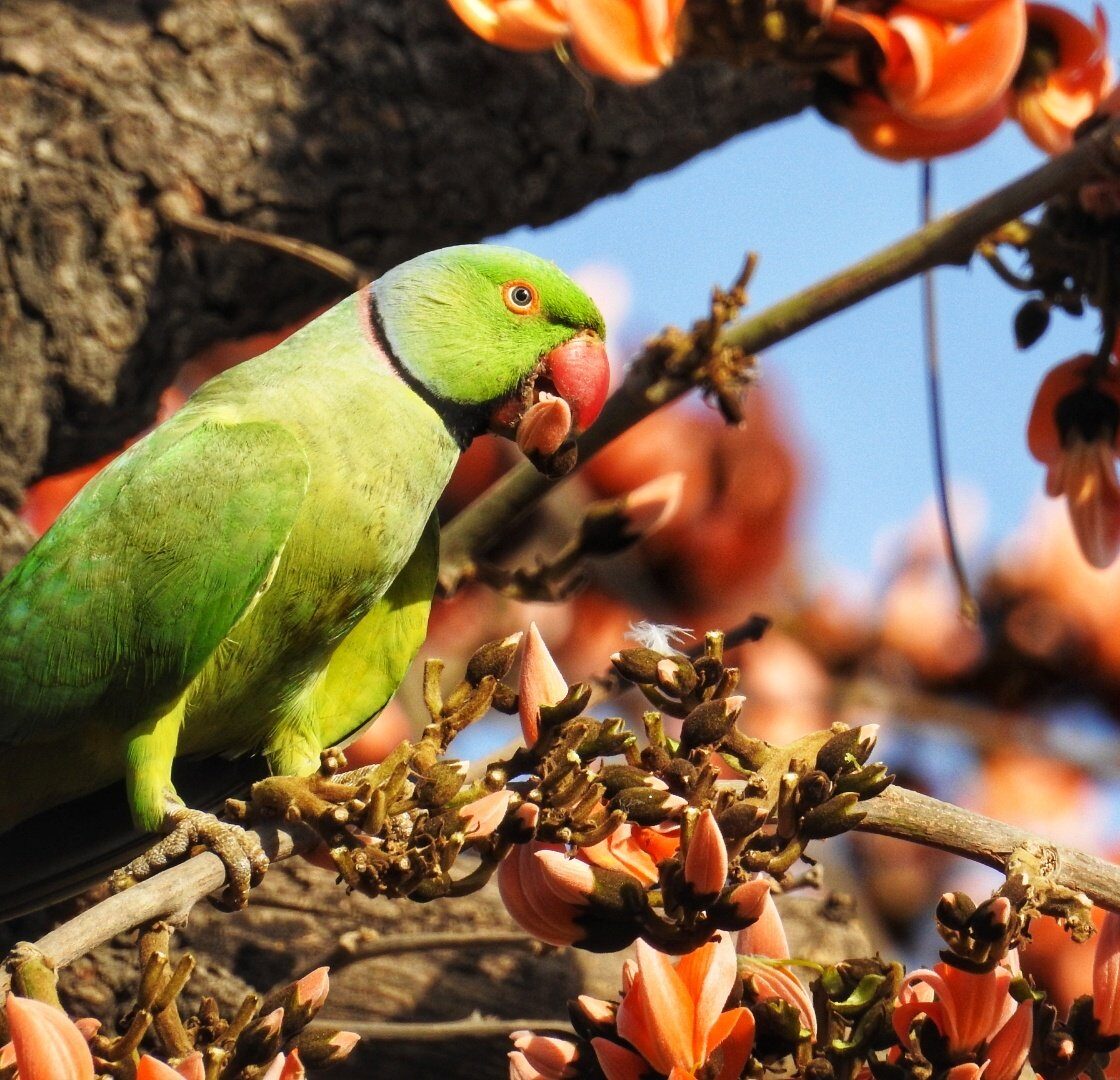
Banner image: A parakeet in the Delhi ridge. Photo by Neha Sinha.
Notice: Transcripts are machine and human generated and lightly edited for accuracy. They may contain errors.
Trees are more than a name
Neha Sinha: The one thing we still have are jackals in Delhi, and that makes me very happy because when I was growing up, I would hear them laughing at sunset. And they have this peculiar woo, woo, woo call. It’s like a howl or a laugh. And they, they, they’re very dog-like, they play with each other. But we still have jackals in Delhi, and that is the one thing I like to hang onto, that a lot of things have changed, and there’s a lot of loss.
I think love and loss are so often tightly bound together. If you love something, you also fear losing it. So we’ve lost the insects, we’ve lost the dolphins, but at least we still have the jackals. And the book is a quest to see if the things of my childhood are still in Delhi.
Mike DiGirolamo: Welcome to the Mongabay Newscast.
I’m your host, Mike DiGirolamo. Bringing you weekly conversations with experts, authors, scientists, and activists working on the front lines of conservation, shining a light on some of the most pressing issues facing our planet, and holding people in power to account. This podcast is edited on Gadigal Land.
Today on the Newscast, we speak with conservation biologist Neha Sinha, whose upcoming book, My Wild City, paints a picture of the unique beauty of nature, people, and non-human lives in the city of Delhi. Sinha writes with strikingly poetic prose in this detailed memoir and ode to nature, and I can’t recommend it enough.
It releases September first. Reading this book makes you realize how much nature is a part of your emotional life, your upbringing, your childhood, moments of joy, and also pain. It is, as Sinha says in the book, “Not the name of something that is the most important, but how it tunnels into your life.” My Wild City is a glimpse of how nature tunnels into hers and the lives of the people of Delhi, and hence encourages a reflection upon the reader to examine how the nature around them shapes their world and why it is necessary to protect it.
While I understand a large portion of the audience for this book are going to be those who are already enamored with nature, I argue the ones who might find the most insight are the ones in positions of power and authority who consider themselves in service to the public, for it may alter their perspective.
While Sinha tells me that the internal tide is not yet turning in politics, she has seen many people wake up to the need to protect nature and connect the dots on how much their lives depend on its preservation. So much of the wildlife in not just Delhi, but cities around the world is under pressure.
But like in this book, people are fighting to revive it and drawing hope from its very presence, which I think is best summarized by Sinha’s words. “The thing about nature is that it has the potential to revive, to be rewilded, to be restored, and love gives us a way out. If we care, we can do great things.”
Hi Neha, thank you for joining us. Welcome to the Mongabay Newscast.
Neha: Thank you so much for having me, Mike.
Mike: I really loved your book. I have to say that you, you have this incredibly poetic way that you weave memories into the nature of Delhi, and these are personal memories that you share, and it really provides, I think, an incredibly compelling read and narrative.
So well done. I just wanna start first with your chapter on trees, and you mention in this chapter that the name of a tree is not the most important thing, but that you allow it to tunnel into your life. So can you explain what you mean by that, and how the trees of Delhi are so important to the lives of human and non-human beings alike?
Neha: First of all, thank you. I’m so glad you like the book, and given that you’re from another part of the world, that means something more to me because when one writes a book like this, one always wonders if it’ll resonate with somebody who’s not from that part of the world. So coming to the name of this tree is my tree, we often have names for relationships in our lives to do with people, to do with humans.
So you have an aunt and an uncle and a father, mother, sibling. But I think with the non-human world, sometimes relationships or even identification doesn’t always have a correct moniker. so I may not know what the name of a tree is. So maybe in, Australia, eucalyptus or a gum tree is well-known but maybe it won’t be well-known in another part of the world or perhaps you simply think all trees are the same when you’re a child or you don’t know how to name a relationship even with something that cannot speak.
So I– the purpose of that chapter is to really turn the page on how it was when we were children when we had a sense of wonder towards all things. We didn’t necessarily need to have the correct names for everything, but we wanted to feel all the feelings for something that was part of our lives.
So for me, that was a tree outside my window. I had no idea which tree it was. I just knew that it gave me a long relief from my mathematics homework, which I never enjoyed. So I’d look out at the tree and, there’d be birds on it, parakeets and mynahs and bulbuls squabbling over a nest hole, et cetera.
And it gave me so much relief ’cause it pulled me out of my homework and it pulled me out of the chores I had to do, which felt so hard as a nine-year-old or a 10-year-old. And I realized even later in the book growing up, becoming an adult, that it’s the relationship that’s important. And I do feel sometimes even as adults we’re not able to name our relationship with a tree or a, or an animal or a plant because, A, it’s not speaking, and B, I think our language doesn’t allow for– to easily encompass what your relationship with a tree would be.
So there’s another w- a wonderful author based in India. Her name is Sumana Roy. She writes about how if a tree dies you don’t know how to express that. You do know how to express bereavement if a family member dies or even if a pet dies, but you don’t have that feeling, you don’t have that language or vocabulary for a tree.
So I just wanted to get to the heart of it. It doesn’t matter if you don’t know the scientific name. And particularly in my field, conservation, it’s so important. We’re always talking about scientific names and subspecies, but I think the bedrock has to be the relationship you have with that tree or that animal And we can start from there.
So when I say the name of this tree is my tree, what I’m trying to say is that your relationship with the tree is the foremost thing. And then comes identification, and then comes in knowing, two more things about it. And I think in the absence of this relationship with the non-human, our lives would be so much more lonely
Mike: Yeah, you’ve really– I mean, it becomes really apparent as you read the book how this commonality functions not just for yourself, but for everybody that is in it.
At one point in the book, you, you join a, a birding group that has people from, very diverse walks of life, but you all coalesce around your love of birds, and it’s a really beautiful section. But I wanted to ask you about, and I don’t know if I’m pronouncing her name correctly, but you, you met someone named Valari who was doing a PhD on the very thing that we were just talking about, like the human relationship with trees.
And I just would love to hear you explain more about that friendship and her, her s- her study.
Neha: Yeah. Valari became one of my best friends. And, in the way that we can join together if we have a common hobby, even if we are not similar as people. We are not similar as people. But we used to go bird watching together, and she would always stop for the plants, not even the trees, but the plants, like the herbs and the shrubs.
And I would be like, “What are you doing? The bird is over there.” So I was always chasing or pursuing the moving object, and she would stay still for the object that never moved, which is the plant. And because she’s from a botan- she’s a botanist, she’s an urban ecologist. And so I almost had a masochism, almost like a ableism towards things that were moving.
And I think that happens to a lot of people from the wildlife background, that we like to pursue the tiger and the leopard and the rhino and the big bird. We want to see all the things that are moving, and we move through the forest trying to pursue that. And then there are the plant people who stop and stay still and watch something that’s not particularly moving.
So it was a shift in my perspective to be with her because it taught me to appreciate the things that are very, very, very silent and passive. And, you know there’s something called plant blindness? That is a, it’s a word that’s often used in the conservation community that even conservationists such as myself don’t pay enough attention to the basis of life, which is the plant kingdom because we’re always pursuing the big bird and the charismatic mammal or the, the, the animal that’s moving.
So she was doing her PhD on the trees of Delhi, and I would go with her to study and observe the trees. I was looking mostly at the birds, I’ll confess. But she was taking notes of what is coming on the tree and what are the interactions. And it’s interesting, a city like Delhi is not known particularly for women standing around looking at trees because it is, A, not a city that’s very safe for women And B, it is a city that’s known as the political capital.
Yes. So in going with her, I also unearthed other layers, almost like onion layers of the city where I was born, which is basically my city. And I understood it through its trees. And trees are also interesting because they tell time in their own ways. You have trees that are hundreds of years old in the city, and they’ve survived drought and disease, and they’ve been witnesses to our lives in many ways.
And a tree can be like a civilization. A single old native tree obviously houses birds and bats and animals, and it’s almost like a living heritage in the city, which makes it so interesting because otherwise we identify cities as a jungle of buildings. But how wonderful to look at a city also as a jungle of trees or a civilization of trees
Protected spaces and restorative attention
Mike: Yeah, there’s so much that I could jump off of on what you just said, and we’ll come back to a couple of things.
But there are literal forests areas in Delhi where, as I understand it, you can’t cut the trees, and many of these are untouched for, I believe it was centuries as you describe, which is … I think that’s, that’s quite unique. So how many of these forest areas are there? And, and there’s a lot of them in the book that you go through of course, but c- can you describe some of them for the audience, maybe some of the more notable ones in your view, and what does this do to the composition of Delhi?
Neha: Thank you for that question. We have one of the oldest mountain ranges on Earth, called the Aravallis, that actually goes through Delhi, though I have to say the forest was disturbed quite a bit in terms of the fact that th- there was an invasive tree that was planted by the British. So not all the forests are untouched.
The forest that I describe in the book has a grove of about 350-year-old trees, which are jal trees, which are native to Delhi, which do well in the heat of Delhi and are basically native to this latitudinal belt. But a lot of the other city forests have been protected, but might not have the best composition of trees.
But because Delhi is the political capital, it had a fair amount of, fair amount of protection in the way that city forests were created earlier for a ceremonial purpose, that there was a particular section of society that had access. So the British said only the British would go there and enjoy the forest and hunt game, et cetera.
And then slowly after independence, some of the city forests were preserved. There were also a lot of citizens’ movements to save the trees because as you can imagine, it’s not easy to have groves of forests in a place where real estate is so expensive, where there’s so many people living. It’s, it’s India’s largest city.
There’s more than 30 million people. So there have been repeated protests and litigation to keep the city forests. And for me and thousands of others who enjoy and fight for these forests, the point is we feel that the forests add a character to the city, which is absolutely irreplaceable because it’s, it’s irreplaceable to look out of a window and see a forest.
Because otherwise, you just see forests of people. And I think a lot of writers like me who write about urban wildlife and urban nature will argue that- Having trees and wildlife in cities is more important than in any other place because there’s just so many of us in cities that you get so easily saturated and your mental health really suffers because you’re always seeing thousands of people and cars and roads.
So we have some remarkable features in the city. So not only do we have this really old Aravali mountain range, which has forests still, we also have these old monuments which are in the forest. So in the, in, in the book, I go climbing on Delhi’s oldest fort, which is now inside a, a forest and the fort is now colonized by beetles and geckos, which I find very fitting and very cyclical in its own way because they were there before the fort was built and they’ve come back there now.
And to have this extremely old forest with extremely old monuments is like a combination of build and natural heritage, which is absolutely charming and a very, very unique feature, I think, of the city and I hope we get to keep it. In fact, I think other cities should, think about building a green infrastructure which is native to that area and preserving it for all posterity.
Mike: You mentioned in one point in the book that it was something that Stephen Kaplan, you said he wrote, wrote about, that there’s a restorative attention that being in nature brings versus the overstimulation that cities can sometimes generate. So can you describe how the nature of Delhi provides that restorative attention to people?
Neha: I think all great cities in the world have this dichotomy. It’s exhausting, but it’s also exciting. I- it’s, you get very tired and overstimulated, but you might have pockets of peace that you might find. For me, the pockets of peace have always been in nature and being outdoors. And Steve’s idea of restorative attention is so meaningful to me and to many others like me who go bird watching or go outdoors climbing, et cetera.
Because in so many things, when you’re waiting for something, there’s an anxiety. I think bird watching is one of those rare things when you’re waiting for the bird but you’re not anxious. Or even gardening, There’s an author called Anuradha Roy. She writes about how gardening is also the wait for things.
You plant the seed, you wait for it to blossom or fruit, but that wait can be restorative. It can be calming, as opposed to being stuck in traffic when you’re just waiting to get out of it. You’re, you’re just stressed out and you just want to somehow be out of that situation. So being out in nature, seeing a large tree, being able to see a blue space or a green space, whether it’s a wetland or whether it’s a forest, restores our breathing and I think it brings us back to the present.
And, to be able to see through more than just the eyes, to also be able to see with your fingers and with your toes, so being barefoot or touching the soil, all of these things bring us back to the present. And I think that it creates almost meditative sort of outlook. It gives you an experience which takes you away from the Microsoft Excel spreadsheet that you’re working on, your salaries, your, little worries that we have in life every single day.
And I think nature, and there’s so many studies that say nature has this incredible mental health benefit, that the more vegetation you’re able to s- access and see and walk in, the better your immune system, the better your attention to detail, and it’s also good for the eyes. So I find in many, many- In many, many ways, every single day in the city you’re waiting for something.
You’re waiting to get to work. You’re waiting for your workday to get over. You’re waiting, waiting, waiting, and it’s stressful. Except when you’re out in nature, when you’re just waiting for things to happen to you. So it’s immersive rather than stressful. And so often you’re surprised by what you see. So I studied at Oxford, and there were– whenever I would go out in, in the countryside or even in the city of London, there were foxes, right?
And the foxes would just surprise you. And the ability to feel surprised, as opposed to being this extremely cool, unbothered urban character who does not ever get surprised, I think being surprised, allowing yourself to be surprised, is a more meaningful way to live your life. And I think being in nature gives you that awe, and it gives you that surprise, and it makes things so much more exciting because you don’t know what you’re gonna get.
Every single time you see a different bird or a different animal, and that is a wonderful part of life.
Meaning in hard times
Mike: A lot of the book has reflections and, and is interspersed with events that happened during COVID lockdowns. And I think that that’s a really, that’s a really powerful narrative of, of the experiences that you had with that and, and the, I guess, comfort that nature provided during those extremely stressful moments.
And I was curious if you could talk about w- what nature provided for yourself or perhaps other people in Delhi during those extremely hard times.
Neha: I think not just for Delhi, for all of India, people were noticing nature a lot more. So I’m on X and, my followers would ping me. They would be like, “There’s a dinosaur in my garden.”
I’m not kidding, this is what people would write to me and they would send me a blurry bad camera, camera phone picture of a monitor lizard, which is pretty much not a dinosaur. And they would say, “The birds are so loud, the bird’s song is so loud.” And I’m like, “No, the bird song is not loud. You’re just quieter because the birds have always been here and so has the monitor lizard.
It’s just that you’re dying to listen now.” And I think that became a very, not just for me, but I think for so many people picked up bird watching as a hobby at that time because not just bird watching, but also astronomy because they would watch the sky at night and they would watch their gardens and their balconies during the day.
It gave rise to a movement called balcony birding. And I think though it was a horrible time in terms of uncertainty, in terms of we didn’t know what’s gonna happen the next day. We didn’t know how many more people we were going to lose. It definitely reconnected people to nature. I think it gave them a time to switch off and pay attention to the natural world around them.
And for me, it was a difficult time. I lost a couple of friends to COVID and the, especially the second wave of COVID in 2021 was devastating. But there was a bird family outside my bedroom window, which it was, it was a green pigeon and she was raising her chicks and she was the exact same color as the tree she sat on.
And the tree had green and yellow leaves, and she was green and yellow, and she used to teach her chicks to stay very still all day long. So all day long The chicks would be taught and trotted by their mother to stay still because their camouflage is the only defense. it’s an animal, it’s a bird that can get preyed on by other birds.
So they were active and feeding maybe at dawn and maybe towards dusk, but during the day they’d be very still. And I would watch them from this little gap between my window grill- the grill of my bedroom window, and it really taught me to be still myself because I was so restless. We all were because we felt so caged.
We couldn’t go out. We couldn’t go anywhere. And to be able to see a bird that’s basically teaching her chicks to be still almost taught me also that let’s accept the situation we are in, and we’ll figure out how to get out of this, but let’s be calm for the moment. And there were, of course, other birds and other butterflies.
And I think towards the end of the evening, we would all be turned up. All of us were looking at the sky to take pictures of the moon and to see where the stars were that night. And the, the skies were clearer. There was less pollution because people were not driving their cars on the road. And it became a cosmological thing.
It became a universal thing. Everybody would post their pictures of the sunset and then the moonrise and the stars, and it became, it bound us with meaning. Doing this every day, having the same routine every day, looking at the birds in the daytime and the sky at sunset and then in the night, and I think the natural world is always waiting to bind us with this kind of meaning and always to take us out of our present situation if only we pay attention.
Loss of the fireflies
Mike: Speaking of that, o- of it providing meaning, there’s a … there isn’t there is. There is a term called shifting baseline syndrome, which you bring up in the book. And you, I think you refer to it in the chapter where you visit Deer Park and you’re talking about, you’re talking about how there are less fireflies than there used to be.
And what generations are seeing today, they may think of as normal, whereas generations past got to see many more fireflies. That to me felt like a, a microcosm of a larger shifting baseline syndrome. So I was wondering if you could talk about the shifting baseline syndrome in Delhi. What are generations seeing today that, that they’re not getting to see that was present maybe just even a generation ago?
Neha: There’s something known as the insect apocalypse, and the entire world is suffering from it, that the local populations of insects have really dropped. So in my generation, I can tell that the number of fireflies, the number of just any kind of insect, particularly during this time of the year, the monsoon, has sharply come down.
There was a time when you were driving your car in the monsoon and the windshield would be covered in insects or, all the light fixtures were full of insects that were attracted to the light, and that time is over. The insects are gone. And there’s also a decline of insectivorous birds in India right now.
That’s what the State of India’s Birds report says, because there aren’t enough insects. But before that, there were larger animals that were lost. So Delhi has the river Yamuna, which used to have, dolphins at one point, and we don’t have that anymore. And as each generation comes onto itself and grows into their own people, they think it’s normal to not have insects, to not have dolphins, to not have wolves and other kinds of creatures.
And the one thing we still have are jackals in Delhi and that makes me very happy, because when I was growing up, I would hear them laughing at sunset. And they had this peculiar woo, woo, woo call. It’s like a howl or a laugh. And they, they, they’re very dog-like and they play with each other. But we still have jackals in Delhi and that is the one thing I like to hang on to.
That a lot of things have changed and there’s a lot of loss. I think love and loss are so often tightly bound together. If you love something, you also fear losing it. So we’ve lost the insects, we’ve lost the dolphins, but at least we still have the jackals. And the book is a quest to see if the things of my childhood are still in Delhi.
So I go on a quest to see, do we still have fireflies? Because at this time of the year, in July, end of July, August, our lawns would be full of fireflies and my mother would always talk about fireflies in her childhood. It was so common. It was very normal to have fireflies everywhere. And now in the book I’m searching for them, so you have- you read it to find out if I find them.
But the point is, if you don’t know what you’ve lost, then you’re never gonna search for it. So It’s nice also to look at the history of a place and try to see what it used to have before we came, or what it had two or three generations ago. Even the house sparrow is something that has declined in Delhi and in other parts of India as well because it used to nest along with us.
The nature of buildings has changed in the meantime. There’s more glass. There, there are less ledges for the bird to nest on because it nests inside houses. The house sparrow likes to live near people. And with windows getting shut because of global warming and air conditioning, the access to the bird coming inside the house has really diminished.
And I had a childhood where house sparrows would make nests year after year behind the painting of one of my grandfather’s paintings in, in the drawing room, or there’s a cup of a ceiling fan. A ceiling fan extend, extends from the ceiling and there’s a cup at the top. She would make a nest in the cup.
We were not allowed to use the fan at a very high speed in order to prevent the bird from getting hit by the fan. So those are my memories of childhood, and sparrows are gone as well, and I think it’s a great loss because in a way we would grow up together. I used to spend my summer break seeing the sparrow feed her chicks, and they were young ones just like me, and then one day it stopped.
So while it feels quite dangerous to love something which you are losing or if it’s just going locally extinct, I do think it adds to our life a great deal when you’re sharing a life with the natural world
Mike: Hello, listeners, and thank you for tuning in. As I always like to mention, Mongabay is a nonprofit news organization, and we rely on the funding from listeners like you.
So if you’d like to support this podcast, go to patreon.com/mongabay to become a monthly sponsor of the show. If you want to pre-order a copy of My Wild City, which releases on September 1st, 2026, please see the link in the show notes
Where dolphins once swam
Mike: You, you, you write about the Yamuna River later in the book, and you mention how there are plans to rewild it or revitalize it.
But I really love how you wrote this. You said, you wrote that, “The river needs to be rebuilt in the imaginations of the people of Delhi to make it a place from the unplace it has become.” And that really sat with me. So I was wondering if you could elaborate on that. Can you talk about what the Yamuna meant to you and, and how it, how do you rebuild that in the imaginations of the people of Delhi?
Neha: So the Yamuna comes from a glacier in the Himalayan mountains. It’s a glacier-fed river. It’s, it’s a sacred river, and it’s a perennial river. It, it flows throughout the year and it joins the Ganga River, which then falls into the sea. So it’s an old, sacred river. And it used to be this gorgeous, merry river until we started throwing all our sewage into it, until we started building along the banks of it and basically constraining the flow of the river.
And I also write in the book how we only remember a river when she is flooding. When, when the river does something out of the ordinary is the only time we actually remember the river because otherwise it’s a river with dirty water. It’s become an unplace because nobody wants to go there out of their free will.
People wanna go to places that are clean and entertaining, and maybe they don’t find a, a river with dirty water so clean or entertaining. And, in Is a River Alive?, which is Robert Macfarlane’s new book, he writes about … He, he argues that rivers could be living beings, could be living entities because he, his argument is that they carry so much culture within them.
But before we get into the culture and the history of a river, we, we, we need to understand that this is a natural feature of the city which actually helped the city become the city it is because so many civilizations have sprung up on the banks of rivers because people needed water and great civilizations have always come where there’s a lot of water or fresh water.
And a river that was leaping with dolphins and fish today is greatly diminished because of the industrial and other kinds of waste that are in it. So one of the plans for the river now is to build or develop biodiversity parks around the, the banks of the river to reclaim the natural state of it, and some of this has already started.
And I think this is, this is gonna be an effective way to invite people to come and walk on the banks once more. And from a place of neglect to become a place of recreation or to become a place of … that invites you to discover something different, that’s very valuable. And we’ve managed to save the river From becoming completely channelized canal.
What I mean to say is that we still do have the riverbanks through the city. We’ve had a lot of court interest, a lot of judicial interest in the river, so we still have the riverbanks. So the plan to make the biodiversity park, I think, along the banks is something that is useful and should, should, should happen.
So imagine you’re walking on the banks of a river and migratory birds are there in winter, and you, you look at it, and you, you think that this is a place I could come back to next year. So it becomes more of a pilgrimage rather than a sort of, “Let me cover my nose and mouth because this is a dirty place.”
And I think it, it, the irony is not lost on me that, that we so often degrade and pollute things that we take for granted. So something like a river which has always been there can so easily be taken for granted because we think nothing is ever gonna happen. But the fact is that the glaciers are melting.
The fact is that we need more than ever now to take care of our natural world and
I think taking people to the river would be rebuilding the river in their hearts. Because unless you feel this is something worthwhile, you’re not going to engage with it. And, there are so many environmentalists in Delhi who will take children to the point where the river Yamuna enters Delhi, where the water is sparkling, and they will say, “This is how the river can be throughout, throughout the city.
So let’s work towards making this a desirable state. Let us, let us pledge not to throw garbage in the river, or let us ask our policymakers to streamline the restoration of the river.” So restoration of the river would not just be cleaning the water, it would be re- reinstating the ecological processes of the river, which includes having the right vegetation on the banks, which includes allowing wildlife to thrive so that the river can restore itself and also reducing the effluence and the, the chemical load into the river.
So we still have the Yamuna, but it’s a reduced state, and we need to restore it and rewild it. And there’s so much great literature on rewilding that’s coming up throughout the world. There’s George Monbiot, who wrote this wonderful book called Feral, in which he talks about how we actually need more wildness in our lives.
He argues that instead of more tameness and docility and sameness, what we actually need is more wildness. So we need more of the wild river, and we need more of engagement with the sea, for example, to come alive as human beings. And I agree, and I think rewilding a river is, is doing the right thing for the river.
And it would also be, in the long run, doing the right thing for the people because you would be bringing the river alive for the people to enjoy as well.
The quiet revolution
Mike: I, I love how you just connected the dots there about how doing the right thing for nature is doing the right thing for pe- for the people because I think a lot of people sometimes don’t see the two things as interconnected, and you, you really o- outlined that quite clearly.
My favorite quote in the book that you wrote is, “The thing about nature is that it has the potential to revive, to be rewilded, to be restored, and love gives us a way out. If we care, we can do great things.” And I just– I was just struck by that. And I, I’m curious to hear, do you feel that there could be or might be a turning of the tide in possibly even politics where people are starting to wake up to that?
Neha: I don’t know about politics, but I definitely see the tide changing in regular people. I think it started with COVID, because I think people could not help but see the natural world around them. And the number of people worldwide who are interacting with birdwatching, for example. Birdwatching is a huge thing today, right?
And eBird, which is citizen science in which you’re uploading your bird list, is a huge thing. Then there’s so many apps like Merlin and iNaturalist, where you’re just uploading your observations of a bug or a bush or a bird. And I think there are thousands and thousands of people now in most places going outdoors and documenting nature and telling their friends about it.
So I think in terms of citizen science and citizens being interested in nature, there’s never been a better time. And I think initially, earlier, before we had the apps and things, people would have to open a book to see which bird is it, which plant is it. It’s easier today with applications on your mobile phone.
This, there was a bird called Flaco. It was, it was an eagle owl in New York, and that bird probably was the most papped bird in the history of bird. She, Flaco had his own team of birdwatchers, like, watching him all the time. Similarly, there’s a, there’s a hornbill in Delhi that doesn’t usually come to Delhi, and that must be the most studied hornbill on Earth because it’s in Lodhi Gardens in South Delhi that are
As we are speaking, I’m sure there would be 30, 40 birdwatchers watching that hornbill right now. And I think that’s another thing that cities can do. A, the place that you’re going is not too far from any place, right? So if you have a Central Park in New York or a Lodhi Gardens in Delhi, it’s not too far from you.
You don’t have to drive five hours to reach. And B, there is a community of people who are likely interested in the same things. There are birdwatchers in every city. So I think, I don’t know about the political scenario. I think it goes up and it goes down. But I can tell you for sure, there hasn’t been a better time for citizens to be engaged and involved in nature.
And in many ways, it’s actually urban wildlife that has done that because across the world, people, birdwatchers in cities or people who like being outdoors in cities, plant people, reptile people, have all been, like, taking people on nature walks or just going out in the city. And I think that, that’s what has started this quiet revolution of, of documenting the natural world
When a tree tunnels into your life
Mike: I wanna ask this before too much more time passes, but you mentioned that your favorite tree is the semel, I, I believe. Can you explain to our audience why?
Neha: It’s such an emotional story, and the best part is I’m sure you have a similar emotional story. Everyone, everyone does. I think there comes a li- time in our life when we begin parenting our parent, when our parent becomes sick or when our parent is ailing, and you realize that you are the parent now.
You have to take care of your mother or father. And that happened to me a few years ago. My father had a heart condition. I was not in India, I was abroad, and I spoke to him on a video call, and I just knew that he needed to go to hospital. I came back to India and we rushed him to hospital, and, he had to go in for emergency surgery.
So you’re going into hospital not knowing if you’re gonna come back out in the way that you went in. you don’t know if the patient is going to be fine, and it’s just a very grim time. I kept wondering if I had enough money to cover the surgery. I had a single credit card and I was like, “I’m gonna put everything on the table and let’s see if we can get out of this.”
And the hospitals are such grim places. And after he had his surgery, there was a nurse who asked him a question and he fumbled in his answer and she laughed at him, and it registered as the cruelest thing I’d ever heard. I couldn’t imagine that a nurse was laughing at a patient. And it seeped into me, and it k- seemed to poison me in a way.
I had a spike of bitterness in my chest, and I would go around every day in the hospital with a kind of frown on my face, wondering if we, we were able to come out of this as a family. And then I looked out of the window and there was this dramatic, ridiculously beautiful tree standing outside, which was the same old tree.
And it, it flowers once a year. It’s an Indian tree. It flowers once a year around springtime, which is, March, and it was March, and it was flowering. It had these gorgeous big red flowers. And I was like, “What is this ridiculous tree?” It seemed like a carnival. Seemed like a circus in itself because it was full of birds and other animals.
And the hospital was so grim and gray, and the tree was so resplendent, and the, the, the, the flowers were so red that it seemed almost like a foil, a contrast to what I was going through in my internal mind as well as externally because, the hospital is such a dreary place almost. And so then I started watching the tree, and it really gave me a feeling that there is a bigger world out there.
And I think sometimes you just need that reminder that your entire world sometimes seems like it’s in this room. This is the room which has my family. My parent is ailing. I don’t know if he’s gonna be able to get out of this. Something changes, right, in these kind of difficult situations, which are physically and mentally challenging And then you look at a tree and it restores you.
It makes you feel that you might have strength that you didn’t know about. And it’s also unique to see a tree in a very urban environment because the tree itself is a survivor. It has survived so much pollution. It survived so many people in, in this bustling place. I’m not looking at a forest, I’m looking at a single tree near the parking lot.
And I- much like O. Henry wrote about in The Last Leaf, in which a tuberculosis patient looks out and she, she’s, she’s looking at the last leaf of the tree, and that kinda gives her hope. I think it’s true for all of us. I think we all might have had that one point in our lives when something external and unexpected gives you hope and tells you it’s fine to keep going.
Don’t give into despair. I think despair is so paralyzing, and obviously hope is exactly the opposite of that. It gives you energy to move on, move forward. And from that despair and that spike of bitterness in my chest, I felt it began to dissolve because I was able to look at the beauty of the tree and the fact that it was so connected with other things.
There was a black kite, a bird of prey on that tree. It had a nest on that tree, and there were so many other birds that would sit on the boughs. It reminded me again how nature is all about connections. You can never see one thing in nature and not see the connections it has with other things around it.
And the isolation that you feel in a hospital room- Mm … can be belied or can be, contrasted with, with an aspect of nature that seems so connected to the world around it. And I think the tree saved my life in a way. My life was not in danger, but it saved me from despair. And I was like, I’m gonna find out more about this tree.
And I became obsessed with that tree after that. And my father is fine. My father is still with us. And it’s because of the semul, though, that I felt that I could be fine as well.
Decolonization is also recognizing native biodiversity
Mike: Yeah, I, I thought it was a– And thank you so much for sharing that. It- I thought it was w- one of the most beautiful sections of the book, and I just wanted to, wanted to ask about the semul.
Thank you for sharing that. Later in the book, you write that decolonization is also recognizing the real diversity in a native forest and learning to mimic that diversity. please explain how and elaborate on that for us
Neha: So we were a British colony and a lot of British colonies around the world have the same s- same sounding names.
So you’ll have a Model Town and a Civil Lines. You’ll have a Kingsway Camp perhaps. And a lot of the lawns look the same. Some of the trees look similar because it’s a particular imagination of how nature has to be. And a golf course looks the same across the world. A golf course, depending on where it is, could be an ecological disaster because it’s very thirsty for water, and it’s not right for a dry place, for example.
So Delhi actually is a dry place, and it is a place where a lot of the native trees have evolved to withstand almost like 50 degree Celsius heat. And the winds that come from India’s only desert, which is in Rajasthan, which is the west of Delhi, the hot winds are coming from the desert and So therefore the trees have thorns because it’s a heat adaptation, tiny leaves, and the trunks are growing in these complicated ways.
So I … The British in their gazetteers have noted how these trees look so poor because they don’t have these large leaves. They, they have thorns. The, the trees look poor. They don’t look impressive to the British. And I think in many ways we inherited that imagination. We, we, we, we inherited the fact that a thorny tree with small leaves or a, a trunk that’s complicated, that’s not growing straight, is not a beautiful thing.
It’s too wild to be appreciated. I think in our gardens and lawns, we like order. And I’m remembering this Kate Winslet movie, which is called A Little Chaos, which is about gardening in a way that allows for a bit of chaos in the garden. But just to say that the right thing to plant in any part of the world is to plant the local native.
That’s always the right thing to plant. And the local native might not look like the way we have drawn trees as illustrations when we were children or the way trees have come to us. Not every tree looks like an oak tree or not every tree looks like a pine tree. And every part of the world will have a different kind of native tree which will look completely different from other parts of the world, right?
So decolonizing the mind would involve appreciating, first of all, the natives that have evolved to be in the hot or cold or peculiar places that we live in. And in the way that we survive the city, they are able to survive the city without too much help. And decolonizing the mind would then be to invite these plants and trees into our homes and gardens and enjoying them for their peculiar beauty.
And I think it’s also interesting that notions of beauty also are an aesthetic, and this is an aesthetic that can change. I think if I were to ask anybody in any part of the world, “What are the five native plants in your region?” I don’t know if people can answer. Sometimes I don’t get the answers because we have these kind of garden plants and trees that have taken over the world, but they m- might not be right for us and they need a lot of pesticide and they need a lot of water typically.
They need a lot of attention. But a native Will never need that kind of attention from us. It’s pretty hardy. And the idea of something being a weed is also so it can be contested. Sometimes things are not weeds. I think they, they might just be a native from that area which maybe has smaller flowers or it has more thorns and we just look at it like it’s a country cousin almost like unsophisticated and not as attractive as the other, other things we find in the garden.
So the book is an invitation to decolonize the mind and to also relook our aesthetics of beauty. And I’m always advocating for having more natives in our gardens. And I remember a gardener telling me that, “Oh, but this plant has thorns.” And I said to him, “Roses have thorns too but we’ve accepted roses all over the world.”
So it’s just a question of opening the mind really. And I think natives, plants and trees have evolved along with bugs and butterflies and birds. They’re very important food sources. So as the planet warms and as things get harder generally, wildlife needs native plants and trees as refuge as well
‘The justice we give ourselves’
Mike: I would be remiss if I didn’t bring this up, and you mentioned it earlier, which is that you said that Delhi is not a safe city for women.
And that’s quite apparent, and you, you write about that in, in the book. And there was, there was a moment where you were visiting, I believe you were visiting the old fort with Valari, but correct me if I’m wrong, and you had a pair of binoculars with you. And the guard stopped you because of the… he says it was because of the binoculars, but, And, and he, and he, he questions, “Why do you have these?” And, “Why are you looking at the birds?” And then you said, “Because we love them,” or, “Because it’s fun.” I can’t remember or recall exactly what you said, but I just thought that that section was extremely profound. And rather than ask you a, a question about it, I would just invite you to tell our listeners about how that moment was for you, if you would like to.
Neha: Yeah. Thank you. Before we came to the guard questioning us to the binoculars, we also had the parking lot attendant getting very angry at us because he wanted us to park our cars in a particular way. And I write about sudden male rage being a factor in our lives, where suddenly a man gets extremely angry, disproportionately angry because it almost seems intolerable that women are, are going around doing things that they wanna do for fun.
Not for raising children, not for buying groceries, but just for fun because they’re interested in that. And I think Delhi has pockets of safety, but a lot of it is unsafe. You might have read about the crime in the city. And of course big cities have crime, but that’s not to say that that’s a desirable state to be in.
And I find it fascinating and obviously disturbing that men still wanna tell women how the world should be, and we’re just supposed to absorb it, right? So the other question is, who gets access to public spaces? And who decides that you can’t have binoculars here, or you can’t take pictures here? Or why do I feel anecdotally that they pick on women more than they pick on men?
And let’s make it bigger than women. Let’s make it about any person who’s marginalized. Let’s make it about a gay person or maybe a person from a different community who maybe the authorities or, or any form of power really. It doesn’t have to be authorities. It could just be maybe the more dominant group deciding wha- that you can’t be there.
That, you shouldn’t be there. And I think it becomes a question then of- Of looking at these societal norms in a way which, which dictate that this is what you can do, this is what you can wear, this is where you can go. And rightly I used to be scared of the dark because I was told from childhood that, “Don’t go out in the dark.
Don’t go out in the dark in the city. Don’t go by yourself. Don’t, don’t go to parks alone,” et cetera. And there’s a section in the book where my father is trying to explain to me not to go to this little wooded area behind my house alone, and he’s telling me, “You’re gonna get kidnapped.” He didn’t use the word sexual assault because I was very, very young, but he said kidnap and I used to be like, “Why would somebody kidnap me?”
And then you realize kidnap is a euphemism that your parent is trying to warn you about other things. And there’s so many euphemisms in our life that come in that way, in which you’re told, “Go home,” or, “Why are you here?” And encountering again that sudden male rage or encountering again authority which tells you that you can’t be there makes you want to rebel against that.
And I think for a lot of women, not just women, for a lot of people who might have felt marginalized, birdwatching or being out in nature has been an act of resistance. There is a wonderful author called J. June Lanham who writes about being a Black birdwatcher in the US, and he has this gorgeous poem that I quote in the book.
It’s called Joy Is the Justice We Give Ourselves. So I’m gonna say I’m out here because I like it. Okay? I’m not gonna say I’m here because I had to do this and I have to write a book, and you don’t know you’re gonna write a book when you’re out there. You, you, you, you don’t know yet. So I’m not gonna be like, “Oh, I’m collecting data.”
I wanna say, “I wanna be here ’cause I like it. Suck it up. Just accept it,” right? And it’s a quiet rebellion. It’s a quiet rebellion, and also being out in nature can make you stronger. Also, in terms of the fact that it can be hot and cold and uncomfortable, and all these native plants with all the thorns are, like, prickling your ankles, et cetera.
But it’s, I think it’s a wonderful resistance, and I think it can be quite moving to find a community, a found family almost, of people who want to do that with you and experience life and that rebellion together
Mike: Neha Sinha, I think that is all the time we have for today, and I just want to say congratulations.
It’s an incredible book, really, and thank you for speaking with me today.
Neha: I’m so glad you enjoyed it. Thank you for this conversation.
Mike: As always, if you’re enjoying The Mongabay Newscast or any of our podcast content and you want to help us out, we encourage you to spread the word about the work that we’re doing by telling a friend and leaving a review of this show.
It really does help expand our reach. But you can also support us by becoming a sponsor by going to our Patreon page at patreon.com/mongabay. As I mentioned earlier, we are a nonprofit news outlet, so when you pledge even just a dollar per month, it does make a very big difference, and it helps us offset costs.
So if you’re a fan of our audio reports from Nature’s Frontline or you enjoy our independent journalism, go to patreon.com/mongabay to learn more and support The Mongabay Newscast. You can also read our news and inspiration at mongabay.com, or you can follow us on social media. Find Mongabay on LinkedIn at Mongabay News and on Instagram, Threads, BlueSky, Mastodon, Facebook, and TikTok, where our handle is @mongabay, or on YouTube at MongabayTV.
Thank you as always for listening
