


- The Chinju no Mori Project has planted more than 680,000 trees along Japan’s coastline to mitigate the impact of tsunamis.
- The project took its inspiration from the “guardian forests” that often surround Shinto shrines.
- These forest groves helped protect several shrines from destruction during the massive earthquake and tsunami of 2011.
- Despite the project’s popularity, most towns continue to turn to concrete seawalls to guard against the next disaster.
MINAMISOMA, Japan — Kazuo Monma stepped out onto the small stage and looked at the large crowd with a sense of relief. The weather report had called for rain all weekend, and the mayor of Minamisoma, a coastal city in Japan’s Fukushima prefecture, worried that few would show for what had become an annual event for volunteers from across the Tohoku region.
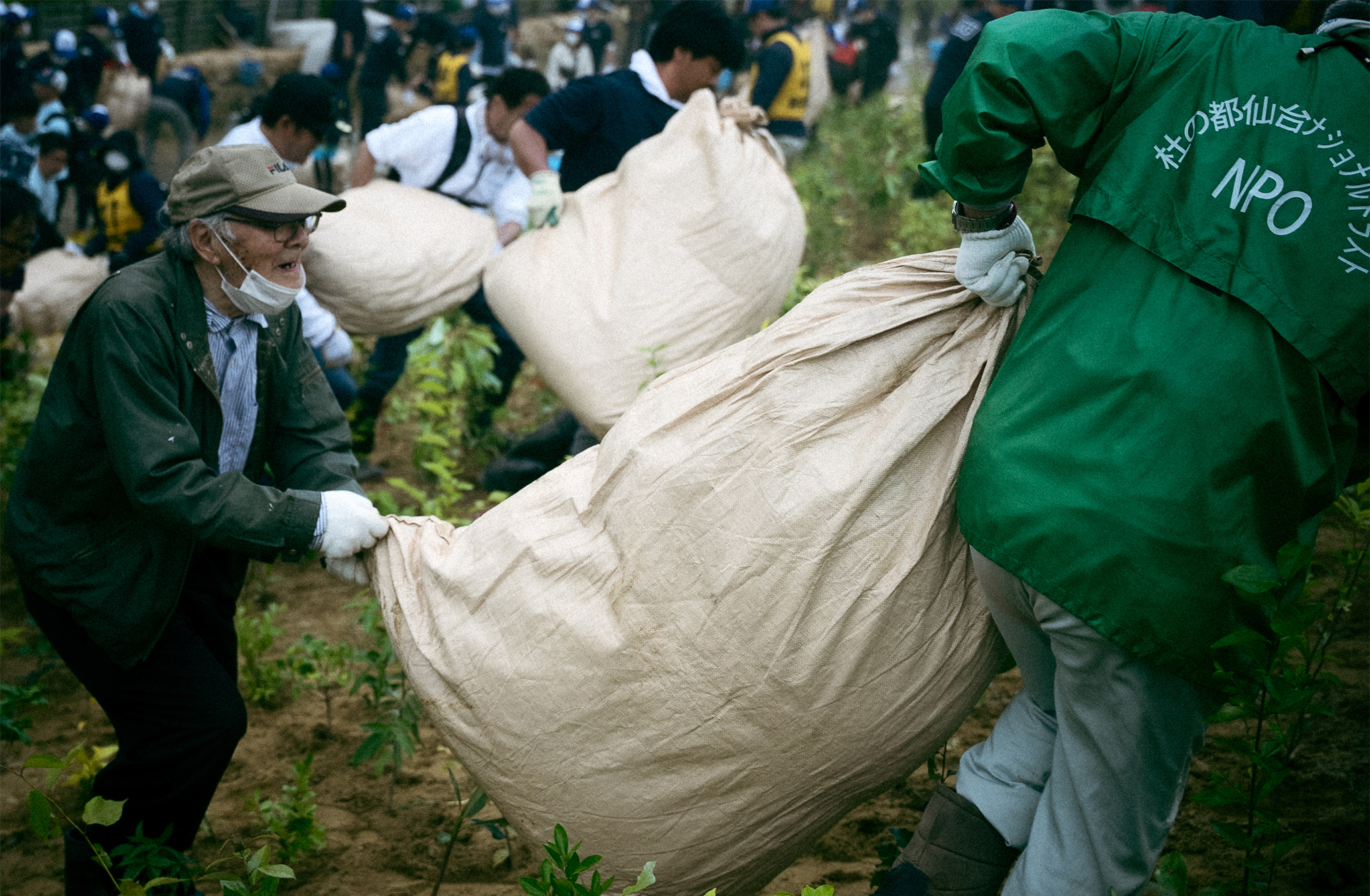
Instead, Monma stood in front of more than 1,000 people. The assembled crowd, some from as far away as Kanagawa prefecture, more than 300 kilometers (about 200 miles) to the south, were there to plant more than 12,000 trees along the steep dunes that line Minamisoma’s sandy beaches.
“I really do think we should be proud of this moment,” Monma said to the crowd. “This is a place where thousands of people have kept this up for so long.”
Minamisoma, like more than a dozen other coastal communities across Japan, is the site of an innovative experiment in disaster resilience. While seawalls have become the dominant way of mitigating the impacts of tsunamis and typhoons, one organization is touting a mix of seawalls and a wall of trees — following a specific species and planting choice — could do a better job at protecting at-risk communities.
Fifteen years ago, in March 2011, the northeastern Tohoku region was the site of one of the 21st century’s worst natural disasters. A magnitude 9 earthquake struck 72 km (45 mi) off the coast of Miyagi prefecture. What followed was a tsunami of monumental scale, a devastating wave that rose to heights as tall as 40 meters (131 ft) above sea level — cresting over seawalls to crash into coastal communities. More than 19,700 people were killed, with thousands more reported missing, along a 2,000-km (1,240-mi) stretch of Japan’s northeastern coastline.
As the region rebuilt, its leaders searched for solutions to protect residents from the next tsunami. Many chose to build walls, but one project suggested another solution.
An idea takes root
The Chinju no Mori Project was behind the event in Minamisoma. The foundation has planted some 680,000 trees over the previous 14 years to act as natural tsunami barriers alongside seawalls by using the methods of famed Japanese botanist Akira Miyawaki.
Proponents say the eponymous “Miyawaki method” produces hearty, fast-growing forests by recreating the conditions that would be found in nature. The Miyawaki method calls for the planting of a wide variety of trees and shrubs — often more than 20 varieties — in a tight arrangement.
“If two plants are side by side, and one suddenly spreads its branches out wide, the other one is in trouble, it might even die,” said Makoto Shinkawa, secretary-general for the initiative, which is also known as the Morino Project. “They are competing with their very lives on the line.”
As the trees compete, they grow taller. Below, shrubs and smaller bushes thrive in the shade. The results are dense, rapidly growing forests that have helped spread the Miyawaki method’s popularity worldwide. But critics of the method say many of its claims lack scientific evidence, according to a study recently published in the Journal of Applied Ecology.
While the method may have its critics, the goal of the Morino Project — to plant a natural forest barrier to protect communities from tsunami — is backed by a wealth of historical evidence.

130 years of disaster and resilience
Japan’s Tohoku coast has been the site of repeated earthquakes and tsunamis. Over the course of more than 130 years, the region has been struck by at least four major tsunamis that left significant damage in their wake.
Remarkably, detailed reports recording the extent of that destruction are available to modern-day researchers.
“This is something special about Japan,” said Jeremy D. Bricker, an expert in coastal disaster resilience at the University of Michigan in the U.S. “So that’s why we focused on this area, because one: it’s really subject to these repeated events; and two: there’s been great record keeping over the last half millennium.”
Bricker co-authored a study focused on the damage caused by tsunamis in the years 1896, 1933, 1960 and 2011 while studying at Tohoku University, in Miyagi prefecture. The study compared rates of destruction in towns that were protected by seawalls and those that had coastal forests instead.
“Hard infrastructure is more protective, in general, [but] coastal forests are really good at dissipating the energy of smaller events,” Bricker said of the study’s findings.
According to the study, rates of both death and destruction lowered when seawalls were taller than 5 m (16 ft). Smaller seawalls often had the opposite effect — increasing the rates of death and destruction.
Coastal forests, meanwhile, also successfully reduced rates of death and destruction, either by acting as a barrier that absorbed the force of the tsunami or by discouraging the construction of housing in disaster-prone areas.

Religious roots
Japan’s Shinto shrines have long used forest groves as a means of protection and worship.
“The veneration of nature is a very important part of Shinto,” said Koji Suga, who researches the modern history of Shintoism at Tokyo’s Kokugakuin University.
The earliest shrines were sacred spaces within the forest, often centered on a shintai, a sacred object that believers say house a kami, or divine spirit. Today, some forests are so sacred, they’re off-limits to all but the most senior priests. Others are planted as an act of worship, or as a source of building material for future shrines. These forests also offer shrines protection, especially in times of disaster.
“It’s part of traditional Japanese wisdom,” Shinkawa said.
Researchers from the Public Works Research Center, a Japanese nonprofit, reported that out of 27 shrines located along the coast in the Tohoku region, only two were lost in the 2011 earthquake and tsunami. The study found that shrines in the disaster-prone region were often constructed in areas that were seen as safe evacuation points during previous tsunamis.
One such shrine, the Amaterasu-mioya Shrine, in Otsuchi, Iwate prefecture, was the inspiration for the Chinjou no Mori Project.
“This is in the disaster-stricken area of Otsuchi,” Shinkawa said as he pointed at a photo of the shrine, still surrounded by its Chinju no mori, or “guardian forest.” “Everything around here was destroyed by the tsunami. But this shrine is the only one that’s still standing, right?”
A shrine stands for hope
In 2011, during the earthquake, Toshiaki Fujimoto wondered if the world was ending. The disaster had shaken Otsuchi with such force that Fujimoto imagined it would come apart.
“It was the first time I’d ever experienced an earthquake that strong — so strong that I thought the roads might split, the mountains might collapse,” Fujimoto recalled.
He sprinted up the steps of the nearby Amaterasu-no-Miya shrine. The shrine was constructed on a 21-m-high (69-ft) hill that sat within eyesight of the town’s famed Kirikiri Beach.
“A few minutes later, the tsunami hit,” Fujimoto recalled. “It surged over the national highway. The houses I knew so well just popped up, floating away like boats or buoys. They’d veer right, then left and sometimes crash into each other.”
The wave had reached a staggering height of 22 m (72 ft) above sea level in some portions of the town. Fifty-two percent of the town was submerged by the tsunami. More than 3,000 homes were destroyed.
But the shrine, surrounded by its forest grove, survived.
“I was relieved,” said Fujimoto, who is now the shrine’s chief priest. “You know, if this had been swept away, I would have been in terrible shape mentally, but because it’s still here, I was actually able to get involved in the reconstruction of that area.”

For many, the shrine became a powerful symbol of resilience in a time of disaster.
“These days, religious beliefs and faith are fading, especially now,” Fujimoto said. “But during a massive disaster like this… well, some people say there’s no such thing as gods or Buddhas. But I think what we learned from this disaster is that these places serve as a spiritual anchor.”
While Otsuchi’s Amaterasu-no-Miya shrine became the inspiration for the Morino Project’s forest tsunami barriers, the town chose a more common means of protection against future tsunamis: a massive concrete seawall.
A concrete solution
In the years following the 2011 earthquake and tsunami, Japan has spent some 1.4 trillion yen, or $8.2 billion, constructing 432 km (268 mi) of concrete seawalls at more than 620 locations along the coast, according to data compiled by the Ministry of Land, Infrastructure, Transport and Tourism, and the Reconstruction Agency.
Drive along National Route 45 as it runs from Otsuchi south to the city of Sendai and large seawalls dominate the landscape. Some sit low, like squat stepped pyramids, before the sea. Others rise straight up as flat walls of gray concrete that are so tall, it’s easy to forget there’s an ocean on the other side.
“There were actually a lot of people who opposed building the tsunami walls,” said Ryuji Kano. “I’m not sure if it was decided on the national level or the prefectural level, but the decision had already been made. The construction was going to go ahead.”
Kano is the owner and head chef at Denpachi Sushi, a seaside restaurant in Ishinomaki, Miyagi prefecture. The small fishing town, like others in the prefecture, was hit hard by the tsunami. Kano lost the original Denpachi sushi restaurant in the disaster.
“My house was swept away too,” Kano said. “All of it was. This place was devastated. Only two houses remained intact. The rest were destroyed.”

The town’s solution was a dramatic one. In some areas, like Ogatsu district, the entire town would be raised up by 9 m (30 ft) above a large seawall. In other parts, the seawall itself would rise above the town, a straight gray wall replacing views of the town’s ruggedly beautiful coast. In one area near a fishing port, a small section of the wall has been covered with murals in an attempt to reclaim some of the lost beauty.
Kano, though, said he wishes the town had spent the money on evacuation routes and a robust shelter on high ground.
“If they’d just built the evacuation routes, the tsunami defenses wouldn’t have needed to be that high,” he said. “Then we would have been able to come straight back and rebuild our homes.”
Ishinomaki may be surrounded by towering seawalls, but if the town was hit by another tsunami similar in scale to the 2011 disaster, Kano said he doubts the walls could protect the town.
“I would just run for my life,” he said.
Trees — and trouble — in Tohoku
Despite annual efforts like those in Minamisoma, the Morino Project’s grand ambitions of planting a large coastal forest wall to complement concrete barriers have failed to take root elsewhere.
While some towns chose concrete over trees, others that had favorable views of forests couldn’t agree on what shape they should take. The Tohoku region was long known for its coastal forests of black pine, many of which were washed away by the 2011 tsunami.
The Morino Project favors a variety of broadleaf evergreens, shrubs and bushes instead of forests dominated by the traditional Japanese black pines (Pinus thunbergii) — pointing out that the shallow roots of the pines are what allowed the forests to be so thoroughly destroyed in the first place.
“A lot of the trees were even uprooted by the force of the wave and the scour and acted as battering rams further inland,” Bricker said.
In Miyagi prefecture, a 58-km (36-mi) drive north from Minamisoma, volunteers working with the Morino Project planted coastal forests of broadleaf evergreens in Iwanuma and Sendai cities. But Sendai officials have planted plenty of black pines too.
Sendai’s city government favored the tree in its Hometown Forest Regeneration Project, planting it alongside broadleaf species like oak and cherry. “Black pine has been planted along the coast for generations,” Sendai’s city office wrote in an emailed response to questions about the coastal forest projects.
Black pine, or kuromatsu, has a deep historical connection to Sendai. The city’s founder, Date Masamune, ordered the planting of kuromatsu as the main species in a 17th-century afforestation program. The tree was planted in such abundance that it became synonymous with the region.
That’s why Natori, located between the cities of Sendai and Iwanuma, decided to focus heavily on black pines instead of the tree species favored by the Morino Project in its own coastal afforestation program.
Aike P. Rots, a professor of East Asian religions at the University of Oslo, wrote in a 2021 study titled “Trees of tension: re-making nature in post-disaster Tohoku” that because of disagreements like that, “it would be nearly impossible to get all municipalities on board.”
Many municipalities that planted trees also chose to build concrete seawalls as well. In Sendai, the coastal forests lie behind a large seawall. The city found that “coastal forests alone cannot completely stop large tsunamis.”
“Rather, they are positioned as one component of a multi-layered disaster prevention system designed to reduce damage,” the city office wrote. “When a tsunami reaches land, the trees help slow the flow of water and trap drifting debris and timber, thereby limiting the spread of destruction.”
Other towns have simply chosen concrete alone.
“We’re struggling to help local government leaders — people like mayors, village chiefs, and prefectural governors — understand the project,” the Morino Project’s Shinkawa said. “We explain to them that this is such a great initiative, but they just don’t seem to get it.
Banner image: Volunteers carry bags of straw at a tree planting event in Minamisoma, Fukushima prefecture, Japan in June 2026. Image by Jonathan Vit for Mongabay.
Saving forests to protect coastal ecosystems: Japan sets historic example
Japan’s example: Can forest planting reduce climate disaster risk?
Citations:
Morales, N. S., Fernández, I. C., Durán, L., & Craven, D. (2025). Tiny forests, huge claims: The evidence gap behind the Miyawaki method for forest restoration. Journal of Applied Ecology, 63(1). doi:10.1111/1365-2664.70242
Ishizawa, T., Goto, K., Nishimura, Y., Miyairi, Y., Sawada, C., & Yokoyama, Y. (2022). Paleotsunami history along the northern Japan trench based on sequential dating of the continuous geological record potentially inundated only by large tsunamis. Quaternary Science Reviews, 279, 107381. doi:10.1016/j.quascirev.2022.107381
Nateghi, R., Bricker, J. D., Guikema, S. D., & Bessho, A. (2016). Statistical analysis of the effectiveness of seawalls and coastal forests in mitigating tsunami impacts in Iwate and Miyagi prefectures. PLOS ONE, 11(8), e0158375. doi:10.1371/journal.pone.0158375
Uda, T., & Sakai, K. (2013). Survival of shrines from the 2011 Great Tsunami. Journal of Disaster Research, 8(sp), 826-834. doi:10.20965/jdr.2013.p0826
Tsuge, T., Shoji, Y., & Onuma, A. (2022). Assessing public preference for construction of giant seawalls using the best–worst scaling approach. In Ecological research monographs (pp. 401-414). doi:10.1007/978-981-16-6791-6_24
Rots, A. P. (2019). Trees of tension: Re-making nature in post-disaster Tohoku. Japan Forum, 33(1), 1-24. doi:10.1080/09555803.2019.1628087
FEEDBACK: Use this form to send a message to the author of this post. If you want to post a public comment, you can do that at the bottom of the page.
Cite this article
Jonathan Vit (2026). In coastal Japan, one project is planting forests to stand against tsunamis. Mongabay Conservation news. DOI: https://doi.org/10.66709/news-325096

