


- The UN’s Food and Agriculture Organization says the number of people facing hunger globally fell by around 43 million people between 2022 and 2025 — 20% of Africans were food insecure in 2025, compared to just 6% in Asia.
- FAO’s director of agrifood economics, David Laborde, said severe cuts to development aid, armed conflict, and climate shocks have held back food production in Africa over the past decade.
- Analysts told Mongabay that African governments need to stop promoting agriculture approaches that rely on imported synthetic fertilizer and pesticides, and instead support more effective practices that strengthen soil fertility, diversify crops and diets for farmers, and are more resilient to external shocks.
In its latest report on food security and nutrition around the world, the UN’s Food and Agriculture Organization says the number of people facing hunger globally has declined for the third consecutive year, but Africa still has the highest number of people with insufficient food.
The FAO report estimated that 20% of Africans faced hunger in 2025, compared to just 6% in Asia, and nearly 5% in Latin America and the Caribbean. The FAO report says the number of people facing hunger globally fell from 8.6% in 2022 to 7.8% in 2025. It further estimates that in 2025, hunger affected 14 million people less than in 2024 and 43 million less people than in 2022. In 2030, the report projects between 510 and 520 million people will be food insecure worldwide and more than half of them (56%) will be in Africa.
“While the prevalence rate of undernourishment slightly stabilized at 20.0% in 2025, demographic pressure actually pushed the absolute number of hungry people [in Africa] to a record 309 million, surpassing Asia for the first time,” David Laborde, director of the FAO’s Agrifood Economics Division, told Mongabay via email.
Laborde said that severe cuts to development aid, armed conflict, and climate shocks have hindered food production on the continent over the past decade.
Erratic rains and rising temperature have affected food security at the global level too, disrupting agriculture, reducing yields, degrading farmland, and often, provoking food price inflation.
Laborde said soil degradation affects roughly 20% of global cropland, with South Asia and sub-Saharan Africa the worst affected. “Reversing just 10 percent of this degradation could restore enough agricultural production to produce equivalent food for 154 million people annually,” he said.
Before the U.S. and Israel launched a war against Iran, FAO predicted the number of people facing hunger worldwide would fall to 503 million by 2030, Laborde said. However, he added, the closure of the Strait of Hormuz has driven the cost of energy and fertilizer up, almost certainly slowing the decline.
According to FAO, the African countries that have seen the greatest reduction of food insecurity since 2022 include Togo, Zimbabwe, Guinea-Bissau, Tanzania, and Kenya.
“This reflects economic growth and expansion of agricultural production,” Laborde said. The countries that he said have performed “quite badly” are the Democratic Republic of the Congo, Sudan and Nigeria — all countries that have been riven by armed conflict.

Change course to build African food security
Timothy Wise, a researcher and author on agriculture, environment and the right to food, said more frequent and severe droughts and climate events have left farmers in many parts of Africa vulnerable.
He said an approach to agriculture, promoted over the past 20 years under the banner of “a green revolution for Africa” has failed to deliver food security for Africa’s population, because it has encouraged the expansion of maize monoculture that relies heavily on imported synthetic fertilizer. This has not produced the promised surplus of grain, but it has caused soil across the continent to become less fertile.
“This has left farmers more vulnerable to drought and disruptions in markets,” he told Mongabay in an email. “African governments need to stop promoting input-intensive agriculture and support more effective and low-cost approaches, which strengthen soil fertility, diversify crops and diets for farming families, and increase resilience to external shocks.”

Ange-David Baïmey, a researcher at GRAIN, an international organization that advocates for smallholder farmers, said the continent is lagging behind its peers, because policies favoring large-scale agricultural investment are failing.
“If you look at some countries, like Ivory Coast or Liberia, more than 30,000 hectares [74,100 acres] can be given to a foreign company to do rubber or to do oil [palm] plantations, yet it is clear that the issue of hunger is related to cassava or potato,” he told Mongabay.
“If we want to improve food production and distribution in Africa, the first thing we have to do is to put the small-scale farmers in the center of our policy,” Baïmey said. “You cannot continue to believe that the large-scale agriculture will feed Africa.”
He said that African governments should support smallholder farmers to access land, water and shared seed to improve their productivity.
“A lot of these big, big companies are just coming to take control of the land to produce and it is for exportation. So first of all, we have to help our farmers, our small-scale farmers to produce,” he said.
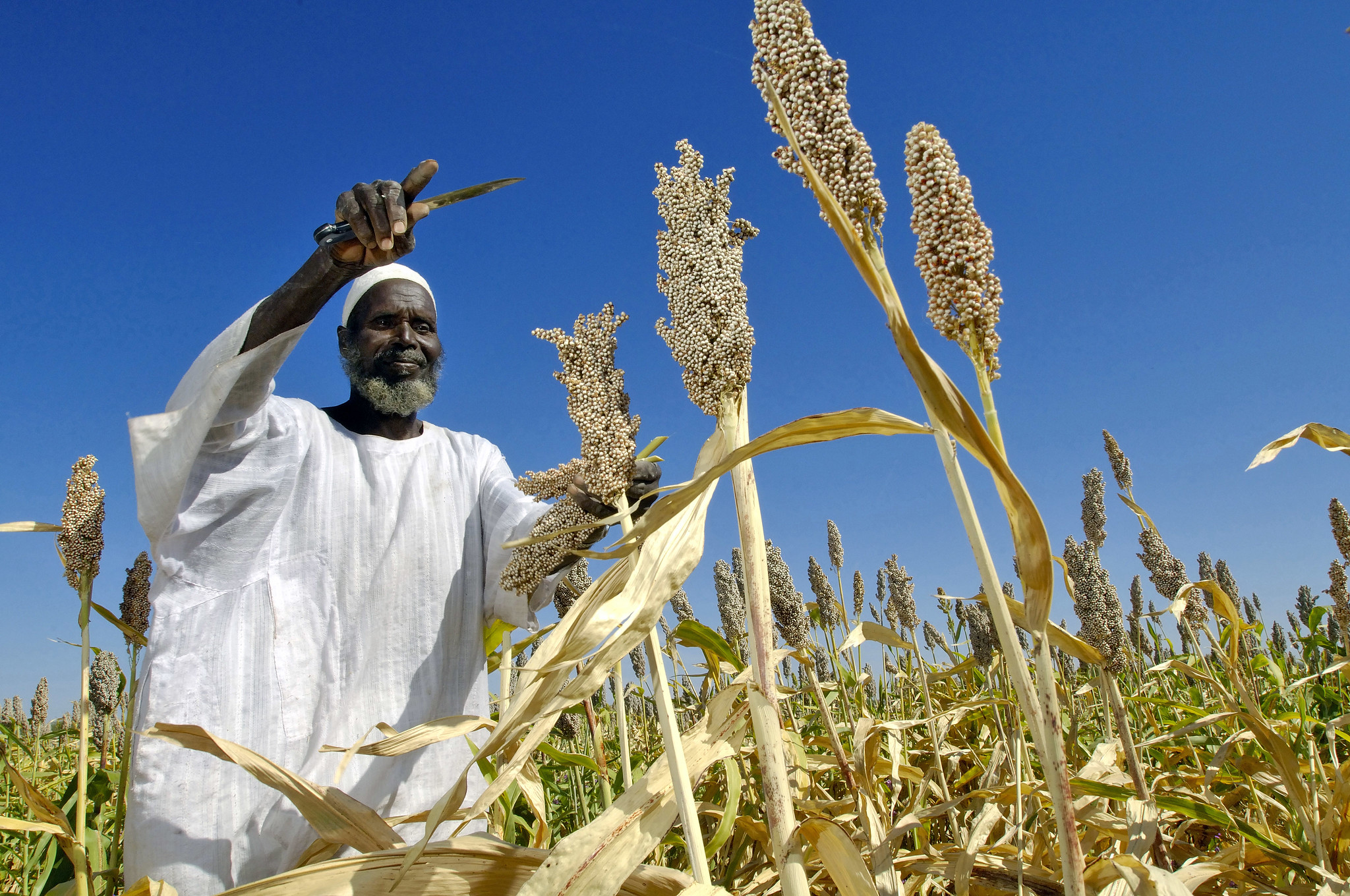
Banner image: Harvesting sorghum in Sudan in 2011. Image by Africa Renewal via Flickr (CC BY-NC-SA 2.0).
Movement gives African rural women farmers a voice, but still battles landownership
FEEDBACK: Use this form to send a message to the author of this post. If you want to post a public comment, you can do that at the bottom of the page.

