


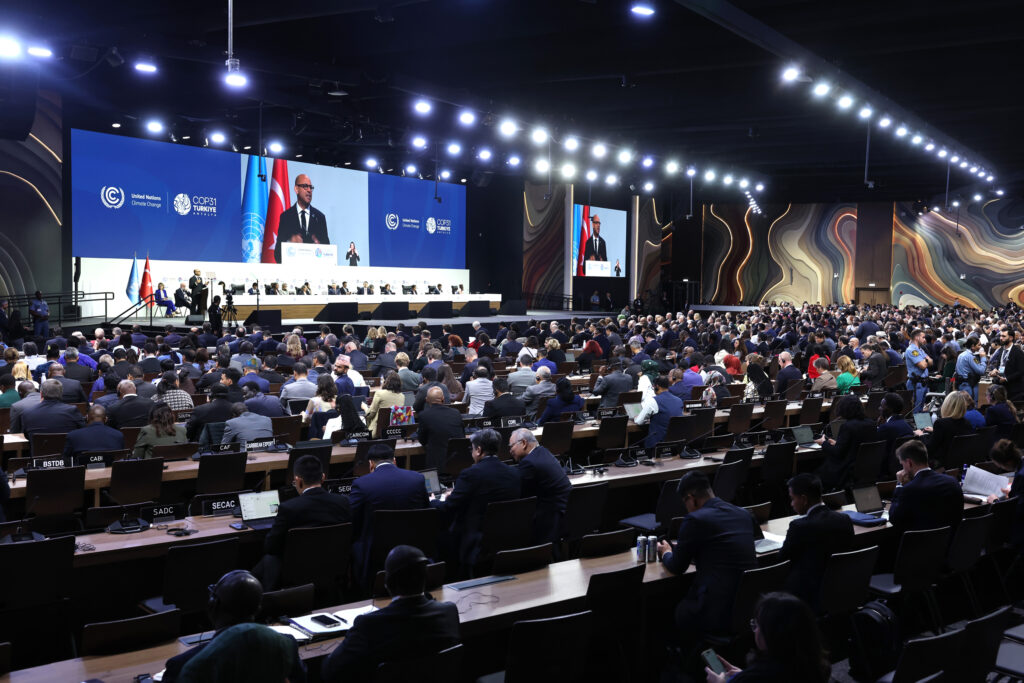
ANTALYA, Turkey—The stench of fossil fuels has become a hallmark of the United Nations “Conference of the Parties” climate talks, starting with the airplanes and buses carrying delegates to the conferences.
Two annual meetings have been held in Poland, where coal remains king. Eye-searing petrochemical smog marred the skies over Dubai at COP28. In Baku, Azerbaijan, most buildings are coated with gray grime from refinery pollution, and last year at the “Nature COP” in Belém, Brazil, hundreds of diesel generators ran day and night outside the conference halls in a futile effort to cool the heavy tropical air.
The latest iteration of the negotiations, COP31, opened Monday here with diesel fumes in the city’s busy streets providing another reminder that the world remains deeply dependent on the fossil fuels driving the climate crisis even after three decades of climate negotiations.
The backdrop to this year’s conference is bleak. Scientists report that the average global temperature has reached a record high of more than 3.6 degrees Fahrenheit (2 degrees Celsius) above the preindustrial baseline in the last few days. Several dozen glaciers have disappeared since last year’s talks. Rising seas are flooding coastal cities. And carbon dioxide emissions in 2026 are on track to reach another record high.
The climate crisis didn’t reach this point overnight, said Marc Hudson, an unaffiliated climate researcher in the United Kingdom. It is the culmination of decades of missed opportunities, political compromises and broken promises. Understanding how it happened requires revisiting a surreal and occasionally absurd history, he said.
A convenient starting point is 1957, when scientists from around the world shared research and met repeatedly to study Earth as a system, rather than individual components, as part of the International Geophysical Year. It was also when American scientist Charles Keeling began developing a system to measure the rise of CO2 in the global atmosphere, and when a landmark research paper challenged the assumption that the oceans could absorb CO2 emissions from fossil fuel burning.
It’s clear from the scientific record, Hudson said, that researchers understood the looming problem nearly 70 years ago.
Climate Politics
But the issue did not appear on political radar screens until 1985, when scientists at an international climate conference in Austria warned that rising CO2 levels could produce climate warming greater than any in human history, with significant consequences for agriculture, ecosystems and people.
The researchers urged governments to start considering policy responses. A few years later, the Intergovernmental Panel on Climate Change was born. In 1990, the panel issued its first major climate assessment, spurring the United Nations to action.
Representatives from more than 140 countries spent 15 months negotiating the United Nations Framework Convention on Climate Change. At that point, about 10 industrialized countries were responsible for about 80 percent of all historic CO2 emissions. There was broad agreement that those nations should take the lead in reducing climate-altering pollution and that any treaty should not deny poorer countries the chance to develop.
That disagreement remains one of the defining features of climate diplomacy, and the United States has been central to that debate since the beginning, Hudson said. George H.W. Bush, a former fossil-fuel industry executive, was president, and he was “even more sympathetic than the Democrats to big auto, big oil,” Hudson said. The Bush administration feared that the international community would mobilize against carbon dioxide emissions in much the same way it had against ozone depletion just a few years earlier.
France and a few other European countries pushed for a treaty that would obligate rich, industrialized countries to set timetables for emission cuts, but it was “very important for the Americans and the Saudis and the Gulf oil and gas exporters that whatever deal emerged from an international negotiating process was as weak as possible,” Hudson said. Bush threatened to boycott the 1992 Rio Earth Summit if a treaty included binding language on emissions cuts.
The French and other proponents of emissions-reduction targets had to choose between pressing ahead with a strong treaty that the U.S. wouldn’t sign or watering down the agreement to secure American support.
“This was straightforward, naked power politics,” Hudson said. “The Americans and the Saudis wanted to make sure that they could keep on selling and using fossil fuels for as long as they wanted, and they didn’t want to have to negotiate on actual emissions reductions.”
In the final weeks of negotiations for the U.N. Framework Convention on Climate Change agreement, references to binding cuts were removed from the draft and the U.S. became an early signatory because it was “no longer worried about what was becoming a toothless agreement,” and setting the stage for the first Conference of the Parties, COP1, in Berlin, Hudson said.
The Kyoto Protocol
The climate framework was vague, but it included an agreement to try to stabilize emissions at 1990 levels. Most people involved in the talks hoped a more detailed agreement with timetables and national plans would soon follow, said Joanna Depledge, a climate diplomacy researcher at the University of Cambridge.
Most probably never would have believed that emissions would still be increasing 30 years later, she added.
The early international steps toward tackling global warming came after the end of the Cold War, as former adversaries sought to cooperate, she said.
This story is funded by readers like you.
Our nonprofit newsroom provides award-winning climate coverage free of charge and advertising. We rely on donations from readers like you to keep going. Please donate now to support our work.
The United States’ role was complicated and essential, especially given the country’s scientific leadership at the time, she said. “It had the tech, the computer and the meteorological observations, and was also a leader in politics.” And while the U.S. played hardball in the talks, it compromised to become part of the U.N. framework agreement, she said.
But then, as now, she added, the U.S. was reluctant to accept an agreement that would put the onus on developed countries to reduce emissions first and was reluctant to assume any financial obligations toward developing countries. This worldview has continued shaping the climate talks for 30 years.
At COP1 in Berlin in 1995, delegates acknowledged that the U.N.’s climate framework alone would not solve the emerging global warming problem, so they agreed to keep meeting to reach a follow-up deal with quantifiable emission-reduction targets for industrialized countries. Since then, the 198 countries party to the climate framework have met 29 more times to try and implement those basic ideas.
Just two years later, the Kyoto Protocol, with obligatory emissions reductions for industrialized countries, was adopted at COP3. But just before the conference, the U.S. Senate passed the Byrd-Hagel Resolution by a vote of 95–0, declaring that it would not ratify an agreement on emissions cuts that did not require similar commitments from developing countries, or that would harm the U.S. economy.
President Bill Clinton signed the agreement in 1998, which may have been a high-water mark for U.S. engagement in the process, at least until the Paris Agreement was adopted in 2015, Depledge said. But Clinton never sent it to the Senate.
In 2001, his successor, President George W. Bush, said the U.S. would not ratify the Kyoto Protocol, taking momentum away from the global push to curb global warming.
It took several years for the world to regain traction after that decision, but at COP15 in 2009, India, South Africa, China, Brazil, Indonesia and Mexico—all developing countries with rapidly growing economies and rising emissions—were on the verge of making emissions pledges, which would have been a huge step forward, Depledge said. But the potential breakthrough faltered, as developing countries felt pressured to sign a deal they thought could slow their economic development.
The next several rounds of climate talks were marked by excruciatingly slow, incremental progress that eventually led to the Paris Agreement at COP 21.
Under the pact, all countries agreed to try to limit warming by making voluntary emissions cuts based on their own national circumstances. They also agreed to an international reporting scheme to help track progress. The agreement also spelled out that wealthy, developed countries should cut emissions first and should support developing countries with finance and technology.
Why So Slow?
Since the 2015 climate pact was adopted in Paris, the annual talks have focused on implementing the agreement’s goals, and the process has clearly bogged down, especially since COP26 in Glasgow.
“I would say it’s been a very depressing backtracking and souring of global climate politics,” Depledge said. In particular, she added, Saudi Arabia has been disrupting the process “in ways we haven’t seen for a while, and I think that the Trump presidency gives them free rein to do that.”
Depledge says that, after decades of studying the U.N. climate talks, she sees three main reasons for the slow progress. First is the continuing divide between developed and developing countries along with additional fragmentation within the latter group. Economic and legal tension over who is responsible and who will pay for the damage has become “deeply entrenched in the climate regime” in a way that’s detrimental to progress.
She said this may be because the United Nations General Assembly, a political body, launched the climate discussions. Had the climate talks been initiated by the World Meteorological Organization or the United Nations Environment Programme, they might have been seen as more technical and less politically controversial.
A close second to the “North-South economic divide” are the strategic actions of the fossil fuel lobbies, both behind the scenes and in public discourse, she said. “And by definition, they have tremendous power because, hey, we all use oil and gas. And they have been extraordinarily successful in keeping progress slow.”
The third big hurdle, she said, is the consensus-based approach used in the U.N. climate talks because every major decision requires consensus for approval. The convention’s failure to adopt a voting rule has blocked more ambitious decisions, especially those related to the underlying science. Such decisions could have been much stronger over the past 30 years if a majority of countries could outvote the handful of blocking countries, she said.
About This Story
Perhaps you noticed: This story, like all the news we publish, is free to read. That’s because Inside Climate News is a 501c3 nonprofit organization. We do not charge a subscription fee, lock our news behind a paywall, or clutter our website with ads. We make our news on climate and the environment freely available to you and anyone who wants it.
That’s not all. We also share our news for free with scores of other media organizations around the country. Many of them can’t afford to do environmental journalism of their own. We’ve built bureaus from coast to coast to report local stories, collaborate with local newsrooms and co-publish articles so that this vital work is shared as widely as possible.
Two of us launched ICN in 2007. Six years later we earned a Pulitzer Prize for National Reporting, and now we run the oldest and largest dedicated climate newsroom in the nation. We tell the story in all its complexity. We hold polluters accountable. We expose environmental injustice. We debunk misinformation. We scrutinize solutions and inspire action.
Donations from readers like you fund every aspect of what we do. If you don’t already, will you support our ongoing work, our reporting on the biggest crisis facing our planet, and help us reach even more readers in more places?
Please take a moment to make a tax-deductible donation. Every one of them makes a difference.
Thank you,

Reporter, Austria
Bob Berwyn is an Austria-based reporter who has covered climate science and international climate policy for more than a decade. Previously, he reported on the environment, endangered species and public lands for several Colorado newspapers, and also worked as editor and assistant editor at community newspapers in the Colorado Rockies.
