


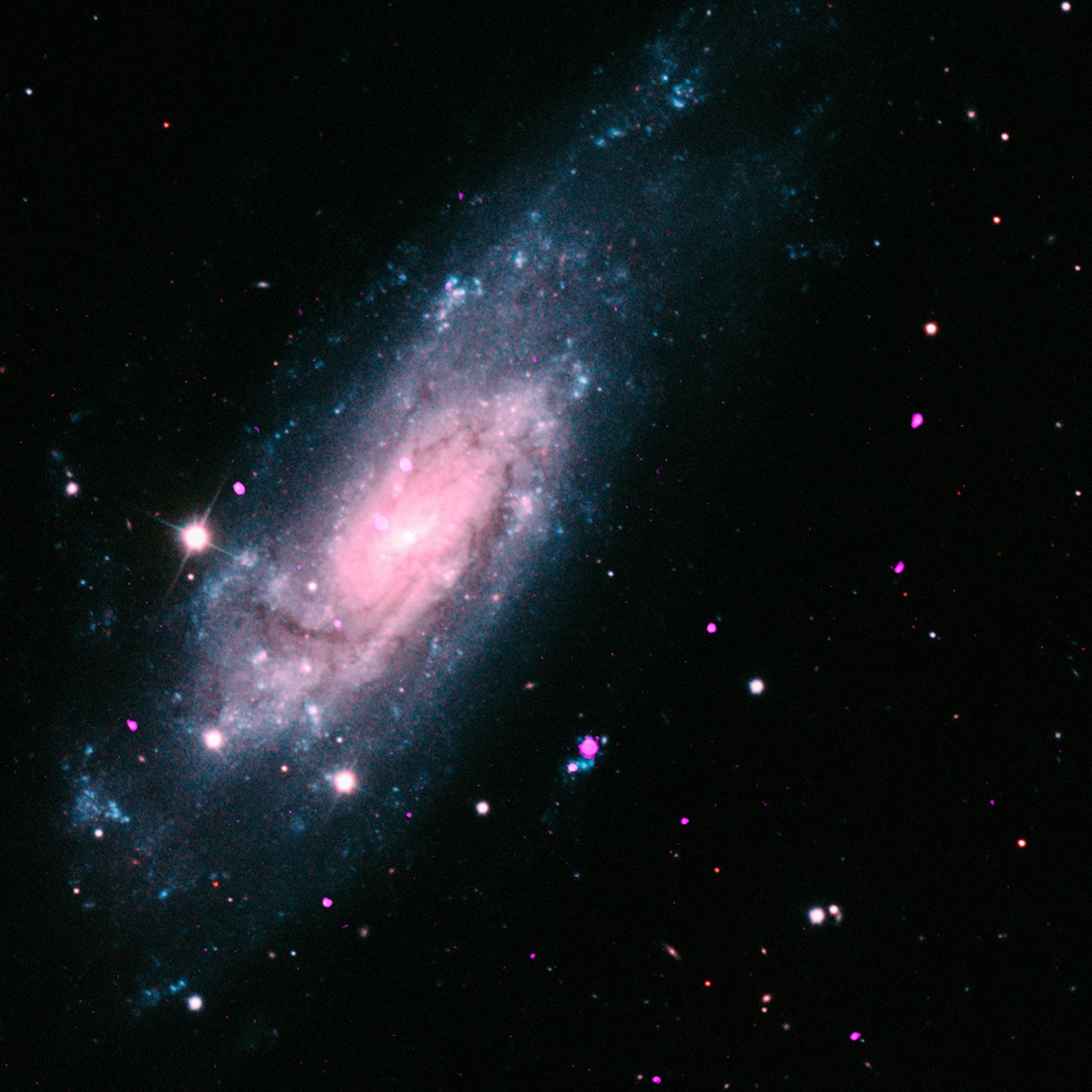
Using NASA’s Chandra X-ray Observatory, astronomers have discovered what is triggering repeated outbursts from a giant, unstable star.
A new study, published Monday in the latest issue of The Astrophysical Journal, details the discovery of a previously hidden companion object that keeps pulling material away from the massive star every 113 days as they orbit one another. This partner is either a stellar-mass black hole, or the dense collapsed core of a massive star called a neutron star.
This is the first X-ray detection of one of this class of erupting stars. It is also the first of these objects found with a black hole or neutron star companion.
The volatile star, known as AT 2016blu, is in the spiral galaxy NGC 4559, located about 30 million light-years from Earth. Astronomers estimate the mass of this star is at least 33 times that of the Sun.
“For 15 years, astronomers have been watching this star get really bright and then dim again on a regular basis,” said Mojgan Aghakhanloo of the University of Virginia in Charlottesville, who led this study. “Until we were able to get Chandra data at the right time, we couldn’t figure out what was making this happen.”
The star AT 2016blu is a type of luminous blue variable, which are hot, massive stars characterized by changes in brightness. Eta Carinae, for example, is a particularly well-known luminous blue variable.) AT 2016blu is a special type of luminous blue variable that undergoes rapid and repeated increases in brightness. The spikes in brightness are so extreme that they resemble supernova explosions, where a massive star collapses onto itself and material then hurtles outward into space. However, unlike in a supernova explosion, the star is not destroyed, so AT 2016blu is also referred to as a “supernova impostor.”
Between 2012 and 2026, astronomers detected at least 27 bursts of optical light, or light in wavelengths that are visible to our eyes, from AT 2016blu roughly every 113 days.
“This star’s behavior was confusing at first because it kept acting like a supernova, but clearly it’s not because it keeps surviving these outbursts about three times a year,” said co-author Núria Torres-Albà, also of the University of Virginia. “To understand the cause of these eruptions, we realized we needed X-ray data, timed so that we’d observe the star when it was in an outburst.”
The team used Chandra because it is the only X-ray telescope with sharp enough vision to distinguish AT 2016blu from another nearby bright X-ray source.
“We suspected that the bright repeating flashes at optical wavelengths might actually be powered by periodic blasts of high-energy X-rays,” said co-author Nathan Smith of the University of Arizona in Tucson. “The dense gas surrounding the system is heated by the X-rays and then glows in the optical. So, we needed to plan the Chandra X-ray observations carefully to be simultaneous with an optical outburst.”
Chandra data from March 2026 revealed that AT 2016blu was at least 100 times brighter in X-rays than in Chandra data from 2001 to 2002, which is before the outbursts began. The best explanation for this is that material from the star is falling onto a neutron star or black hole during the closest approach in their oval-shaped orbit around one another. When they come close together, material ejected by the star gets captured by the black hole or neutron star. The material orbits at very high speeds close to the speed of light, getting so hot that it shines brightly in X-rays.
AT 2016blu is bright enough in X-rays to be classified as a candidate of ultra-luminous X-ray source. These are rare, bright X-ray sources found with telescopes like Chandra that astronomers have yet to fully understand. Scientists’ current thinking is that some of them contain neutron stars, and others have black holes.
These new observations suggest there could be a link between ultra-luminous X-ray sources and the kind of violent stellar eruptions seen in AT 2016blu, especially because many ultra-luminous X-ray sources undergo large changes in X-ray brightness.
The discovery of this system may also help studies of stars that change in brightness before they undergo supernova explosions. Astronomers suspect that much of this behavior may be caused by systems containing a massive star orbiting a compact object or another massive star.
To collect the optical data, the team used the Katzman Automatic Imaging Telescope, the Las Cumbres Observatory Global Supernova Project , and observations from the American Association of Variable Star Observers, including those from more than 30 amateur astronomers, to monitor the star’s brightness.
When these observations showed that the star was in outburst in early 2026, Chandra observations were triggered and obtained in March 2026 as part of its “Target of Opportunity” program designed to take account of special events.
NASA’s Marshall Space Flight Center in Huntsville, Alabama, manages the Chandra program. The Smithsonian Astrophysical Observatory’s Chandra X-ray Center controls science operations from Cambridge, Massachusetts, and flight operations from Burlington, Massachusetts.
To learn more about Chandra, visit:
This release features a composite image of a spiral galaxy with a giant, unstable star at its outer edge. Using Chandra, astronomers have discovered the star’s previously hidden companion, which triggers luminous outbursts every 113 days.
The spiral galaxy is NGC 4559. Shown at a sharp angle in the composite image, its flat pink and milky blue face tilts toward our upper left. Sitting near the outer edge of the dense spiral, near the center of the frame, is a small group of pink and blue dots. This group is outlined with a white square, enlarged and annotated in supporting images.
The smallest pink dot in the square is AT 2016blu, a massive star some 33 times the size of our Sun. For over 15 years astronomers have been watching this star get bright and then dim again in optical light on a regular basis. Chandra’s X-ray observations suggest that a hidden companion object, either a stellar mass black hole or a neutron star, is pulling material from AT 2016blu every 113 days as they orbit one another. This captured material gets so hot that it shines brightly in X-rays.
Other pink and blue specks within the white square and enlargement are unresolved stars or star clusters, too distant to be related to the movement of material between AT 2016blu and its hidden but influential neighbor.
