


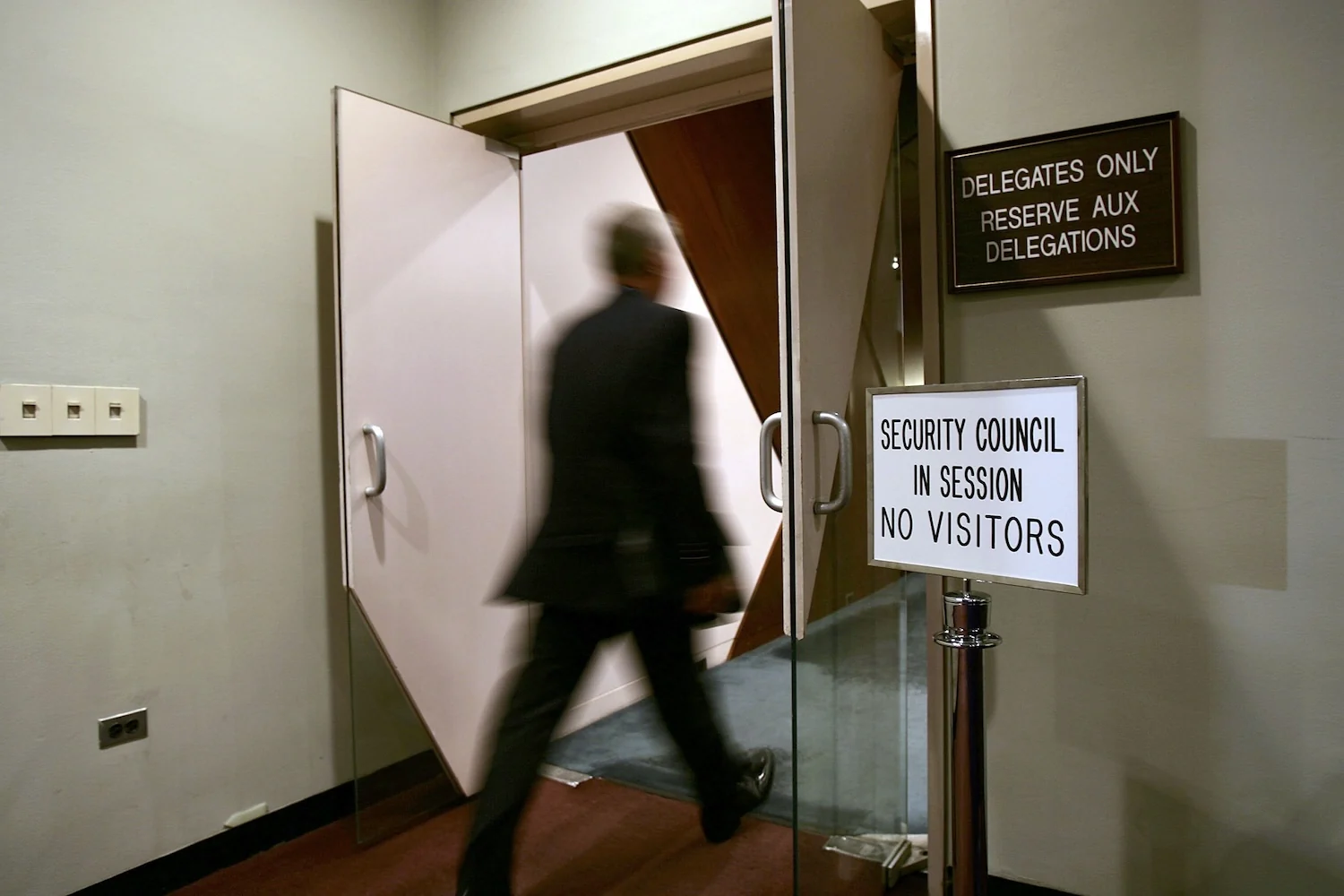
International order is not the absence of conflict, nor is it the rigid defense of the status quo. Rather, it is the existence of predictable mechanisms to manage inevitable disagreements. And the primary mechanism tasked with upholding international peace and security—the United Nations Security Council (UNSC)—is no longer fit for purpose .
The UNSC still resembles the world of 1945, giving privileged status to the victors of World War II and the holders of colonial empires. Without reform to give rising and middle powers a status commensurate with their growing influence, states will eventually see more sense in pursuing their security interests unilaterally or through exclusive, destabilizing blocs. For now, with a few notable exceptions, states remain committed to speaking the language of multilateralism. But make no mistake: Reforming the UNSC is not a matter of aesthetics or desirability; it is an absolute necessity.
Three dynamics have held up reform. But each may be slowly giving way, creating a rare window for genuine change.
The first and most commonly cited obstacle is the Security Council’s five permanent veto-wielding members, or P5—the United States, China, Russia, France, and the United Kingdom. The P5 countries are wary of admitting rising powers as fellow veto wielders, as it would diminish their own influence in the body and make it more susceptible to deadlock.
However, without reform, the council’s legitimacy in the eyes of the global majority will deteriorate, rendering it more and more irrelevant. The P5 will be the biggest losers if the UNSC fades into insignificance, as they have the most to lose: their veto prerogatives. Consequently, the P5 are only likely to allow for reform when the council appears to be nearing the brink of collapse—a point that the world may soon approach if the P5 continue to wield their vetoes with impunity.
The second issue is the deadlock between the two main reform groupings: the G4 coalition of Germany, Japan, Brazil, and India, which favor enlarging the permanent membership of the UNSC to include themselves, and the Uniting for Consensus group, which favors only adding additional elected seats to the council. The uncompromising competition between these two blocs has prevented other proposals from gaining steam. However, Germany’s recent failed bid for a two-year term on the council has put into question the viability of its claim to a permanent seat—and the viability of the G4 proposal as a whole. This enables a possible shake-up that allows for the emergence of new and more creative reform ideas.
The third factor is that discussions over which reform model would best enhance the UNSC’s efficiency, effectiveness, and legitimacy has, to date, been largely speculative. Neither side has been able to predict with any meaningful accuracy the implications of their proposed reforms.
This, too, is now changing. Thanks to artificial intelligence, complex simulations can be conducted that calculate potential shifts in the council’s performance. We have conducted such a simulation to determine precisely what each proposal would achieve—and what it would risk. The simulation shows that the G4 model would dramatically increase gridlock over the next five decades. Council business would slow down as decision-making speed per resolution would grow from 28.5 days to 42.1 days, and veto use would grow by more than 60 percent. Despite giving them a seat at the table, the resulting paralysis would encourage leading powers to work outside the UNSC, defeating the purpose of reform entirely.
Yet while the Uniting for Consensus group’s proposal would limit the damage to the council’s efficiency and effectiveness, it fails to resolve its legitimacy deficit. The UNSC cannot effectively serve as a long-term custodian of the international order if Britain continues to enjoy a more privileged position than India—the world’s most populous country and likely soon to be its third-largest economy.
How, then, to resolve this conundrum? The AI simulation points to two mechanisms.
First, if more countries are to gain the veto, then this must be balanced by creating a veto override mechanism: for example, a veto wielder must secure one or two concurring negative votes among sitting council members, otherwise, a two-thirds majority in the General Assembly can overturn the veto.
The simulation shows that this would reduce veto usage by up to 40 percent, even before any cast vetoes are overturned. It would also speed up decision-making on average from 28.5 days to 21 days because veto wielders would either know that they have the necessary concurring vote(s) and cast their veto without delay, or know that they don’t and be incentivized to compromise to avoid a potentially humiliating General Assembly override.
Skeptics argue that the P5 countries are unlikely to agree to any reform that dilutes their veto privileges. But the simulation projects that successful overrides would occur only 28 percent of the time (or as low as 14 percent of the time, if the vote to override takes place by public roll call rather than by secret ballot). Agreeing to this limited mechanism, which would only take effect when a great power is isolated to the point of having no allies on an expanded council, is a small price to pay to ensure the council’s long-term legitimacy—and the permanent members’ privileged position that comes with it.
Second, a pool of “semipermanent” members, serving multiple lengthy terms and rotating on and off the council a few countries at a time, would offer middle powers that fail to earn a permanent seat a substantial consolation prize. According to the simulation, it would also triple small states’ likelihood of election to an ordinary council seat by taking these middle powers out of the running.
Countries such as Japan, Brazil, Argentina, India, and Pakistan currently monopolize the council’s nonpermanent seats, serving on average more than one term per decade, leaving smaller countries to earn a place only once every 30-50 years. The simulation shows that this proposal, if tabled by a strong coalition of small and developing states, has a 78 percent chance of being adopted and contributing to breaking the logjam.
The “international order” may be an abstract concept, but it takes concrete form in the institutions through which states manage their differences, constrain the use of force, and prevent conflict from descending into chaos. None matters more than the UNSC.
For decades, the presumed trade-off between legitimacy and effectiveness has been an obstacle to meaningful reform. Our simulations suggest that this is a false choice: A more representative council can also be a more effective one. What is, in fact, impossible is a new and stable order without a Security Council designed for it.
