


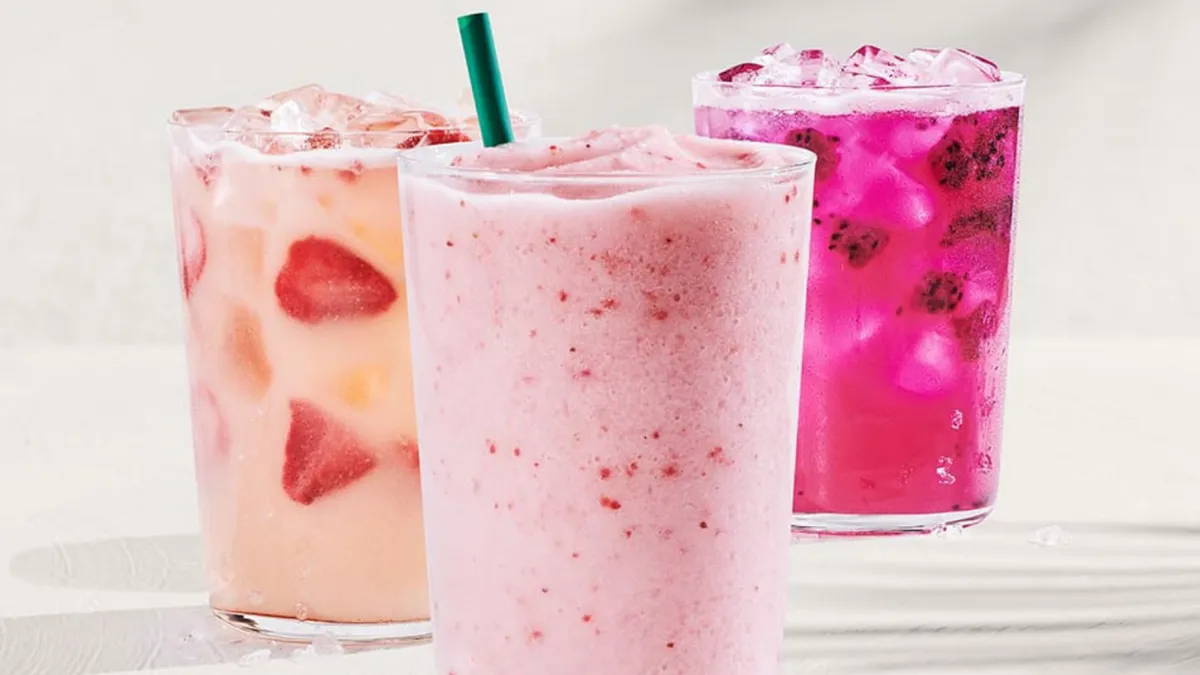
- Social media posts claim that a new ingredient at Starbucks, a blending powder used to make new drinks called blended refreshers, is hazardous to human health. Baristas have reported coughs and headaches, among other symptoms.
- All of the powder’s ingredients are approved by the FDA as food additives. Snopes found no evidence that the powder is dangerous to consumer health, but it may pose some danger for baristas, who report that the powder easily forms dust clouds, suggesting that symptoms are caused by inhaling the powder.
- One of the powder’s ingredients is silicon dioxide, commonly called silica. There is a form of silica (crystalline silica) known to cause cancer and permanent lung damage, but that form of silica is not used in the blending powder.
- Evidence for the potential harm of inhaling the form of silica used in the blending powder (amorphous silica) is mixed. Snopes estimates that baristas’ exposure likely falls within the National Institute of Occupational Safety and Health’s recommended daily exposure limit for amorphous silica.
- The natural human reaction to foreign substances in the lungs is coughing. Federal guidelines recommend that anyone experiencing symptoms from exposure to amorphous silica move to fresh air.
Beginning in July 2026, posts appeared on social media from Starbucks baristas claiming that a new ingredient at the stores, a powder used to make the coffee giant’s blended refresher drinks, was causing coughs and headaches. Some posts attributed the symptoms to silica, which was listed as one of the powder’s ingredients.
The Starbucks Workers United union, which represents more than 12,000 baristas across the country, also posted several videos about the allegedly hazardous powder.
Following the posts, Snopes readers wrote in looking for more information about the ingredient, wondering if it was safe to consume.
As part of our research for this story, we contacted Starbucks, Starbucks Workers United and the FDA, which is in charge of regulating food additives. Starbucks released the following statement on its website on July 27:
The product used in our coffeehouses is a blending powder which contains a small amount of food grade silica, an FDA-approved ingredient commonly used in food products that helps ingredients mix consistently and supports a consistent beverage experience. It does not contain crystalline silica and is safe for use in food.
The union sent us the following statement and provided links to an info sheet from the Texas Commission on Environmental Quality suggesting amorphous silica exposure had health risks:
After hearing from members across the nation, Workers United sent Starbucks a Request for Information seeking details about the silica in the powder and its potential health impacts. The union also demanded to bargain over the effects of using the product in the workplace.
Only after receiving the RFI did Starbucks share brief guidance with baristas and subsequently Workers United, but the response failed to address inhalation concerns.
Overall, we found that no evidence that the ingredients in the blending powder posed any risk to consumers. However, we were unable to draw a conclusion about the potential health effects on baristas.
Plenty of posts on social media showed a white cloud of powder being released into the air while employees were scooping the blending powder out of its container, and the union claimed it was this cloud of powder that was causing the health issues.
Various social media posts gave us a clear look at the ingredients in the blending powder, which are:
We reviewed the FDA regulations for all of the ingredients listed except the unspecified natural flavor. All are approved food additives. However, it wasn’t clear whether regulations require testing the potential health effects of the substance in scenarios where it isn’t directly consumed.
Silica, the short name of the compound silicon dioxide, drew the most attention of the ingredients because some forms of the substance are a known irritant that can cause serious lung problems. That distinction
Scientists use the word “crystal” to mean any object whose molecules are organized into a repetitive, standardized structure. If an object doesn’t have a crystalline structure, meaning its molecules have bonded together more randomly, scientists call it amorphous.
While silica comes in both crystalline and amorphous forms, it’s most commonly found as a crystal in minerals such as quartz and grains of sand. As such, people working with materials such as concrete, brick and mortar are at high risk for silica exposure. Breathing in small particles of crystalline silica, generally around one-one hundredth the size of a grain of sand, can cause kidney disease, lung cancer, COPD and silicosis, according to the Occupational Safety and Health Administration.
Amorphous silica, on the other hand can be naturally occurring, manufactured in an uncontrolled process or produced synthetically. Naturally occurring amorphous silica generally comes in a form called diatomaceous earth, which often has a low concentration of crystalline silica as well. Similarly, heating up silica to produce glass, which is another form of amorphous silica, also leads to some contamination with crystalline silica.
This makes determining the health risks of amorphous silica less clear, and studies on the topic reviewed by Snopes mentioned this contamination as a difficulty. Those studies found that airborne amorphous silica did not pose a cancer risk but might cause some reversible lung damage at a high enough concentration.
The potential contamination also made reviewing government sources on amorphous silica more difficult. For instance, the Centers for Disease Control and Prevention’s National Institute for Occupational Safety and Health includes several safety pages for amorphous silica, but describes diatomaceous earth as a trade name for the compound.
So, although one page notes that amorphous silica may cause some eye and lung irritation, it’s unclear whether the risks refer to diatomaceous earth in particular, which may be contaminated with crystalline silica, or all forms of amorphous silica, including fully synthetic amorphous silica that is not contaminated with crystalline silica. (The info sheet from Texas that the union provided to Snopes listed several names for amorphous silica, but never described it as a food additive.)
For what it’s worth, the FDA requires that any silica used as a food additive must be synthetically manufactured in a controlled setting, meaning it should not be contaminated with the dangerous crystalline form.
Furthermore, NIOSH places the recommended exposure limit to amorphous silica at 6 milligrams per meter cubed averaged over time but notes that scientific research suggests that high levels of amorphous silica would not cause irreversible or dangerous health effects.
The FDA caps the concentration of silica as a food additive at 2% of the food’s weight, furthermore noting that manufacturers should use as little silica as possible. Because each bag of Starbucks’ blending powder contains 350 grams of powder, each bag contains 7 grams of silica at most. Assuming that 1% of the bag’s 350 grams is released as dust when poured or scooped, that means that pouring the entire bag into a container would release, at most, 70 milligrams of silica dust into the air. (Note: The 1% figure is arbitrary, because the mass of dust released would depend on a litany of variables, and we could not find a reasonable estimate.) When making a drink, meanwhile, the amount of dust released will be significantly less, since videos online show that each blended refresher takes three scoops of powder.
Because the recommended exposure limit to amorphous silica is 6 milligrams per meter cubed averaged over time, and the dust cloud dissipates, employees are exposed to the cloud only for short periods of time, driving the average down. Therefore, even assuming that the blending powder contains highest percentage of silica allowed by regulations (this would mean ignoring the regulation that requires manufacturers to use as little silica as possible), it is unlikely, albeit possible, that a barista’s exposure to amorphous silica through the powder surpasses the NIOSH limit.
With all that said — the human body’s natural reaction to any foreign substance in the lungs, even briefly, is coughing. It’s therefore unsurprising that baristas reported health problems with the ingredient. NIOSH recommends that employees who are have respiratory problems from amorphous silica find fresh air, but nothing more.
For comparison, the Massachusetts Department of Public Health estimated that between 7% and 15% of bakers, who breathe in clouds of flour and other baking ingredients throughout their day, suffer from breathing problems. The condition, called baker’s asthma or baker’s lung, is a combination of irritation and allergy from flour dust, and is one of the most common occupational hazards.
Sources
21 CFR 172.480 — Silicon Dioxide. https://www.ecfr.gov/current/title-21/part-172/section-172.480. Accessed 4 Aug. 2026.
Association, American Lung. Baker’s Asthma: How Baking Can Impact Lung Health. https://www.lung.org/blog/bakers-lung-asthma. Accessed 4 Aug. 2026.
Baur, X., et al. “Baker’s Asthma: Still among the Most Frequent Occupational Respiratory Disorders.” The Journal of Allergy and Clinical Immunology, vol. 102, no. 6 Pt 1, Dec. 1998, pp. 984–97. PubMed, https://doi.org/10.1016/s0091-6749(98)70337-9.
EFSA Panel on Food Additives and Nutrient Sources added to Food (ANS), et al. “Re‐evaluation of Silicon Dioxide (E 551) as a Food Additive.” EFSA Journal [IT], vol. 16, no. 1, Jan. 2018. DOI.org (CSL JSON), https://doi.org/10.2903/j.efsa.2018.5088.
McLaughlin, Joseph K., et al. “Amorphous Silica: A Review of Health Effects from Inhalation Exposure with Particular Reference to Cancer.” Journal of Toxicology and Environmental Health, vol. 50, no. 6, Apr. 1997, pp. 553–66. DOI.org (Crossref), https://doi.org/10.1080/15287399709532054.
Merget, R., et al. “Health Hazards Due to the Inhalation of Amorphous Silica.” Archives of Toxicology, vol. 75, nos. 11–12, Jan. 2002, pp. 625–34. PubMed, https://doi.org/10.1007/s002040100266.
Permissible Exposure Limits – Annotated Tables | Occupational Safety and Health Administration. https://www.osha.gov/annotated-pels. Accessed 4 Aug. 2026.
Silica | ToxFAQs™ | ATSDR. https://wwwn.cdc.gov/tsp/ToxFAQs/ToxFAQsDetails.aspx?faqid=1492&toxid=290. Accessed 4 Aug. 2026.
Silica, Crystalline – Overview | Occupational Safety and Health Administration. https://www.osha.gov/silica-crystalline. Accessed 4 Aug. 2026.
Substances Added to Food (Formerly EAFUS). https://hfpappexternal.fda.gov/scripts/fdcc/index.cfm?set=FoodSubstances&id=REBAUDIOSIDEA&sort=Sortterm_ID&order=ASC&startrow=1&type=basic&search=rebaudioside. Accessed 4 Aug. 2026.
Substances Added to Food (Formerly EAFUS). https://hfpappexternal.fda.gov/scripts/fdcc/index.cfm?set=FoodSubstances&id=SILICONDIOXIDE&sort=Sortterm_ID&order=ASC&startrow=1&type=basic&search=silica. Accessed 4 Aug. 2026.
Substances Added to Food (Formerly EAFUS). https://hfpappexternal.fda.gov/scripts/fdcc/index.cfm?set=FoodSubstances&id=XANTHANGUM. Accessed 4 Aug. 2026.
Substances Added to Food (Formerly EAFUS). https://www.hfpappexternal.fda.gov/scripts/fdcc/index.cfm?id=MALTODEXTRIN&set=FoodSubstances. Accessed 4 Aug. 2026.
Substances Added to Food (Formerly EAFUS). https://www.hfpappexternal.fda.gov/scripts/fdcc/index.cfm?set=FoodSubstances&id=ACACIAGUM. Accessed 4 Aug. 2026.
