


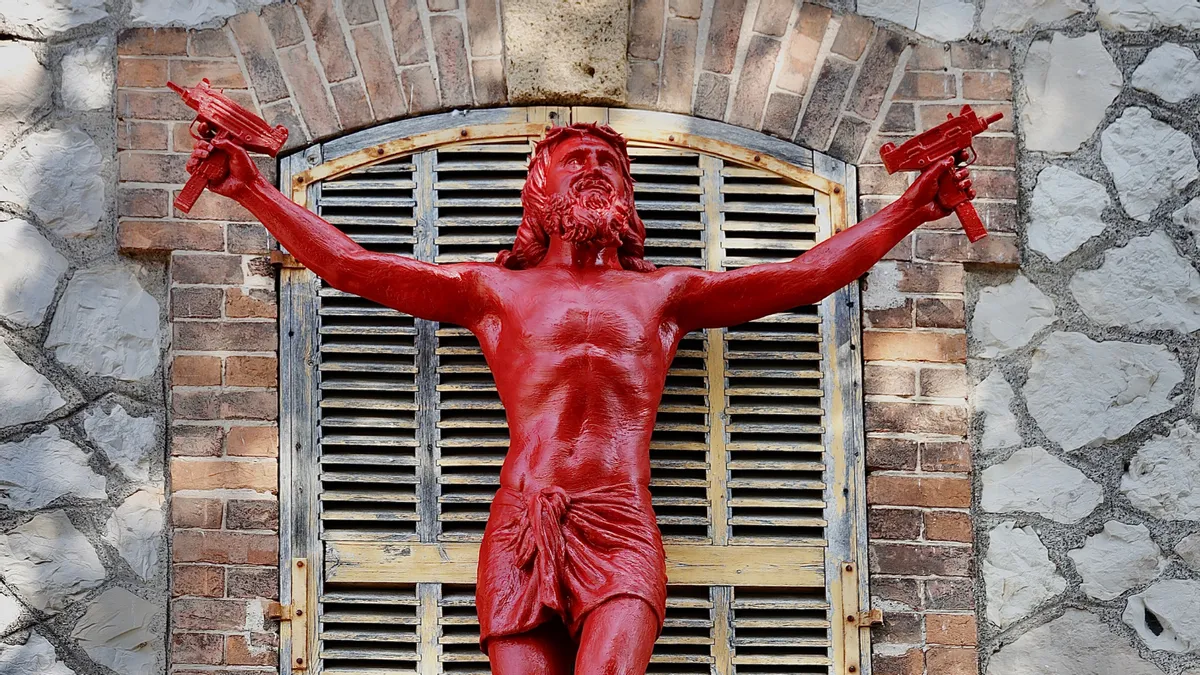
Images authentically show a sculpture of Jesus Christ holding two Uzi submachine guns.
In September 2026, images circulated on social media purportedly showing a sculpture of Jesus Christ completely covered in red paint and holding an Uzi submachine gun in each hand.
“BLASPHEMY: Statue of Christ crucified holding machine guns triggers uproar from Catholics,” one Facebook post (archived) read.

(Facebook page LifeSite)
Photographs of the sculpture spread across Facebook, TikTok and Reddit. Snopes readers also searched our website for information about the images.
In short, the images were authentic. They showed a real sculpture by French artist James Colomina, who confirmed to us via email that he created and installed the artwork at L’Aérosol, a network of spaces devoted to hip-hop and street art in Marseille, France, in September 2026.
What we know about the sculpture
Colomina posted photographs of the sculpture to Instagram on Sept. 10, describing the work as “Tu ne tueras point,” which is French for “Thou shalt not kill.” The post’s description read in full:
Thou shalt not kill.
L’Aérosol, Marseille, 2026.We invented religions, laws, and principles.
Then we invented a thousand reasons to break them.
In an email, Colomina confirmed that the photographs showed the actual physical sculpture, which he installed at L’Aérosol on Sept. 7. “The sculpture is made of resin and painted red,” he said, adding that it “measures approximately 2 meters (6.5 feet) from head to toe.” He also confirmed that the weapons depicted in Christ’s hands were intended to be Uzis.
At the time, French-language coverage also documented the artwork. On Sept. 11, La Dépêche du Midi reported on the sculpture and published photographs credited to Colomina. Toulouse7 published similar details and also credited its images to the artist.
Colomina told us he personally took all of the photographs of the installation that he posted online or shared with news organizations, including images showing the sculpture both outside and inside L’Aérosol.
Why was the sculpture moved indoors?
Some news articles suggested the sculpture was moved indoors in response to public outrage.
Colomina told us he installed the sculpture outside L’Aérosol on the morning of Sept. 7, where it remained throughout the day. At approximately 11 p.m. that evening, organizers moved it indoors. According to Colomina, the decision was precautionary:
As the day went on, concern grew among the staff and organizers. They were convinced that this image, visible from the public space, would provoke very strong reactions. They were concerned about the consequences for the venue, but also about the safety of the staff and the people working there. As a precaution, they ultimately decided to remove the work from the exterior and move it indoors.
Colomina said that, to his knowledge, the decision wasn’t made in response to a specific threat.
“The decision was primarily driven by the concerns of the staff and organizers about the reactions they believed the image would provoke,” he said.
Le Parisien later reported that there were concerns the sculpture could be damaged if it remained outside and that its display could offend the religious convictions of some local residents.
Therefore, the artist’s account suggests that the sculpture was not moved because of a specific threat or protest, but because organizers were worried the outdoor display could cause a strong reaction.
Meaning behind the sculpture
Colomina told us the work was based on the contradiction between the biblical commandment “Thou shalt not kill” and acts of violence committed in the name of religion:
“Thou shalt not kill” begins with a contradiction that fascinates me. The biblical commandment is clear: “Thou shalt not kill.” And yet, throughout history and still today, people have killed and continue to kill in the name of their God, regardless of the religion they claim to follow.
He said depicting Christ holding two Uzis was intended to force viewers to confront that contradiction. “Christ is a symbol here, but the work is not aimed at Christianity or at any particular religion,” Colomina said. Rather, the artwork addressed a broader discrepancy between the principles societies establish and their behavior:
Through the religions, laws and principles that structure our societies, the work confronts us with our contradictions. We establish rules, values and prohibitions, and then find a thousand reasons to break them.
All in all, the photographs circulating on social media were authentic. They showed Colomina’s physical sculpture, which he installed at L’Aérosol in Marseille in September 2026. The artist also confirmed that he took the photographs himself and that the sculpture depicts Christ holding two Uzis.
