


- In January 2025, Panama’s government announced it had caught more than a dozen vessels fishing illegally inside the country’s flagship marine protected area, declaring it the largest such enforcement operation in the country’s history. Yet the government has released little information about the case over the past year and a half.
- To find out what happened, Mongabay sought information from Panamanian government agencies and reviewed government files that a local nonprofit obtained in freedom of information requests. Much of the information in this article, including about the number and nature of the vessels involved and the status of legal proceedings, hasn’t previously been reported.
- Two government agencies have issued fines against many of the vessel owners, though certain cases have been dismissed and the fines in other cases were reduced upon appeal. The status of criminal proceedings led by the public prosecutor’s office, a third government authority, isn’t known.
- The fishers involved protested the fines on multiple grounds; for one, they’ve said they weren’t in fact fishing. Meanwhile, a representative of the Panama-based nonprofit said the government hadn’t been strict enough in enforcing the MPA’s rules and hasn’t conducted the cases with full transparency. The agencies have rejected the criticisms.
On Jan. 22, 2025, Panama’s government announced it had caught 16 vessels fishing illegally inside the country’s flagship marine protected area, declaring it the largest such enforcement operation in the country’s history.
Publicizing the case helped Panama show its commitment to ensure 30% of its waters are “effectively conserved and managed” by 2030, in compliance with the “30 by 30” goal under a 2022 international treaty. Yet Panama’s government has released little information about the case over the past year and a half, leading observers to ask if the vessel owners were ever held to account.
Much of the information in this article, including about the number and nature of the vessels involved and the status of legal proceedings, hasn’t previously been reported. It comes from government files obtained via freedom of information requests by the Environmental Advocacy Center of Panama (CIAM), a nonprofit based in Panama City, and shared with Mongabay, and from Mongabay’s communications with two government agencies involved in the case: the Ministry of Environment, and the Aquatic Resources Authority of Panama (ARAP).
Together, those sources provide new details about the vessels, including that they number 21 rather than 16, and are all Panamanian-owned longliners. They also show that Panama’s government has quietly taken steps to hold the vessel owners accountable. The Ministry of Environment and ARAP have each issued fines for many of the vessels. The fishers involved have protested publicly and appealed the fines, arguing that they weren’t fishing in the protected area and that the fines are incommensurate with their actions. The Ministry of Environment’s cases remain unfinished as they’re under appeal. ARAP has completed its process, ultimately fining 13 vessels.
However, most of these fines were reduced upon appeal, and ARAP dismissed seven of the 21 cases entirely, drawing criticism from Joana Abrego, CIAM’s legal manager. She said the moves show that Panama isn’t being strict about illegal fishing and that the agencies haven’t handled the cases with full transparency. The agencies rejected these criticisms.
What happened in Panama’s flagship MPA?
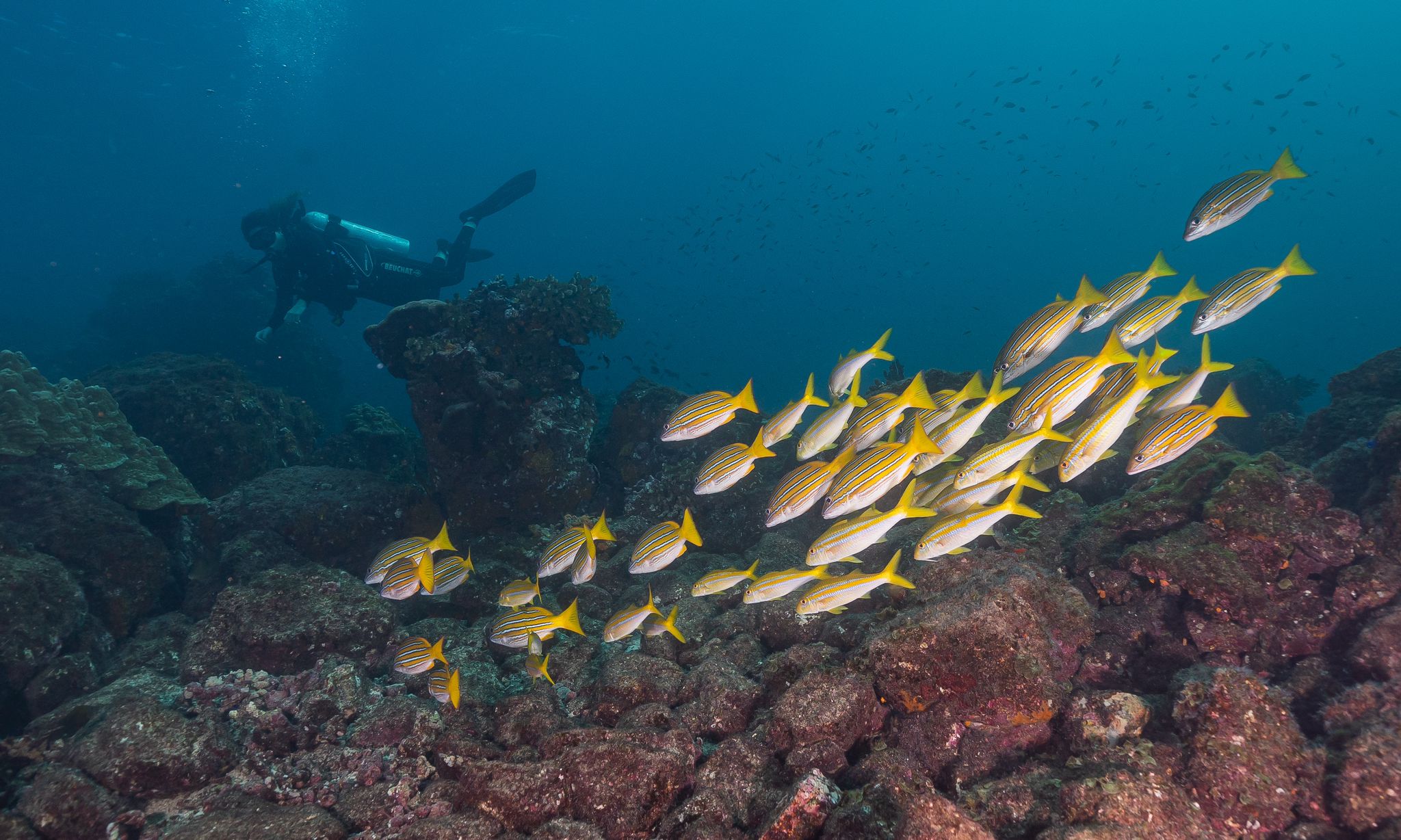
The Panamanian government established the Cordillera de Coiba Marine Protected Area (MPA) in 2015 and expanded it in 2021 to encompass about 67,900 square kilometers (about 26,200 square miles) of seascape. Located dozens of miles offshore in the Pacific Ocean, it contains highly biodiverse underwater mountain ecosystems with 24 seamounts. It’s home to at least 14 marine mammal species and many large pelagic predators, including the critically endangered scalloped hammerhead shark (Sphyrna lewini) and the endangered thresher shark (Alopias pelagicus). In 2022, a rare bottom-dwelling shark called the prickly shark (Echinorhinus cookei) was discovered there.
The MPA is part of the Eastern Tropical Pacific Marine Corridor, a network of MPAs in the waters of Ecuador, Colombia, Panama and Costa Rica. One NGO says the aim of the multinational collaboration is to create a “fishing-free transboundary reserve in one of the world’s most important marine migratory routes.” While limited fishing with certain gear types is permitted in roughly one-third of the Cordillera de Coiba MPA, according to its management plan, longlining is prohibited throughout the entire MPA.
Panamanian authorities, with the support of a network of nonprofit monitoring groups called the Joint Analytical Cell, first identified potentially illegal fishing activity in the Cordillera de Coiba MPA on Jan. 10, 2025. The authorities, including Panama’s National Aeronaval Service, seized seven of the 21 vessels, according to Maximiliano Bedoya, a public relations official in the Ministry of Environment. They did so on Jan. 20 after vessel captains ignored authorities’ warnings to leave.
Yet prior to now, few details about the 21 vessels or their activities in the Cordillera de Coiba MPA had been reported in the international or Panamanian press. ARAP had published a subset of the information in the files on its website, for example in proclamations when it issued fines in the cases, but these were not reported on in the media.

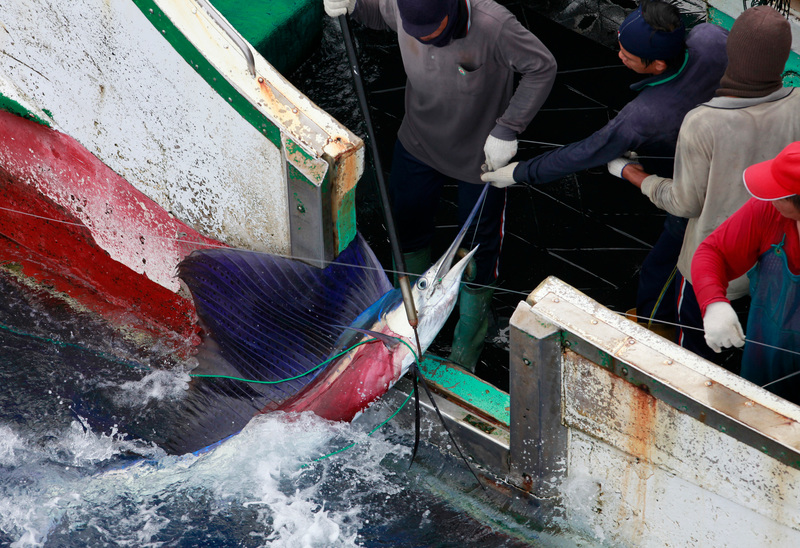
All 21 vessels were longliners between 10.5 and 17.8 meters (34.4 and 58.4 feet) in length, the government files CIAM shared with Mongabay show, and they were primarily targeting yellowfin tuna (Thunnus albacares). In general, longliners can drop hundreds or thousands of hooks per set and can capture large numbers of sharks and seabirds, among other potential environmental impacts.
At least six of the 21 vessels spent more than five days inside the Cordillera de Coiba MPA in January 2025, while the others were there for shorter durations, the files show. Authorities based this conclusion on evidence from transmissions by shipboard vessel monitoring systems (VMS), which send location information to regulators in real time at regular intervals. The longest time any vessel spent inside the MPA was six days, according to Eduardo Carrasquilla, ARAP’s administrator general.
Many of the 21 vessels had unexplained gaps in their VMS transmissions: One had 39 VMS gaps just while it was in the MPA, while another had a gap more than nine hours long, the files show. It’s not known whether captains intentionally turned transponders off, but in general, transmission gaps for VMS and other transponder systems have been associated with illegal fishing.
The vessels were Panamanian owned and flagged, and most came and went from the port town of Pedregal, the files show. Some individual vessels caught more than 15,000 pounds (6,800 kilograms) of yellowfin tuna on their January 2025 trips, though it’s not clear how much of the catch came from within the Cordillera de Coiba MPA; most, if not all, remained at sea for at least 10 days, the files show.
How the cases have played out
ARAP, the fishing regulator, and the Ministry of Environment, which governs protected areas, handled cases separately — that is, there have been two administrative processes, and vessel owners have faced the prospect of sanctions from both agencies.
In terms of these administrative cases, the vessels fall into two categories: the seven that were seized on Jan. 20, 2025, and the 14 others also under investigation for illegal fishing in the Cordillera de Coiba MPA during the same period.
ARAP dismissed its cases against the seven seized vessels. “In several of these cases, the vessels were classified as artisanal or inshore vessels and did not have VMS, so there was insufficient satellite information to technically substantiate the alleged fishing activity within the area,” Carrasquilla of ARAP told Mongabay in an emailed response to questions that he said represented the agency’s official views. He added that the vessels didn’t have fishing gear deployed when they were seized.
Abrego of CIAM said that two of the seven vessels did have VMS and, per Panamanian law, should have been sanctioned by ARAP given satellite evidence of illegal fishing, even if their gear wasn’t deployed when seized. She also said the vessels that didn’t have VMS were legally required to have it — she cited two Panamanian laws — and should have been sanctioned accordingly. In response, Carrasquilla acknowledged the two laws but cited a different law he said takes precedence. Carrasquilla also implied that, while his own agency didn’t pursue action against the seven vessels’ owners, the Ministry of Environment had done so: “these vessels were subject to actions by other competent authorities, particularly in the environment sphere,” he said.

Mongabay obtained limited information from the Ministry of Environment on its handling of the 21 vessels’ cases. The seven seized vessels were returned to their owners following an initial issuance of fines, according to Bedoya, the Ministry of Environment official. Altogether the ministry issued sanctions, including fines, on 13 of the 21 vessels. But the administrative process hasn’t been completed because the fines are being appealed, so the sanctions haven’t yet been enforced, Bedoya told Mongabay.
As for the 14 vessels that weren’t seized, ARAP initially issued fines in all of those cases. The vessel owners appealed on multiple grounds: They questioned ARAP’s interpretation of the VMS records and argued there was a lack of direct evidence of fishing in the MPA and that the fines were not proportionate to the alleged violations. In eight of the 14 cases, ARAP reduced the fines upon appeal (in one case to zero). Following the appeals process, the largest fine was 12,000 balboas ($12,000), and eight vessels were fined 10,000 balboas ($10,000), according to ARAP’s proclamations. (Panama’s per capita GDP was less than $20,000 in 2024, the most recent year on record, according to the World Bank.) The sanctioned parties have agreed to pay in installments; all have made an initial payment and are up-to-date on the payment schedule, Carrasquilla said.
Carrasquilla said the fines were reduced in some cases because the initial fines had been based on the value of the landed product — that is, how much yellowfin tuna the vessels brought back to port — but upon appeal it became clear that not all of the catch could be definitively attributed to fishing in the Cordillera de Coiba MPA.
In addition to the administrative processes, a separate criminal process is being led by the public prosecutor’s office, according to Bedoya. “Proceedings were opened against all individuals involved,” he said. But the current status of these criminal cases hasn’t been made public, and the public prosecutor’s office didn’t respond to requests for comment from Mongabay.

Criticism of the government
Video newscasts from Pedregal in late 2025 and early 2026 show fishers there publicly protesting the fines issued in these (and possibly other) cases. In interviews with local journalists, fishers said the vessels weren’t fishing in the Cordillera de Coiba MPA but just passing through. One suggested that the government was protecting the interests of large foreign fishing vessels and the tourism industry over Panamanian fishers.
In October, in response to criticism, ARAP issued a statement saying that it follows due process in administering fines and doesn’t target any sector, but rather is seeking to improve fisheries governance in response to pressure from the European Union, which gave Panama a “yellow card” for a lack of fisheries control in 2019 that remains in place. This was effectively a warning; a “red card” would mean Panamanian seafood products being banned from the EU market.
Later in October, ARAP staff members met with fishers to discuss concerns that the sanctions were overly harsh. “As an administration, we give direct support to the fishing sector; we are on their side,” a local newspaper reported Carrasquilla as saying at the time.
Mongabay reached out to four of the sanctioned fishers for comment, three of whom owned vessels that remained in the Cordillera de Coiba MPA for more than five days in January 2025, according to the government files. Those three didn’t reply at all, and the fourth didn’t respond to a request to speak on the record.
For her part, Abrego of CIAM said the fine reductions and dismissals were not in keeping with Panamanian law and that the agencies haven’t handled the cases with full transparency.
“I do think it’s a problem because they were very loud once they did this seizure, and that transmitted an image that Panama was being very strict on fighting illegal fishing,” she said. “But the lack of consistency of that transparency as the process continued, and especially as some of the processes were being dropped, [and also] with the [fines] being diminished, it really undermines that effort to transmit that there is a strict, consistent fight in Panama against illegal fishing.”
Abrego said there’s a great deal at stake in the Cordillera de Coiba affair.
“It’s about the capacity of the authorities to control illegal fishing, specifically in marine protected areas that are farther from the coast,” Abrego told Mongabay. She added that protecting the area was “instrumental for Panama to comply with the 30 by 30 international commitment.”
The agencies told Mongabay that they have followed the law in dealing with the cases and have shown their ability to enforce violations of MPA rules. “Far from indicating a lack of control, this case demonstrates precisely the Panamanian government’s capacity to detect, investigate, and administratively prosecute potential violations within marine protected areas through the use of technological tools, satellite monitoring, and specialized enforcement mechanisms,” Carrasquilla said. He added that reassessing fines upon appeal was a normal part of the administrative process and not a response to fishers’ protests. He also indicated that ARAP is taking regulatory action to improve its ability to enforce the rules on MPA violations in the future. Both agencies rejected the idea that they haven’t been transparent.
Carrasquilla also said that ARAP is reclassifying the Panamanian fleet to “align authorizations, registrations, and monitoring and control obligations” with current law. He said that, after this process, 119 vessels that were not previously required to use VMS would be, and that 61% of the nation’s longlining fleet would thus be subject to mandatory VMS use. The remaining longliners, most of which are small-scale, will gradually be incorporated into the system as well, he said.
Panama also recently announced that it would make VMS data for nearly 200 vessels from its national fleet, including longline vessels and shrimp trawlers, available on the Global Fishing Watch map; previously, Panama had only done so for foreign-owned fishing vessels operating under the nation’s flag.
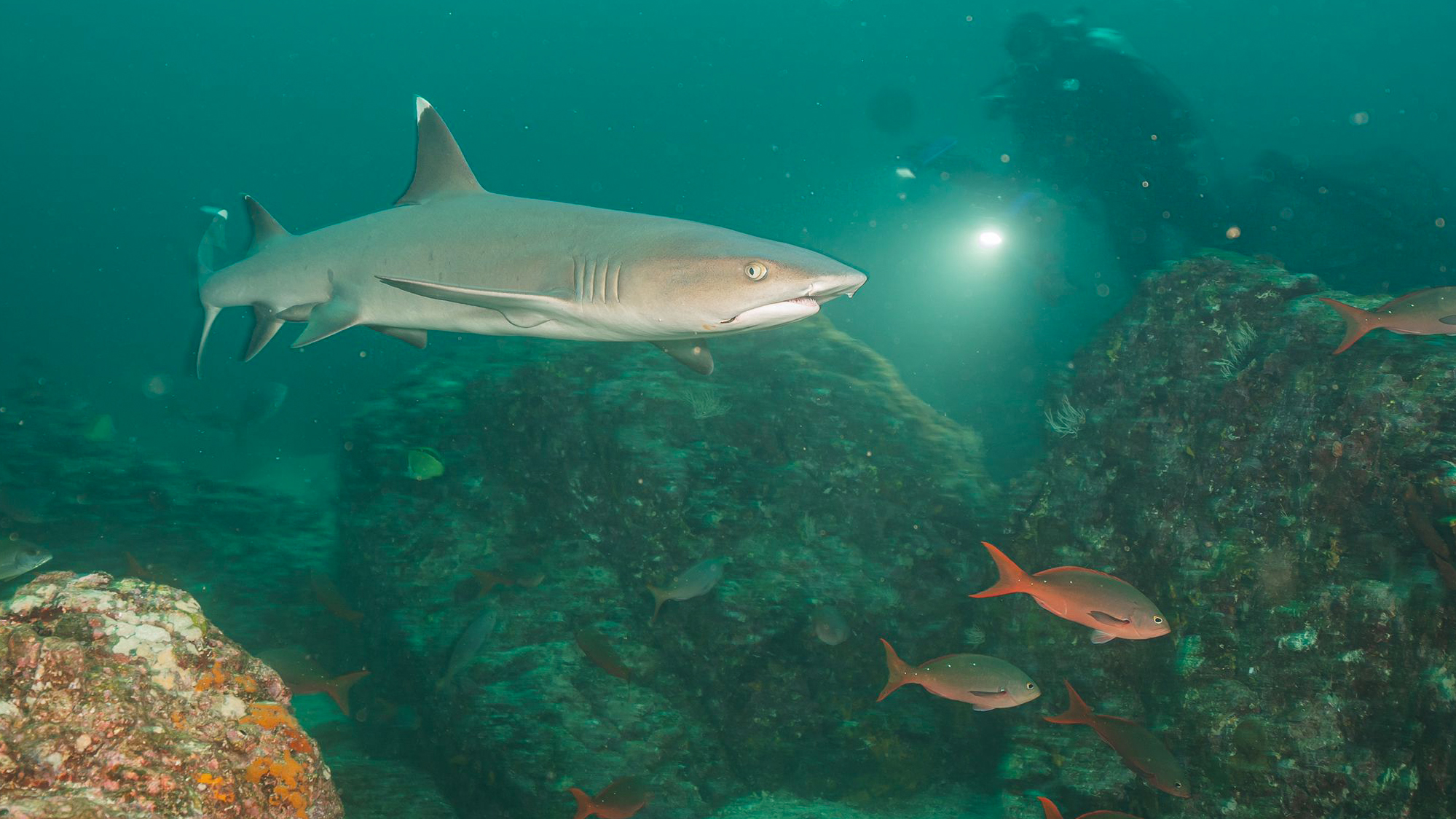
Banner image: A whitetip reef shark (Triaenodon obesus) in the Pacific Ocean off Panama. The species is listed as vulnerable on the IUCN Red List. Image courtesy of Mission Blue/Max Bello.
Borja Bauzá and Max Radwin contributed reporting for this story.
Panama conducts large illegal fishing bust in protected Pacific waters
Feedback: Use this form to send a message to the author of this post. If you want to post a public comment, you can do that at the bottom of the page.
Cite this article
Edward Carver (2026). What happened to the vessels Panama busted in 2025 for fishing in its flagship MPA?. Mongabay Conservation news. DOI: https://doi.org/10.66709/news-324037

