


- Conservation rumors should not be dismissed as misinformation: they influence people’s attitudes toward conservation and how they respond to it, a group of researchers argues in a new op-ed.
- In the Democratic Republic of Congo’s Yangambi Biosphere Reserve, rumors about a scientific tower became a vehicle for both resistance and demands to benefit from conservation.
- These reactions are rooted in a longer history of dispossession and extraction, but also in memories of the jobs and services once associated with conservation, the authors write.
- This article is a commentary. The views expressed are those of the authors, not necessarily of Mongabay.
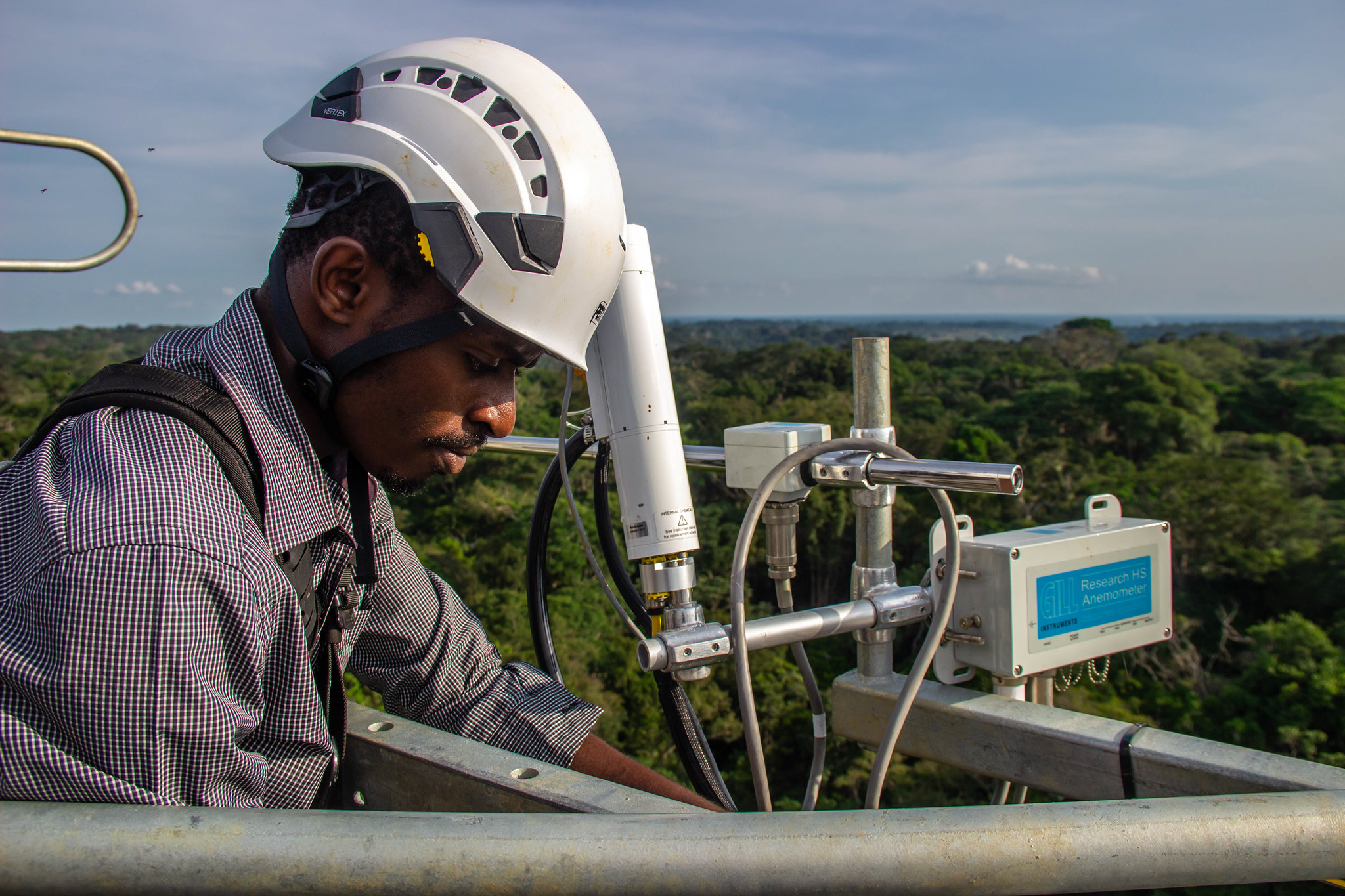
In 2020, a strange rumor began circulating in villages around the Yangambi Biosphere Reserve in the Democratic Republic of Congo’s Tshopo province. A newly constructed scientific tower, people said, was extracting oxygen from the surrounding rainforest and sending it to Europe, where it was being sold for profit.
Not long after, an initiative to plant acacia trees around the reserve was incorporated into the rumor: the trees, some people claimed, were being planted to produce more oxygen for the tower to extract. Then, during an unusually hot spell in May 2024, another version spread rapidly through social media in Kisangani, the provincial capital. This time, the tower was accused of causing the extreme heat by removing oxygen from the atmosphere.
When that rumor spread in 2024, the DRC’s then environment minister, Ève Bazaiba, publicly attributed such claims to “ignorance” and “superstitions.” She posted a video on social media to demonstrate that the tower, CongoFlux, does not extract oxygen: it measures exchanges of greenhouse gases between the rainforest and the atmosphere, helping scientists understand the Congo Basin’s role in global climate regulation.
But correcting the science only gets us so far. Rumors can also tell us something about the people who spread them — and their relationship with conservation.
While conducting research in Yangambi, recently published in Environmental Sociology, we learned that the rumors are ways for people to contest conservation, but also to make claims about who should benefit from it. At the same time, they are shaped by a broader history of conservation, extraction, and development projects in the region.
It is for these reasons that, as the political ecologist George Holmes has put it, conservation rumors should be taken “seriously, but not literally.”
-
Aereal view of the Congoflux tower in Yangambi, DRC. Image by Fiston Wasanga/CIFOR via Flickr (CC BY-NC-ND 2.0).
When rumors resist
Conservation rumors are far from unique to the DRC. In southern Chile, the creation of private protected areas generated rumors that they were a front for hidden agendas, ranging from a plan to steal Chile’s water to a CIA-backed conspiracy. Across France, Norway and Greece, opponents of wolf conservation attributed the animals’ return to covert reintroductions by environmentalists, NGOs, or government agencies. In southern Chile, farmers have similarly claimed that state wildlife authorities were responsible for the presence of pumas.
A growing academic literature interprets such rumors as covert forms of resistance. They are particularly common where people have few formal opportunities to challenge powerful conservation authorities: they can be spread collectively and relatively anonymously, circulate rapidly, and evolve as they travel. In many ways, the rumors circulating in Yangambi confirm this interpretation, as they provide people with a way to turn otherwise diffuse grievances into compelling, shared, and sharable narratives of injustice.
This can have very real consequences for conservation. Rumors can undermine trust and cooperation, encourage subtle noncompliance with conservation rules, and, in some cases, help mobilize more overt forms of resistance, from protests and obstruction to sabotage.
Such resistance can contribute to forest clearing, the killing of charismatic wildlife, attacks on conservation personnel, and the destruction of conservation infrastructure.
-

The Yangambi Biosphere Reserve is at the heart of the second largest tropical rainforest in the world, which is vital for the world’s climate and regional water supply. Image by Glòria Pallarès.
We saw this process unfolding in Yangambi. Cables connecting the CongoFlux tower to the electricity grid disappeared, newly planted acacia trees were burned, protected forests cleared, conservation facilities looted, and Turumbu youths at one point erected a barricade preventing researchers from reaching the tower.
When the claim that the tower was causing extreme heat spread in Kisangani in 2024, the stakes became higher still. One crowd reportedly grew to more than 300 people as a man urged them to travel to Yangambi and tear the tower down.
When rumors demand reciprocity
But in Yangambi, rumors are rarely simply expressions of resistance.
When people spoke about the extraction and sale of oxygen, they rarely demanded conservationists disappear. Instead, they asked why the local population did not receive a share of the rewards, and why jobs associated with it go to other people.
These demands for redistribution and reciprocity make sense in the wider context of stark inequality. International conservation organizations bring significant funding, while scientists emphasize the global importance of Yangambi’s forest ecosystem. Yet nearby communities remain poor, with limited employment, livelihood opportunities, or public services.
If their forests are so valuable, people ask, why are so few of the benefits reaching them?
-

CAPTION: Carrying firewood in Yangambi, Tshopo, DRC. Image by Axel Fassio/CIFOR via Flickr (CC BY-NC-ND 2.0).
The oxygen rumor gave this apparent contradiction a compelling explanation: perhaps outsiders were extracting something valuable from the forest after all. Similar frustrations surrounded the acacia-planting project. Villagers had expected that, after encouraging them to plant the trees, the Center for International Forestry Research (CIFOR) would return to purchase them from the local population. When this expected economic relationship failed to materialize, the idea that the trees served another — hidden — commercial purpose became more plausible.
This use of rumors to make claims about wealth and its distribution has a long history in Africa. Studies of witchcraft and the occult, for example, show how rumors and gossip can express expectations about how resources should be shared and the obligations of those who benefit from them. Applied to conservation, rumors therefore express not just resistance, but demands for a fairer share of the benefits that it might bring.
The history behind the rumor
Neither the resistance nor the demands for reciprocity expressed through rumors emerged from nowhere. Both are rooted in Yangambi’s longer history of conservation.
Created under Belgian colonial rule in 1939, the reserve incorporated large areas that previously formed part of the ancestral estate of the Turumbu people. To this day, Turumbu chiefs claim they have never been sufficiently compensated for this. During colonization, Yangambi was also a center of commercial production, exporting rubber, cotton, and other commodities to Europe. Stories about outsiders extracting something valuable from the forest therefore echo this history of dispossession and extraction.
This history has another side, too. Colonial conservation, despite the coercion, was embedded within a much larger socio-developmental project — one that created its own set of expectations that still reverberate today. Around 10,000 people were employed in the region of Yangambi, receiving housing, health care, food rations, and schooling. A Turumbu agricultural cooperative also provided its 1,000 or so members with a market for their produce, alongside seeds, tools, and technical support.
-

Houses for Belgian workers of the the National Institute for Agronomic Studies and Research (INERA). Image courtesy of Fergus O’Leary Simpson.
-

Houses for Congolese workers of the the National Institute for Agronomic Studies and Research (INERA). Image courtesy of Fergus O’Leary Simpson.
These contrasting historical experiences help explain the apparently ambivalent politics that are expressed through the rumors. Memories of dispossession and extraction give force to suspicions that outsiders are once again benefitting from local resources. But memories of the economic opportunities that accompanied colonial conservation activities also shape expectations that local people could, indeed should, receive benefits too.
Listening beyond rumors’ factual claims
What can rumors teach conservation authorities? Rather than dismissing them as factually inaccurate or flawed scientific theories, a more fine-grained, qualitative analysis provides important insights into their tellers and the world they inhabit. On the one hand, rumors serve as conduits for local political agency. On the other, they are shaped by people’s historical experiences of conservation efforts and what went alongside them.
Taking rumors seriously therefore means listening beyond their factual claims. In Yangambi, doing so reveals a population that is not simply rejecting conservation efforts, but asking what place it will have within them — and what it should receive in return.
Fergus O’Leary Simpson is a postdoctoral research fellow at the Centre for Interdisciplinary Research on Rural Transformations (IACCHOS) and an associate researcher at the Institute of Development Policy (IOB), University of Antwerp. Kristof Titeca is a professor in the Politics of Development at the Institute of Development Policy (IOB) at the University of Antwerp and senior associate fellow in the Africa Programme of the Egmont Institute. Papy Bambu holds a PhD in Sociology and is a faculty member and researcher at the University of Kisangani, where he also directs the Laboratory for Population, Environment and Social Safeguards. Eric Abanati is a researcher at the University of Kisangani and a PhD candidate in the Department of International Relations. Andre Malekani holds a Bachelor’s degree in Biology and is a researcher at the Biodiversity Monitoring Centre of the University of Kisangani, where he also works as a consultant on biodiversity assessments and environmental impact studies.
Banner image: Installation of the technical equipment of the Congoflux tower in Yangambi, DRC. Image by Fiston Wasanga/CIFOR via Flickr (CC BY-NC-ND 2.0).
Militarized conservation: Insecurity for some, security for others? (commentary)
Citations:
Simpson, F. O., Titeca, K., Bambu, P., Abanati, E., & Malekani, A. (2026). ‘They’re selling our oxygen!’ Rumours and conservation in Yangambi Biosphere Reserve. Environmental Sociology, 1-14. doi:10.1080/23251042.2026.2712611
Holmes, G. (2022). Tell your friends: Taking rumour and gossip seriously, but not literally, in biodiversity conservation. Oryx, 56(1), 1-2. doi:10.1017/s0030605321001666
Skogen, K., Mauz, I., & Krange, O. (2008). Cry Wolf!: Narratives of wolf recovery in France and Norway. Rural Sociology, 73(1), 105-133. doi:10.1526/003601108783575916
Theodorakea, I. T., & Von Essen, E. (2016). Who let the wolves out? Narratives, rumors and social representations of the wolf in Greece. Environmental Sociology, 2(1), 29-40. doi:10.1080/23251042.2015.1119349
Benavides, P., & Caviedes, J. (2021). Unnatural pumas and domestic foxes: Relations with protected predators and conspiratorial rumours in southern Chile. Environmental Values, 31(2), 131-152. doi:10.3197/096327121×16141642287782
Butt, L. (2005). “Lipstick Girls” and “Fallen Women”: AIDS and conspiratorial thinking in Papua, Indonesia. Cultural Anthropology, 20(3), 412-442. doi:10.1525/can.2005.20.3.412
Komi, S. (2025). “The real truth about wolves”: Political ecology of wildlife conservation in the post-truth era. Geoforum, 160, 104238. doi:10.1016/j.geoforum.2025.104238
Holmes, G. (2007). Protection, politics and protest: Understanding resistance to conservation. Conservation and Society, 5(2), 184-201. Retrieved from https://www.jstor.org/stable/26392880?seq=1
Simpson, F. O., & Geenen, S. (2023). Batwa return to their Eden? Intricacies of violence and resistance in eastern DRCongo’s Kahuzi-Biega National Park. The Journal of Peasant Studies, 50(3), 1106-1124. doi:10.1080/03066150.2021.1970539
Mariki, S. B., Svarstad, H., & Benjaminsen, T. A. (2015). Elephants over the cliff: Explaining wildlife killings in Tanzania. Land Use Policy, 44, 19-30. doi:10.1016/j.landusepol.2014.10.018
Comaroff, J., & Comaroff, J. L. (1999). Occult economies and the violence of abstraction: Notes from the South African postcolony. American Ethnologist, 26(2), 279-303. doi:10.1525/ae.1999.26.2.279
Koy, J. K., Ngonga, A. M. M., & Wardell, D. A. (2019). Moving beyond the illusion of participation in the governance of Yangambi Biosphere Reserve (Tshopo Province, Democratic Republic of Congo). Nature Conservation, 33, 33-54. doi:10.3897/natureconservation.33.30781
FEEDBACK: Use this form to send a message to the author of this post. If you want to post a public comment, you can do that at the bottom of the page.
Cite this article
Andre Malekani, Eric Abanati, Fergus O’Leary Simpson, Kristof Titeca, Papy Bambu (2026). What conservation rumors reveal about climate projects in the Congo Basin (commentary). Mongabay Conservation news. DOI: https://doi.org/10.66709/news-328390

