


Drinking water costs spiked faster than inflation, grocery prices and median household income, researchers at nonprofit Food & Water Watch outlined in a first-of-its-kind report released Tuesday.
The average community water system increased household drinking water prices by 62 percent between 2015 and 2025—with costs in Louisiana, Maryland and New Hampshire having particularly steep rises, according to the 17-page report. California also stood out in the data when it comes to seeing expensive water bills.
Kristin Dobbin, an assistant professor of Cooperative Extension at the University of California, Berkeley, who was not involved in the report, called the analysis “extremely important.”
The finances behind drinking water are “not something we’ve had a big picture view on across the country before,” Dobbin told Inside Climate News on Monday, noting that broad trends are much easier to review for national electricity rates.
“We need to situate the water conversation within these broader concerns about affordability,” she said. “Certainly, it’s striking that they found just how quickly water costs have risen in the decade.”
Food & Water Watch gathered and analyzed 2025 water billing data for the nation’s 500 largest community water systems, which serve more than 155 million people, or 45 percent of the country. The nonprofit compared that data to household water bills from 2015.
The new report—“Surging Water Costs amid the US Affordability Crisis”—notes that last year, the average U.S. water system charged households $531 a year for 60,000 gallons of water, an estimate of annual average water use per household.
Eleven years ago, water systems typically charged about $336 a year per household, which is about $457 in 2025 dollars when adjusted for inflation.
While water bills vary greatly nationwide, a corporate water system in San Jose, California, had the highest price for water in the report, charging $1,416 annually in 2025.
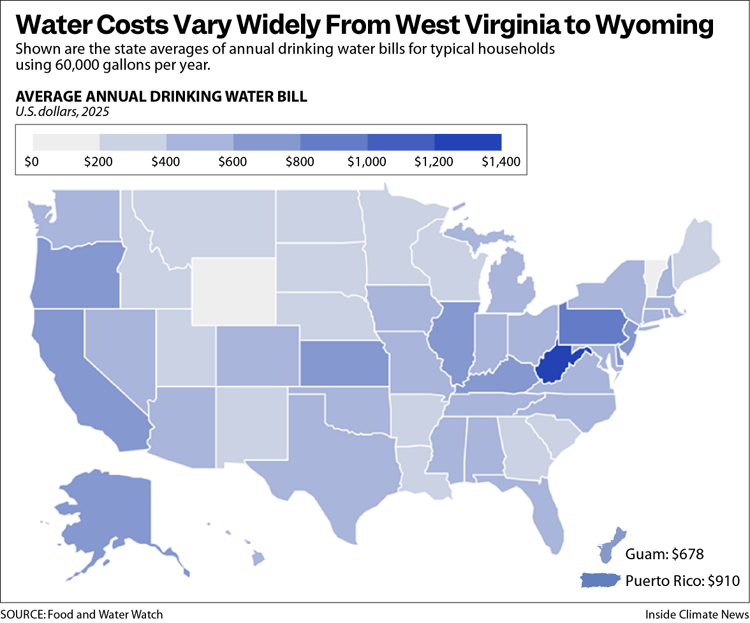
Fifty-two percent of the 25 most expensive systems reviewed by Food & Water Watch were in California, despite the state’s systems representing just 18 percent of the 500 systems in the dataset.
In Louisiana, Maryland and West Virginia, water bills grew about twice as fast as state median household incomes, the report found.
In New Hampshire, bills grew nearly five times faster.
Mary Grant, the water policy director at Food & Water Watch, said West Virginia jumped out in the report.
Many water utilities claim that their bills are largely still affordable for median-income households, she said.
“But in some places like West Virginia, water bills are becoming unaffordable for a typical household at the median income, and that’s really a warning sign,” Grant said. “I think that we really need to have federal action to stop this crisis before more people suffer from unaffordable water bills.”
This story is funded by readers like you.
Our nonprofit newsroom provides award-winning climate coverage free of charge and advertising. We rely on donations from readers like you to keep going. Please donate now to support our work.
Affordability “is a legitimate challenge for many households,” said Jenn Kocher, a spokesperson for the National Association of Water Companies, which represents regulated, private water companies, which serve nearly 40 million U.S. customers.
Due to a publication embargo, Kocher could not review Food & Water Watch’s full report.
Still, after reviewing some of the findings Kocher said any assessment of water rates should also consider system performance, including reliability, water quality compliance and long-term infrastructure conditions.
Rising water bills “reflect sector-wide cost pressures, not ownership models,” Kocher, whose group has also fought for a permanent federal water-assistance program, said Monday. “In addition, rate comparisons should account for actual household usage and customer assistance programs, rather than posted rates in isolation.”
Why are water bills so high nationwide?
Dobbin, of UC Berkeley, said factors including inflation are having a big impact on the drinking water sector, which relies on specialized materials like treatment chemicals, a supply chain that was stressed during the COVID-19 pandemic and water infrastructure that is deteriorating nationally.
The Environmental Protection Agency recently found drinking water systems across the U.S. will need $625 billion in upgrades over the next twenty years to meet existing water quality standards. The American Water Works Association placed that figure closer to $960 billion.
In Maryland, a vast majority of customers receive water from municipal water systems, with rates set by city, town, or county governments instead of the Maryland Public Service Commission, which affects affordability, said Maryland People’s Counsel David Lapp, who heads an independent state agency that represents residential and noncommercial utility customers.
“Water service is an essential public service, but small privately-owned water systems in Maryland typically lack the customer base and financial resources necessary to provide that service reliably while maintaining affordable rates: of the 22 private water companies in Maryland, most serve fewer than 1,000 customers and some serve as few as ten,” said Lapp, who could not review the full embargoed report on Monday.
“In recent years,” Lapp said, “we have seen rates for customers of some of these private water companies, mostly in rural communities including in western Maryland, increase substantially.”
Other findings from Food & Water Watch’s report:
- Water bills increased at 1.6 times the overall inflation rate and more than 2 times the rate for groceries
- Water bills increased 19 percent faster than the U.S. median household income
- Water bills were considered unaffordable for low-income households in 93 percent of the analyzed water systems
- The “worst affordability crisis” was in Puerto Rico, where low-income households were charged a “dangerous 20 percent” of their income for water, researchers said
In the report’s list of recommendations, the nonprofit said local and state governments should ban water privatization and repeal pro-privatization legislation, as well as hold polluters accountable for drinking water contamination and large corporations for emitting new contaminants.
Congress and the federal government should also “reject cuts to safe and clean water and restore federal funding to address the nation’s water affordability crisis,” report authors noted. A Congressional Research Service report from earlier this year detailed stark cuts to federal water infrastructure planned by the Trump administration.
Looking ahead, Food & Water Watch said droughts and severe weather—driven by climate change—are expected to continue to “threaten water supplies and infrastructure globally, generating expenses that will be pushed onto ratepayers.”
Data center construction and expansion, compounded by intense water-use by industries like large-scale farms, are also expected to push up water costs, Food & Water Watch said.
About This Story
Perhaps you noticed: This story, like all the news we publish, is free to read. That’s because Inside Climate News is a 501c3 nonprofit organization. We do not charge a subscription fee, lock our news behind a paywall, or clutter our website with ads. We make our news on climate and the environment freely available to you and anyone who wants it.
That’s not all. We also share our news for free with scores of other media organizations around the country. Many of them can’t afford to do environmental journalism of their own. We’ve built bureaus from coast to coast to report local stories, collaborate with local newsrooms and co-publish articles so that this vital work is shared as widely as possible.
Two of us launched ICN in 2007. Six years later we earned a Pulitzer Prize for National Reporting, and now we run the oldest and largest dedicated climate newsroom in the nation. We tell the story in all its complexity. We hold polluters accountable. We expose environmental injustice. We debunk misinformation. We scrutinize solutions and inspire action.
Donations from readers like you fund every aspect of what we do. If you don’t already, will you support our ongoing work, our reporting on the biggest crisis facing our planet, and help us reach even more readers in more places?
Please take a moment to make a tax-deductible donation. Every one of them makes a difference.
Thank you,

Reporter, California
Steven Rodas covers water, wildfires and agriculture throughout California for Inside Climate News. Based in Los Angeles, he previously reported on the environment in New Jersey, covering energy, pollution, wildlife and development. Steven’s work has appeared in the San Francisco Chronicle, NJ.com/The Star Ledger and Grist. He worked as a copywriter at Google. Steven has a master’s degree from Syracuse University’s S.I. Newhouse School Of Public Communications. He is fluent in English and Spanish (and welcomes your tips).
