


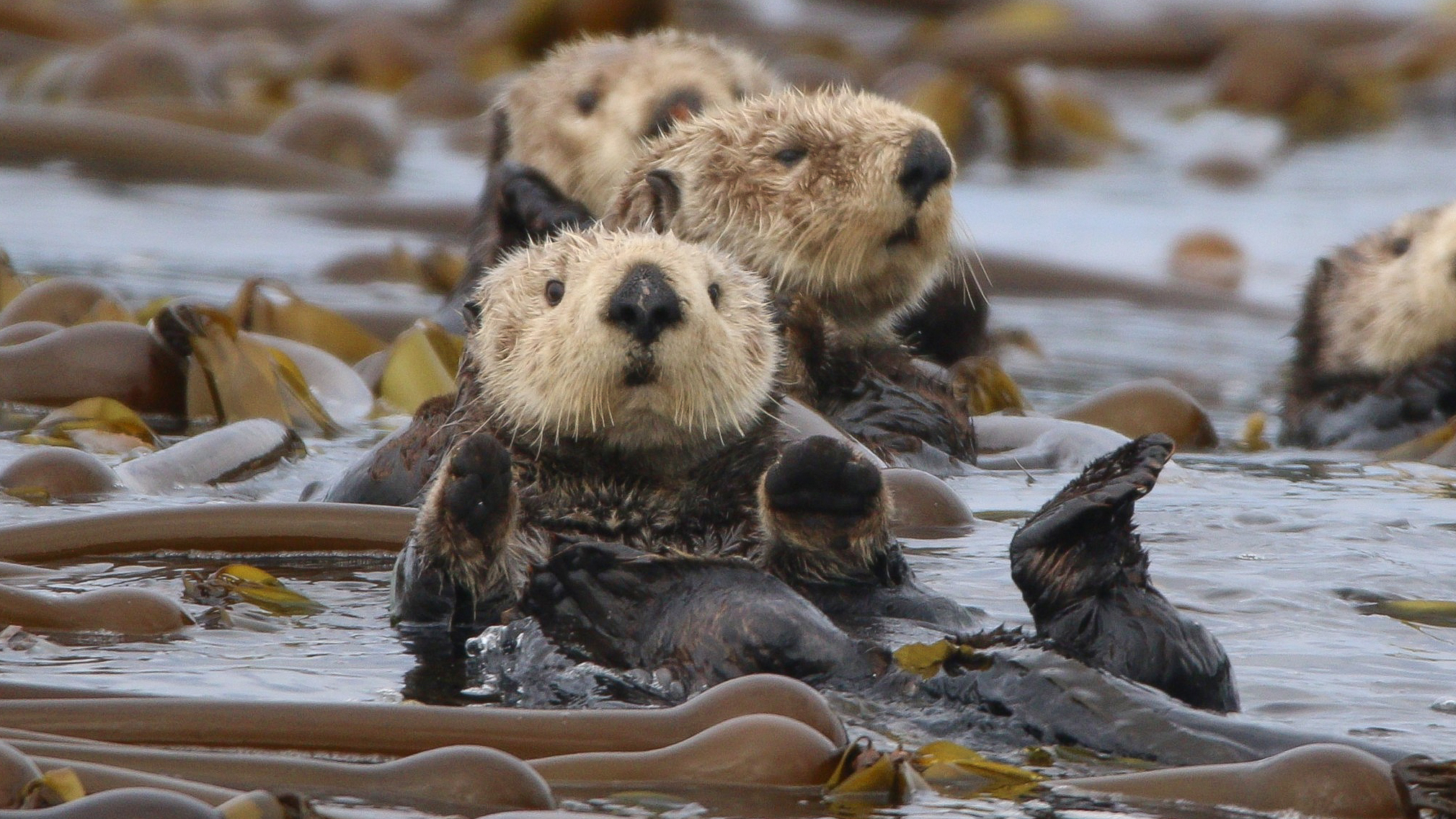
- In Clayoquot Sound, British Columbia, a partnership between the Tla-o-qui-aht First Nation, Redd Fish Restoration Society and West Coast Kelp grows kelp at scale to support an ecosystem in decline.
- The fur trade eradicated sea otters; their return enables kelp to thrive.
- Underwater cameras are monitoring the newly formed kelp forest.
- The success of the project will be measured by science and the return of ecological abundance.
Emily Fulton spends a lot of time in a small boat cruising the waters of Clayoquot Sound off the west coast of Vancouver Island in British Columbia, Canada. As the marine program manager for the nonprofit Redd Fish Restoration Society, she regularly checks on a newly created kelp nursery growing within the traditional territory of the Tla-o-qui-aht First Nation.
“We have grown a lot of kelp,” Fulton told Mongabay in a phone interview.
Touted by its organizers as the largest kelp restoration project on the West Coast of North America, the nursery has planted more than 4,200 square meters (45,200 square feet) of new kelp habitat since launching in early 2026. That’s the footprint of three and a half Olympic-size swimming pools.
The team grows baby bull kelp (Nereocystis luetkeana) and giant kelp (Macrocystis pyrifera) on four lines; each 330 meters (1,083 feet) long, submerged below the water’s surface and away from seafloor predators such as sea urchins. As the kelp grows and matures, they’ll take some of it off the lines and transplant it to sites throughout Clayoquot Sound, to restore degraded kelp forests and also seed new ones.
Getting a project of this scale up and running has cost almost a quarter of a million Canadian dollars ). The funding has come from various sources, including the provincial government, the World Wildlife Fund of Canada and the Clayoquot Biosphere Trust. Managing the project alongside Redd Fish is West Coast Kelp, a business devoted to kelp restoration and the Tla-o-qui-aht First Nation.
For Saya Masso, natural resources manager for the Tla-o-qui-aht, the project is about restoring the self-sufficiency his ancestors once enjoyed. “A society that thrived on the West Coast for 10,000 years, we lived under a system of abundance,” he told Mongabay in a phone interview.
For her part, Fulton said she sees the project as a means to get ahead of the curve before the global decline of kelp becomes an ecological emergency in Clayoquot Sound. “If and when that happens, we just have to be ready to act rather than, at that point, go, ‘now how do we do it,” she said.
Globally, scientists estimate 11,542 square kilometers (4,456 square miles) of kelp forest are lost every year. In some regions, kelp has all but disappeared. Along the coast of British Columbia (B.C.), kelp is under stress. In 2015, along the central B.C. coast, a marine heat wave wiped out kelp forests. The warm waters caused an outbreak of an encrusting bryozoan (a type of invertebrate) that smothered the kelp, causing it to sink to the seafloor and disintegrate.
Considering that the global value of the ecosystem services kelp provides is estimated at around $500 billion annually, these losses are significant. Kelp forests provide food and shelter for marine mammals, fish and invertebrates; they buffer wave energy along the shoreline and sequester carbon. Remove kelp, and the system unravels.

A furry kelp protector
According to Masso, one of the reasons the Tla-o-qui-aht chose to join this project was because sea otters (Enhydra lutris) were returning to the region. “The otter played a big role in establishing our kelp forest,” Masso said. Historically, the Tla-o-qui-aht didn’t hunt the otter because they knew it ate the sea urchin, which fed on the kelp.
But European fur traders did. Prized for their warm pelts, between the 1700s to the early part of the 20th century, sea otters throughout northwestern North America were hunted to near extinction, Hannah Kobluk, a Ph.D. candidate in the Ocean Relations Collaborative at Simon Fraser University in B.C., told Mongabay in a phone interview. Now with protections in place in the U.S. and Canada, sea otter populations are beginning to naturally revive. Canada’s Department of Oceans and Fisheries estimates that close to 1,500 sea otters live in and around Clayoquot Sound.
Kobluk, who is not affiliated with the project, said the loss of sea otters is not the only cause of kelp’s decline along the West Coast. Several factors have contributed, including marine heat waves. However, she acknowledged that when sea urchins are removed, kelp has a better chance of survival.
Along the shoreline of the Haida Gwaii archipelago in northern B.C., for example, sea urchin populations are hyper-abundant. In 2017, the Haida Nation and Parks Canada began restoring kelp on a small 3-kilometer (1.86-mile) stretch of shoreline along Gaysiigas Gway (Murchison Island). Part of the work entailed removing 75% of the sea urchin population within the restoration area. Before work began, kelp grew only in a narrow band around the low-tide level. By the summer of 2019, it had expanded 2-5 meters (6-16 feet) out into the water compared with before the urchins were removed.
“In areas where there are sea otters, such as in Clayoquot Sound now, the sea otters will be eating up all the urchins,” Kobluk said. “That will make things a lot easier for the people doing kelp restoration. Sea otters are like kelp restoration collaborators.”

A nursery for salmon
Supporting recovery of the region’s iconic salmon populations is a key part of the project’s mission. These fish have been struggling under a suite of threats, including habitat loss due to industrial logging, drought and overfishing.
Masso said his ancestors knew thousands of years ago that kelp forests support salmon smolts, offering protection and forage until they are ready to enter the open ocean. Science has now come to the same conclusion. A study that analyzed video imagery from two locations with dense nearshore kelp forests along Washington state in the U.S. found juvenile salmon swimming regularly in the kelp.
This is no surprise to Tatt Charlie, a tribal guardian of the Tla-o-qui-aht. He has been working in the burgeoning kelp nursery. “I’ve been out there a couple of times now,” he told Mongabay in a phone interview. “The first time is when they laid the lines, and it was exciting to see it start. It was more exciting to go back three months later, and you can actually see the progression.” Bull kelp, for instance, grows very quickly, up to 15 centimeters (6 inches) a day.
He said the long-term plan is for the kelp to be transplanted in estuaries near streams and creeks flowing into Clayoquot Sound. There it will provide not only shelter for salmon smolts, but a cool, protected place for adult salmon to forage and rest before the rain comes and the water cools enough for them to head upstream and lay their eggs.

Knowing both where kelp is already growing and where it once grew is crucial in determining the best place to transplant the kelp growing on the stationary lines in Clayoquot Sound. Redd Fish has been using drone technology to map existing kelp beds throughout the area. The idea is to create a database from which to gauge if kelp begins to decline drastically in the region.
As for where kelp once grew — that’s a different story. Other than old forestry pictures that show the coastal rainforest reaching down to the ocean’s edge and appearing to almost merge with the lush underwater kelp forest, most of the historic information about where kelp once grew has come from Tla-o-qui-aht oral history. “We were told where to plant,” Fulton said.
It will, according to Masso, take at least a decade to create accurate maps and to make sure the transplanted kelp survives. Tom Campbell, president and founder of West Coast Kelp, told Ha-Shilth-Sa, Canada’s oldest Indigenous newspaper, that the project plans to double its biomass production within a year or two.

Measuring success
Already the organizers say they’ve learned a great deal.
Figuring out the nuances of how to grow different species of kelp was, according to Fulton, a learning curve. Initially, as the bull kelp started to grow in the newly built nursery, it began to lift the lines it was growing on, rising too close to the surface and becoming sun-bleached. The team had to adjust the system by weighing the lines to counteract the buoyancy of the kelp’s large air-filled bladders.
There is also the question of whether the kelp is actually contributing to biodiversity in Clayoquot Sound.
This is why the team installed four underwater cameras in the nursery. According to Fulton, they come on for five minutes every hour between sun-up and sun-down to record video and still images. The visual data show the marine organisms that are attracted to the kelp and whether they are using it for forage or just as a safe place to rest. “We know that kelp creates habitat, but we don’t have numbers to associate with that, and we want to be able to determine the actual benefit,” Fulton said.
And while the cameras will provide the scientific evidence that Fulton is seeking, the measure of the project’s restorative success for Charlie is the return to a system in balance.
“My ancestors had a system of reciprocity where they knew not to take too much, and we were always giving back,” Charlie said. “So, to have that balance is what we’re trying to achieve with our territories. It’s really interesting to see that these are the baby steps we need to take to set it back to pre-contact 300 years ago.”
Banner image: Northern sea otters (Enhydra lutris ssp. kenyoni) in a kelp forest in Strathcona, B.C., Canada. Image © Liam Ragan via iNaturalist (free to use).
A campaign to protect one of the planet’s only expanding kelp forests takes shape
The world’s kelp needs help — less than 2% is highly protected
First Nations lead the return of salmon to Canada’s Upper Columbia River
Citations:
Filbee-Dexter, K., Pessarrodona, A., Krumhansl, K. A., … Wernberg, T. (2026). Seaweed carbon removal cannot keep up with climate-driven loss. PLoS biology, 24(9). e3003949. doi: 10.1371/journal.pbio.3003949
Eger, A. M., Marzinelli, E. M., Beas-Luna, R., Blain, C. O., Blamey, L. K., Byrnes, J. E. K., … Vergés, A. (2023). The value of ecosystem services in global marine kelp forests. Nat. Commun. 14, 1894. doi:10.1038/s41467-023-37385-0
Shaffer, A., Gross, J., Black, M., Kalagher, A., … Juanes, F. (2023). Dynamics of juvenile salmon and forage fishes in nearshore kelp forests. Aquatic Conservation: Marine and Freshwater Ecosystems, 33(8), 822–832. doi:10.1002/aqc.3957
FEEDBACK: Use this form to send a message to the editor of this post. If you want to post a public comment, you can do that at the bottom of the page.
Cite this article
Jennifer Cole (2026). Science, Indigenous knowledge team up to restore Canada’s kelp. (Sea otters help, too.). Mongabay Conservation news. DOI: https://doi.org/10.66709/news-331571

