


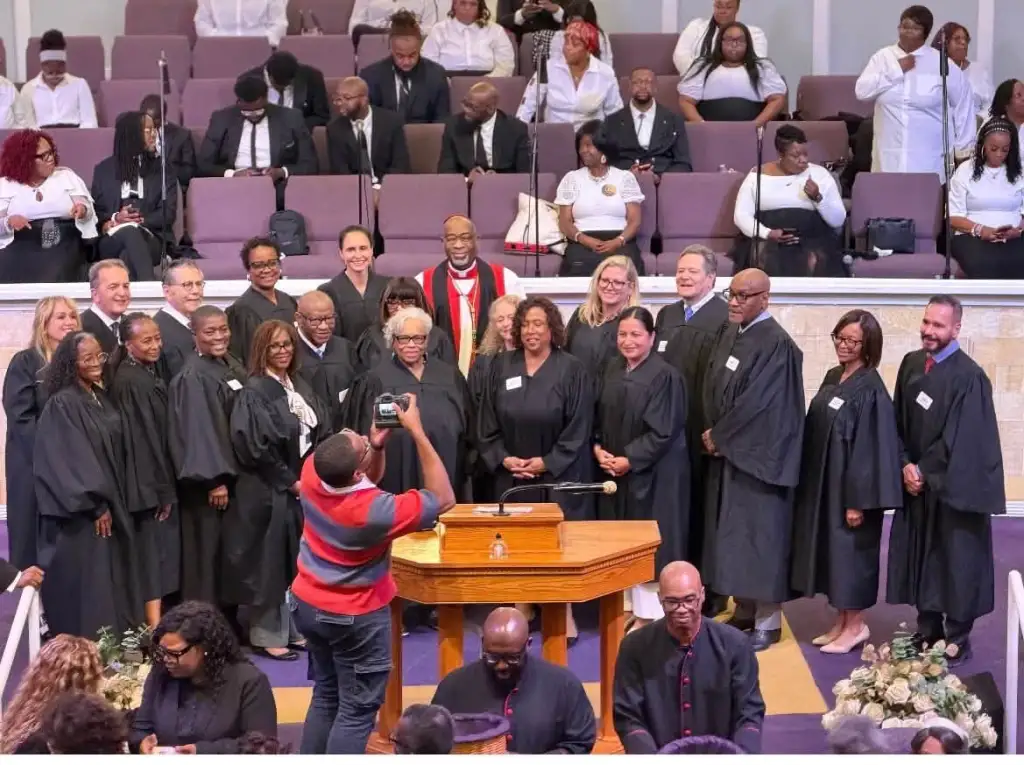
On a Sunday in mid-August, more than a dozen people in black robes filled the two front pews of a Baptist church in Beverly.
“We welcome all these wonderful judges here today. Amen!” pastor Simon Gordon said with a grin, noting this wasn’t the first time judges have shown up at Triedstone Church. “Some I’m starting to know by face — not ’cause I’ve been in the courtroom,” he told the audience, prompting loud laughter.
Gospel singer and radio personality Pam Morris-Walton appeared on a dais below the pulpit, holding a white envelope. She greeted the pastor and introduced herself to parishioners as the “faith-based outreach community consultant for these incredible, honorable judges.”
“I would like to present you a check on behalf of the 2026 Cook County judicial retention class and the members who are present here today,” she said. “This is their offering.”
Morris-Walton handed the mic to Judge Tyria Walton, a seven-year veteran of the bench, who shouted out her own church and pastor before launching into a campaign pitch on behalf of the judges facing a retention vote in November. “We encourage you: Vote ‘yes’ for all of us. Among us we have over 800 years of experience, and we represent judges’ associations all across the county,” she said, rattling off the names of groups representing Black, LGBTQ, Jewish, and Latinx judges.
The 17 judges at church that day then lined up in front of the congregation as Morris-Walton introduced each of them by name. “The judges are in the back of the ballot. Go down and vote ‘yes’ for all of us,” she said again. “Retention is not automatic.”
Statistically speaking, none of the 61 judges on the November ballot are likely to fall short of the 60% “yes” votes needed to stay on the bench. Since 2018, just three of the 256 sitting judges who’ve been up for retention have lost. Before 2018, no Cook County judge had lost retention in 28 years.
And yet, every two years, the dozens of judges up for retention in Cook County form a “class,” fundraising and campaigning as a group. Running this way is unique in the state, and periodically, the practice comes under scrutiny. The strangeness of judges showing up at churches (something they’ve done on at least six occasions this campaign season, but also in past years at pastors’ invitation), or giving them money (usually a donation of $200), or campaigning in their robes (there are no rules against it) seems to be magnified by the fact that they do it as a team. Some find this teamwork itself suspicious and unpalatable, even anti-democratic. But proponents say it’s merely a practical solution to the ethical constraints judges face when they have to act like politicians.

Illinois is one of just two states — the other being Pennsylvania — that have aspiring judges compete for the bench in partisan elections, then run for subsequent terms on their own records in non-partisan retention elections. It also has the highest vote threshold needed for retention — 60% compared to Pennsylvania’s simple majority. And Cook County is unique in the state for having dozens of its nearly 400-member judiciary on the ballot every two years. For example, in DuPage County, the state’s second-most populous county, just four judges are up for retention in November.
The practice of Cook County judges running for retention as a group dates back to at least the 1970s, but possibly as far back as 1964, when Illinois first instituted judicial retention elections with a major constitutional amendment that overhauled the state courts.
The simplistic refrain of “vote ‘yes’” is a byproduct of the strict limits on campaign speech imposed by the canon of judicial ethics; candidates aren’t allowed to discuss political issues, and judges aren’t allowed to talk about cases.
“There’s really not much you can discuss, so it makes it almost impossible to run an issue-based campaign,” said Mary Kay Dawson, a consultant for this year’s retention class who has been active in Cook County judicial elections since the 1990s. “As a judge running for retention, you can state, ‘I’m a good judge, I come to work, I know the law, I rule fairly,’ but that doesn’t really mean anything to voters.”
Instead of fundraising through individual campaign committees, judges pool their money through the Committee for Retention of Judges in Cook County, long led by attorneys and retired judges. Whatever money is left over in the committee’s coffers after the election is passed on to the next retention class.
“It’s not practical financially to have 60 to 80 judges trying to raise enough money to run a countywide race when they have restrictions that the canon of ethics places on candidates,” Dawson said. The canon states that judges’ campaigns — unlike those of other political candidates — are only allowed to raise money beginning one year prior to an election, and judicial candidates cannot solicit donations directly.
The committee hosts one major fundraising event during the campaign season, and usually kicks money over to the Cook County Democratic Party, which can power the retention campaign with its vast advertising apparatus. Though the party also makes its own recommendations about judicial retention, it rarely diverges from the committee’s message to re-elect all judges — the vast majority of whom get on the bench as Democrats.
Robert Clifford, a prominent personal injury lawyer whose firm has given more than $21,000 to the committee since 2000, said he prefers judges campaigning for retention as a group.
“There’s a little bit of an allure to giving to a committee to retain judges, because then I don’t have to deal with all the individuals,” Clifford said. “I’m a firm believer in philanthropy and pushing things ahead and helping, but the bad news is you end up getting on everybody’s call list.”
The ethical considerations appeal to him, too. “I and people in my office appear in front of a lot of these judges, and I like the idea of a generic donation,” he said. “That way some judge isn’t identifying, ‘Jeez, I don’t want to rule in favor or against Clifford because he gave to my campaign.’”
There’s good reason to believe pooling retention funds protects them from corrupt misuse. In the 1980s, when the Cook County courts were mired in a judicial bribery scandal exposed by the FBI’s Operation Greylord, one of its central targets, Richard LeFevour, was found to have used his individual retention committee as a personal piggy bank.

At the retention committee’s September 17 fundraiser, judges lined up in front of a sign that shouted, “VOTE YES TO RETAIN ALL JUDGES!”
In previous years, however, the retention class has sometimes tempered that message.
“When I was more active, we were very careful to say, ‘Vote for qualified judges,’” said former judge Marvin Leavitt.
Reached by phone in Florida, Leavitt said he was not as active as he had been in the past, despite still being listed as the committee co-chair. He encouraged Injustice Watch to interview his co-chair, James Morici Jr., and quickly got off the phone.
Morici did not respond to multiple interview requests. Neither did the retention class chair, Second Municipal District presiding judge Mary Marubio.
The committee has never specified what “qualified” means nor given voters a clear way to discern it. In 2018, when Leavitt was in a more loquacious mood, he told the Chicago Reader it was up to voters to figure it out for themselves.
“The position we take is, you take your position, and we endorse qualified judges,” he said. Commenting on one judge who was under fire as he sought retention that year, Leavitt said, “If you found him qualified, you’ll vote for him. If you found him not qualified, you don’t vote for him.”
Fourteen bar associations review and issue recommendations about judges up for retention, making their own assessments about who they deem qualified. The committee, however, doesn’t tell the public to vote “no” on judges who don’t pass the bar groups’ muster.

November 2026 Cook County judicial election guide
No one knows better which judges are qualified — and which are not — than the judges themselves. Several sitting and retired judges spoke with Injustice Watch on the condition they not be named. They all said running as a group and asking for “yes” votes is the only thing that makes sense. But they also said they had made discerning decisions about their classmates and did not always vote to retain all of them.
“We knew who was good and who wasn’t and who shouldn’t be a judge and who didn’t come to work — we all knew that,” one retired judge said. “There were times when I had voted ‘no’ for a retention judge based on what I know about them.”
At times, retention classes have opted not to include a judge accused of misconduct — for example, Mauricio Araujo, who resigned shortly before the election in 2020 in the wake of sexual misconduct allegations. That same year, Michael Toomin faced a challenge to his retention from a group of attorneys and progressive activists and chose to run his own successful campaign rather than being part of the class.
“If you are a judge, and the reason why you should be subject to higher scrutiny is because of temperament or work ethic or allegations of misconduct,” the retired judge said, then “the majority of judges are like, ‘I don’t want to be lumped in with that guy. I don’t think they should be retained.’”
Some judges don’t take part in class campaigning even when they’re not facing any heat.
“I’ve never participated,” said Judge Patrick Murphy, who’s been through three retention elections since 2004. He said he’s never seen the point.
“In reality, how many judges have lost retention?” he said. “It’s only when newspapers go after them 1,000%, and even then they have a hard time losing.”
It’s unclear whether judges’ longstanding electoral success is due to their own successful campaigning — or merely voters’ tendency to keep incumbents in office. In the absence of exit polling, “there’s no way to measure how many people vote ‘yes’ on all the judges because they get that mailer from the party,” said Albert Klumpp, an independent researcher who specializes in analyzing judicial elections.

Either way, some judicial experts say there is a downside for voters.
Indiana University Maurer School of Law professor Charles Gardner Geyh noted that judges “campaigning en masse” and encouraging the public to treat them as a group is in tension with the state’s democratic ideal of voters holding judges accountable based on their individual records.
“But the data show that voters know very little about incumbent trial judges in retention elections, and that retention rates mimic public confidence levels in the judiciary as a whole,” Geyh said. Indeed, the worst election year for Cook County judges was 1990, when seven lost retention. All had gotten negative ratings from bar associations amidst heightened scrutiny of the judiciary due to the Greylord scandal. Negative bar ratings haven’t been as directly correlated with judges losing since.
“One could see this as an indictment of the retention election system,” Geyh said, because judges are usually retained regardless of their records. “But one could also view it as a kind of safety valve, in which voters are happy to see their judges retained most of the time and don’t see the need to worry about fixing something that isn’t broken.”
There were decades of efforts in Illinois to completely overhaul how judges get on the bench and switch from elections to a merit-based appointment system. The last of these legislative pushes fizzled out in the 1990s. Though some continue to grumble about retention elections, there is no current known proposal to change the Illinois constitution and do away with them.
Clifford said that the electoral system is better than the lifetime appointments judges enjoy in the federal courts, where he also practices. At least this way it’s possible for the public to vote out bad judges. “The vast majority of people ought to be retained,” he said. “And there are some that should not be that fall through the cracks.”
On the flip side, one retired judge argued that the trend for blanket retention serves not just the judges but the public too: If judges were to lose retention more frequently, “then you reduce the quality of the judiciary,” she said.
“Why would you be a partner at a law firm or seasoned prosecutor or public defender and give up job security to run for something you only have for six years? You don’t get the benefit of a pension, and then you give up your whole career and have to start all over again.”
In her view, with judicial primary races plummeting in competitiveness and multiple judges coming on the bench in December with negative ratings and little to no courtroom experience, the public can’t afford to make being a judge less attractive.
The post ‘Vote “yes” for all of us’: Why Cook County judges run as a ‘class’ appeared first on Injustice Watch.
