


Unlock the White House Watch newsletter for free
Your guide to what Trump’s second term means for Washington, business and the world
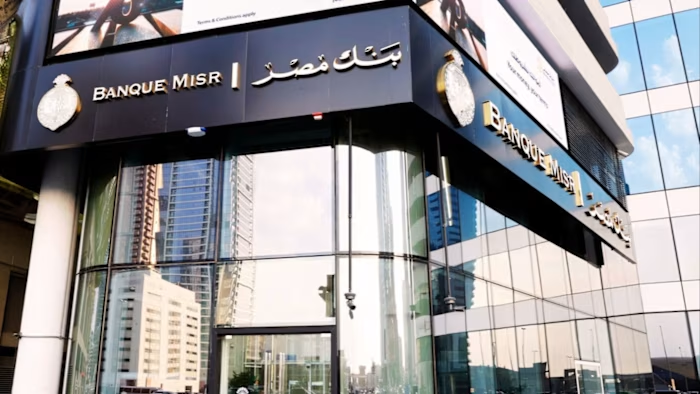
The US Treasury department is set to revoke US financial access to an Egyptian bank’s branches in the United Arab Emirates, in one of the Trump administration’s first steps towards implementing its threatened economic crackdown on Tehran.
The move, announced on Friday, would cut off the UAE branches of Banque Misr, Egypt’s second-largest bank, from banking access to US financial institutions in an effort to block them from transacting in dollars.
“Treasury promised to sever every economic lifeline Tehran has left and finally end the threat of the Iranian regime,” said Treasury secretary Scott Bessent in a statement shared with the Financial Times.
“We also warned that Iran’s enablers cannot continue to enjoy access to the US dollar and the global financial system. Banque Misr UAE decided to find out the hard way and, today, we are taking the first step in holding it accountable for its continued, egregious support of the Iranian regime.”
The Treasury’s action targeting the UAE operations of the Egyptian bank is subject to a 30-day public comment period before it takes effect. It is the first measure taken by the Trump administration since Bessent announced “Economic D-Day” against Iran and its economic and financial partners on Monday.
But the limited nature of the move shows how Washington is reluctant to hit bigger targets around the world that help finance the Iranian regime, including major banks and state-backed entities in China, amid fears that this could further destabilise the global economy and markets. The action comes as Bessent prepares to host G20 finance ministers in North Carolina next week, with the US effort to inflict more damage on Iran’s economy high on the agenda.
The US government says Iran has long relied on a shadow-banking network to evade sanctions and launder illicit oil revenues to gain access to foreign currencies.
The Treasury is also imposing sanctions on the general manager of the Dubai branch of Iran’s Bank Melli and a Hong Kong-based company that the US accuses of helping launder funds for an Iranian entity under sanctions.
The action against Banque Misr UAE is less sweeping than sanctions. But the Treasury said it would bar US financial institutions from “opening or maintaining a correspondent account for, or on behalf of, Banque Misr UAE”.
It would also “require US financial institutions to take reasonable steps not to process a transaction for a correspondent account in the United States of a foreign banking institution if such a transaction involves Banque Misr UAE”.
“Treasury estimates that between January 2024 and June 2026, Banque Misr UAE processed approximately $1.8bn for 103 companies that are potentially part of Iranian shadow-banking networks,” the department said.
The move highlights America’s ability to use the global dominance of the US dollar to exert financial pressure. But the targeting of an Egyptian bank’s Emirati offices stops well short of the “Economic D-Day” threatened by Bessent, which experts said would have to strike major Chinese financial institutions to have real impact.
Chinese purchases of Iranian oil, via an elaborate shadow fleet and money-laundering network, account for “about 45 per cent of Iran’s total government budget”, according to the US-China Economic and Security Review Commission, a body set up by Congress.
For US economic measures to have teeth, “they’d have to directly go after Chinese companies or Chinese banks”, said Michael Kuiken, the commission’s vice-chair.
But experts and former Treasury officials say the US has avoided targeting major banks in the world’s second-largest economy out of concern about Chinese retaliation. The resulting global financial shockwaves could rebound on the US, Kuiken said.
Bessent stressed on Monday that the US didn’t “want to blow up the global financial system”.
“No one should be expecting that the United States is going to take major action against one of the big four Chinese banks. I don’t think that’s likely,” said Max Meizlish, a former Treasury official and sanctions policy expert at the Foundation for Defense of Democracies, who wants to see tougher action by the Treasury.
Bessent came to the podium this week with big rhetoric, but “in the end, what we saw was more of a rollout of the traditional sanctions designations that we’ve seen for years”, Meizlish said.
The administration’s effort to squeeze Iran economically comes six months into Donald Trump’s war effort, which has failed to dislodge the regime or force it to make concessions on its nuclear programme. It has, however, disrupted the global economy. According to AAA, a gallon of regular US petrol now costs $4.10 compared with $3.21 a year ago.
The US campaign has also failed to restore the Strait of Hormuz, one of the world’s most critical energy transit points, to its prewar shipping flows, after Iran shut down most shipping through the strait under the threat of attack.
