


- In the first half 2026, the local council of one district in southeastern Zimbabwe recorded 317 cases of human-wildlife conflict, including attacks on livestock by predators.
- Edson Mabika says he used to lose four or five animals this way every year — until he took an ex-ranger’s advice and painted black and white eyes on the backsides of his livestock.
- Since then, he told Mongabay, he’s lost just one goat and a lamb.
NYANGOMBE, Zimbabwe — In the first six months of 2026, the local council in Chiredzi recorded 317 cases of human-wildlife conflict in this district of southeastern Zimbabwe. In villages like Nyangombe, which is flanked by large game reserves such as Save Valley Conservancy and Nyangombe Community Conservancy, residents say wildlife frequently eat their crops and attack livestock or even people.
“Buffaloes destroy crops and spread diseases, while wild dogs, jackals, leopards and even lions target livestock,” Edson Mabika, a farmer in Nyangombe, told Mongabay.
Mabika said he lost four sheep and a calf to wild animals in less than 10 days despite having a secure kraal and an experienced herd boy with three dogs. The loss prompted Mabika to think outside the box to protect his livestock. He asked a friend, a former game-reserve ranger, for suggestions on how to scare away wild predators without getting in harm’s way.
His friend’s advice caught him by surprise: “He just advised me to try drawing eyes on the butts of my animals,” Mabika said.
Mabika thought the former ranger was joking, but says his friend kept insisting. In January 2025, he painted black and white eyes on the backsides of about a third of his livestock. The first victims of the fake “butt eyes” were a pack of local dogs who barked aggressively after being startled by the new “eyes” on the livestock.
Mabika told Mongabay that before he put decoy eyes on his herd, he lost four or five animals every year. In the last year and a half since he took his friend’s advice, he says he’s lost just one goat and a lamb; in both cases, the animals’ decoy eyes had faded.
The trick is attracting some copycats among his neighbors and the endorsement of experienced game rangers like Langton Bandama, who is often hired to track down stray animals on conservancies including Save and the Gonarezhou Game Reserve. Bandama told Mongabay that fake eyes are common in nature, and he is confident that they can also prevent or delay predator attacks on livestock.
“It takes time for a predator to decide to kill before going for the kill,” Bandama said. “I think adding things like horns on the fake eyes will add value to the eyespots, especially against large ambush predators like lions.”
It’s possible that the idea of drawing eyespots on livestock was brought to Zimbabwe by returning migrants. Tinoda Mafunga worked as a farm laborer in neighboring Botswana before returning to Nyangombe in February. He said he’s familiar with the practice of painting decoy eyes from his time abroad.
“I am sure the idea was first adopted by villagers along the border with Botswana, where the practice is much more common, until it spread to places like Chiredzi,” he said.

In 2020, wildlife ecologist Cameron Radford set out to test whether eyespots on livestock would discourage ambush predators like lions. In a study involving about 2,000 cattle in Botswana that had recently reported high levels of predation, not a single one of the 683 cows he and his colleagues daubed with artificial eyes was killed by lions or leopards. In contrast, 15 out of 835 unmarked cows in the study area were recorded as killed by one of those two ambush predator species (as were four animals whose rumps were marked with simple crosses).
Spotted hyenas (Crocuta crocuta) muddied the data, killing one cow from each of the three categories during this period, suggesting their hunting success is unaffected by decoy eyes.
Many forecasts predict drought conditions for Southern Africa this year, in the shadow of a powerful El Niño event. Bandama said that in his experience, drought pushes herders into game reserves in search of greener pasture, while predators may raid farms and homesteads more frequently.
It might be time for Mabika and his neighbors to start stocking more tins of paint.
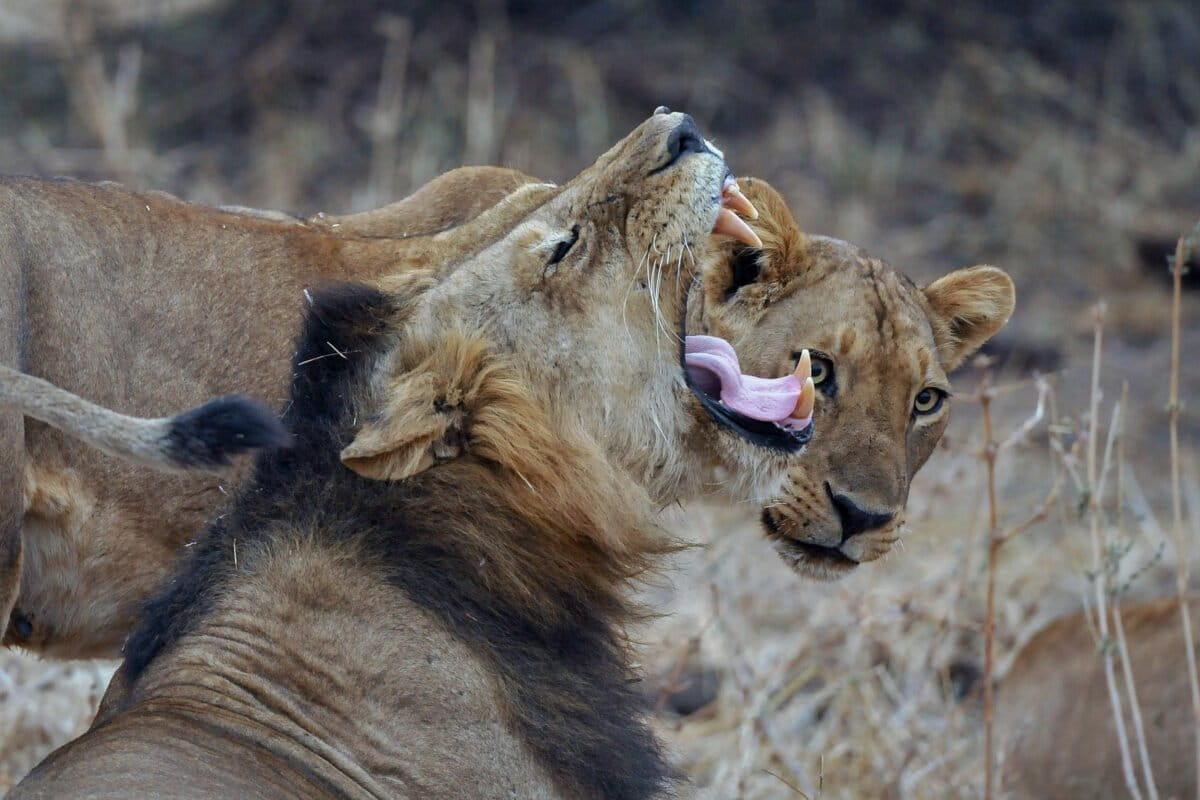
Banner image: Lions (Panthera leo). Image by Julie Larsen © Wildlife Conservation Society.
Citation:
Radford, C., McNutt, J. W., Rogers, T., Maslen, B., … Jordan, N. (2020). Artificial eyespots on cattle reduce predation by large carnivores. Communications Biology, 3(1), 430. doi:10.1038/s42003-020-01156-0
Conservationist wins top award to protect lions and people in Zimbabwe
Feedback: Use this form to send a message to the author of this post. If you want to post a public comment, you can do that at the bottom of the page.

