


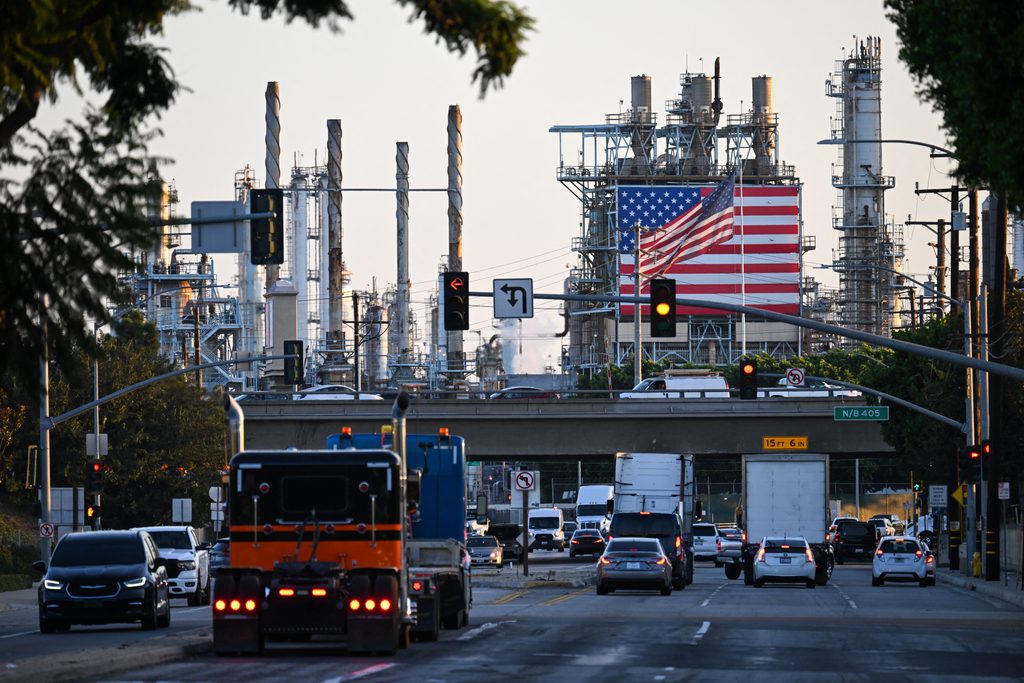
Last week, the Senate voted 73-25 to open debate on the Bipartisan American Affordability and Jobs Act, or “BAAJA,” the biggest rewrite of federal permitting rules in a generation. It would speed approvals for everything from power lines to gas pipelines and make data centers pay for the grid upgrades they need. Its sponsors are racing to pass the bill before Democrats take control of Congress in January, betting that this alignment of a bipartisan Senate deal, a Republican House and a president who backs the bill won’t come again. Last night, senators voted 70-27 to cut off debate on the revised bill, setting up a final vote as soon as this week.
BAAJA’s least-controversial section concerns power lines. Today, a single state can stall an interstate transmission line for years. Environmental reviews for transmission take more than twice as long as for gas pipelines, and the main federal process for planning lines between regions has produced zero miles of high-voltage line since it was created in 2011. BAAJA would let federal regulators approve a line if a state refuses or doesn’t act within a year, and require neighboring grid regions to plan lines together. Even the bill’s fiercest critics call this reform “excellent.”
But the more-controversial Section 1401 of the bill makes a finished permit very hard to take back. Agencies could revoke one only in narrow cases, such as fraud, a court order or an immediate threat to health or the environment. An agency that interferes in bad faith could owe the developer a quarter to half of what it has spent. That makes determining the bill’s climate impacts a question of timing and leadership.
The motivating case is obvious: In 2025, the Trump administration halted five offshore wind projects, one of them about 87 percent built. But the protection Section 1401 provides is fuel-blind. It covers pipelines, LNG terminals and mines just as fully as wind farms. And it affects any permit in effect on or after Nov. 6, so it starts protecting approvals already on the books, not just future ones.
Permit durability, in other words, is an amplifier. It strengthens whoever happens to be issuing permits.
That’s why the bill’s champions and critics can read the same clause and reach opposite conclusions. One of the bill’s authors, Sen. Martin Heinrich (D-N.M.) argues that the bill cuts permitting for a major power line from about two decades to about five years—still too slow for President Donald Trump to finish much, so the next president collects. Earthjustice President Abigail Dillen argues the reverse: Favored industries of the current administration will rush to lock in approvals that no successor can undo.
They aren’t disagreeing about the law. They’re making competing forecasts about what could get approved between now and January 2029. Trump didn’t help Heinrich’s case last week when he said he still won’t approve wind turbines, bill or no bill.
You’d expect the climate models to settle this. They can’t, because the leading one leaves the clause out. Rhodium Group projects BAAJA cuts emissions in every scenario it ran, but says permit certainty was too unsettled to model. Purdue’s Kevin Kircher finds the opposite, largely by assuming more fossil fuel production, a choice his critics dispute. Even Rhodium’s Ben King calls it partly “a bet on what’s going to win out.”
That means the climate math in this debate leaves out the one provision Democrats are split on. Nobody has modeled what locking in the next two years of permits would do.
The calendar will settle it. If mostly transmission lines and wind farms are finalized in the next two years, Heinrich’s bet pays off. If officials mostly finalize pipelines and export terminals, Dillen’s does. Senators could still amend it this week, and in the House, Minority Leader Hakeem Jeffries wants to see changes.. Sen. Sheldon Whitehouse, the bill’s other Democratic author, would rather not wait. Democrats ran on affordability and data center accountability, he says, and this bill could let them start delivering now. The next Congress’s majorities can build on it instead of starting over. And any January rewrite would still need Trump’s signature. “We’d be silly not to take this win,” he told Reuters.
Either way, BAAJA doesn’t end the permitting wars. It raises the stakes of every win, for both sides.
The Latest on Earth
This past week at COP31 in Antalya, Turkey, fossil fuel producers and big consumers resisted any deal with firm targets or a shift away from oil, gas and coal. This leaves Australia, which leads the talks, one week to land something.
COP31’s first draft deal, released yesterday, calls for faster action to phase out fossil fuels and a tripling of adaptation finance, but it offers competing language on fossil fuels that some countries have already rejected. Talks are due to wrap Friday.
Here are some stories that stood out to me outside of the COP31 proceedings:
El Niño will increase the risk of death in childbirth for millions of parents globally, according to The Guardian. Exposure to extreme heat during pregnancy is increasingly linked to premature birth, stillbirth, low birth weight and maternal complications. El Niño conditions are forecasted to peak within the coming months, which can prove to be fatal for many pregnant women who are already living in regions with high maternal and newborn death rates.
The S.S. United States, once the fastest ship on the seas, was sunk 180 feet down to the ocean floor off the coast of Destin, Florida, last week. It was not without purpose: it’s now going to be the largest artificial reef on record. Back in my home state of Florida, artificial reefs are extremely popular for their ability to attract fish to a specific location, which provides local economic benefit both from tourism and fishing. However, creating these manmade habitats has led to significant poaching in the Florida Keys.
Democrats won midterm elections on promises to cut power bills, but Politico reports that the clean-energy buildout they’re betting on, permitting reform included, could raise bills even higher before it lowers them. That leaves the party racing to get costs down in less than two years.
This story is funded by readers like you.
Our nonprofit newsroom provides award-winning climate coverage free of charge and advertising. We rely on donations from readers like you to keep going. Please donate now to support our work.
From Our Bureaus: Dan Gearino and Marianne Lavelle on BAAJA
This week, I talked with two ICN colleagues who have been tracking the permitting bill since it was introduced. Dan Gearino covers the business and policy of clean energy and writes our weekly Inside Clean Energy newsletter. Marianne Lavelle reports on energy and climate policy from Washington and has covered the fight over gas pipelines through New York.
KATE WAXMAN: Section 1401 is the most fought-over clause. Who does it actually protect?
MARIANNE LAVELLE: The Democrats wanted to get something in there because Trump was canceling all of the offshore wind … But of course, the way it’s written, it also would just make it hard to challenge a permit for a fossil fuel.
DAN GEARINO: There needs to be this acknowledgement that … whatever party’s in power is not going to be in power forever … Getting a permit is just part of the process of building something. These projects have to make enough sense for some to invest, like, a billion dollars plus in them, and that’s very much an open question.
WAXMAN: What is coverage of this bill getting wrong?
GEARINO: There’s kind of an inside-the-Beltway, almost covering it like it’s sports … like some of the coverage you see, like in the NBA about trade rumors and gossip… A lot of the coverage that we see in major outlets is trying to get a sense of if it’s going to pass and when it’s going to pass … and I think a lot of what we’re trying to do is understand it, like what does this bill do? … The nonprofit outlets that are geared toward covering energy and the environment, they are much more likely to… get deeper into some of the legal questions and some of the questions of yeah, what does this bill really do? … What happens here is going to affect us for generations, and that’s not true for … whoever won the World Series.
LAVELLE: All over the country, across the political spectrum, people are really angry about decisions being made in their communities that they feel they have no control over … There’s some cognitive dissonance for Congress to be passing something that makes it easier to get past community opposition at a time when the voters made such a strong statement … I will say it doesn’t take away the rights of communities to sue.
WAXMAN: What’s the biggest thing you’ve learned covering this bill?
LAVELLE: I’m struck by the … internal debate … on the environmental side, and that it’s been more difficult for that side to come together than it has been for a faction of the Democrats to come together with the Republicans on this.
If we don’t find a way to have some bipartisan agreement… the U.S. will never have a climate policy that’s durable because we’ll just have this swinging back and forth.
News From Us and Our Partners
Pipelines in Senate offices: Oklahoma Sen. Alan Armstrong’s chief of staff kept his job as general counsel at Williams, the pipeline company Armstrong used to run, while the senator pushed to fast-track pipelines, Lauren Dalban and Nicholas Kusnetz report for ICN.
Why it matters: The permitting bill facing a final Senate vote would limit states’ power to block gas pipelines, a change Williams stands to profit from.
Wildfire litigation: Lawsuits against utilities over wildfire damages have become a multibillion-dollar industry, with more than $18 billion paid to victims since 2017, as law firms and even Wall Street pile into the business, Gloria Dickie reports for ICN.
Why it matters: Climate change is making small sparks into catastrophic fires, but courts can only blame whoever caused the spark, so utilities and their ratepayers end up covering losses that fossil fuels helped create.
Restoring science funds: Rep. Zoe Lofgren, in line to chair the House Science Committee when Democrats take over in January, says her first priority is oversight of the Trump administration’s cuts to federal science, from EPA’s shuttered research office to grant money at the National Science Foundation that Congress approved but that isn’t going out, she told our partner Living on Earth.
Why it matters: The data behind weather forecasts and climate research has been eroding, and a gavel gives Democrats subpoena power to find out what’s been lost and to write funding laws that are harder to sidestep.
Thanks for reading this edition of Today’s Climate, a newsletter dedicated to highlighting the latest essential climate news.
Loved (or hated) this new edition? Tell me so at [email protected]
For conversations with ICN reporters about the stories behind the headlines, you can listen to Inside Climate on YouTube, Spotify, Apple Podcasts, Amazon Music and iHeart.
About This Story
Perhaps you noticed: This story, like all the news we publish, is free to read. That’s because Inside Climate News is a 501c3 nonprofit organization. We do not charge a subscription fee, lock our news behind a paywall, or clutter our website with ads. We make our news on climate and the environment freely available to you and anyone who wants it.
That’s not all. We also share our news for free with scores of other media organizations around the country. Many of them can’t afford to do environmental journalism of their own. We’ve built bureaus from coast to coast to report local stories, collaborate with local newsrooms and co-publish articles so that this vital work is shared as widely as possible.
Two of us launched ICN in 2007. Six years later we earned a Pulitzer Prize for National Reporting, and now we run the oldest and largest dedicated climate newsroom in the nation. We tell the story in all its complexity. We hold polluters accountable. We expose environmental injustice. We debunk misinformation. We scrutinize solutions and inspire action.
Donations from readers like you fund every aspect of what we do. If you don’t already, will you support our ongoing work, our reporting on the biggest crisis facing our planet, and help us reach even more readers in more places?
Please take a moment to make a tax-deductible donation. Every one of them makes a difference.
Thank you,
