


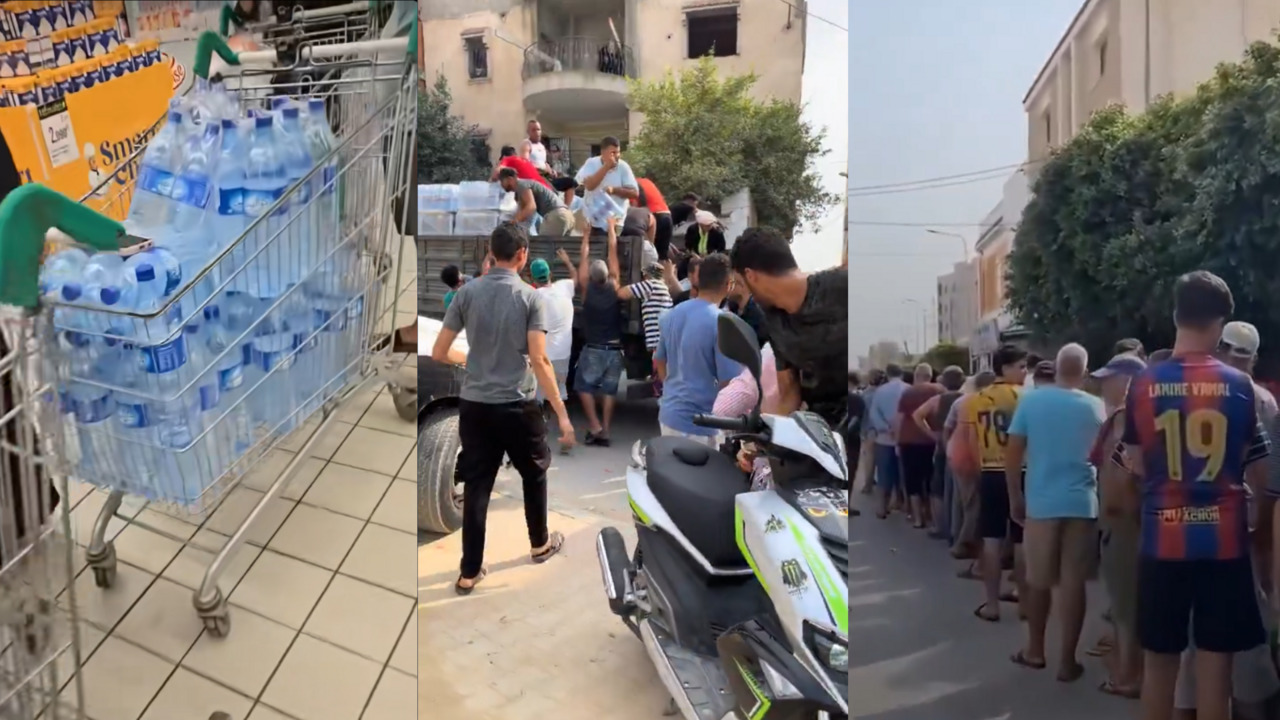
On Wednesday, September 2, Hedi Baccour, the president of the Trade Association of Supermarket Chains, told Tunisian media outlet Mosaïque FM that 2.3 million bottles of mineral water were now being “distributed daily in the big supermarkets in Tunis and its suburbs”. This was a relief for residents of the capital, after a summer when showering, drinking or even turning on the light became a daily challenge for millions of Tunisians across the country. With temperatures soaring to near 50°C, the country experienced frequent water and power cuts, some lasting more than ten hours.
In August, in order to relieve pressure on its electricity grid, the Tunisian Electricity and Gas Society (STEG) began temporary power cuts in certain areas. The increased stress on the system comes from both the need to run air conditioners as well as the heightened numbers of tourists in the summer months. Another factor is the need for water: Tunisia’s National Company for Water Exploitation and Distribution (SONEDE) uses electric pumps in their water systems.
Long lines have been forming in front of shops and at delivery points, sometimes late at night as people try to get a few bottles of water, which has been rationed. No region has been spared the shortages. In Sfax, in Tunis and in tourist-packed coastal cities alike, people are waiting in line for water, paying inflated prices and dealing with raging black markets. All of this is contributing to a growing anger at the government and what is perceived as either its inability or lack of desire to come up with solutions.
‘Everyone’s fighting for a few bottles of water’
In light of the shortages, Tunisians are having to build their schedules around water deliveries. Yassine (not their real name) lives in Jemmal, about 20 kilometres south of Monastir.
“During the day, it’s really hard to get potable water in any shop or supermarket. The large stores hide their stock and then distribute it once a day, often either right before sunset or very late at night, around 2 or 3 am. People know when the water will be delivered, so they wait for the trucks. It’s absolute chaos when the water gets delivered: people fight for a few bottles, and some people end up without any.
Some shopkeepers hide their water and then sell it at double the price. People who don’t have the means to buy a full six-pack of water, which costs more than six dinars [Editor’s note: around €1.78], drink water from wells, which is often poor quality.”
‘There are always people who take advantage of moments of crisis to sell their products for more money’
Ali (not his real name), who was vacationing in the small coastal city of Chebba when the power cuts really got bad, said that he has also seen rapidly rising prices:
“There is basically a shortage of bottled water. If you go to the beach in Chebba in the evening, you’ll see people selling water for much higher than the state-mandated price [Editor’s note: 0.8 dinars for a litre of water, equivalent to €0.24]. In Sfax, you won’t find water in every shop and, if you do find it, then the number of bottles is limited per person. One 1.5 litre of water is supposed to be sold for around a dinar [Editor’s note: €0.30], but on the beach, it’s sold for 2 to 2.5 dinars. This water often comes from the black market. There are always people who take advantage of moments of crisis to stock products that are in demand and sell them for more money.”
Days marked by power cuts
Tunisians have also been struggling with frequent power cuts. Ali says that both people in Sfax, where he comes from, and Chebba, where he is vacationing, are constantly waiting for the next power cut:
“We don’t have any electricity at my parents’ house in Sfax right now. The last week in August was the worst, with the heatwave, with record temperatures and a lot of humidity. In Chebba, there are frequent power cuts— three or four a day— and each lasts an hour or two. The cuts often happen in the middle of the afternoon or the evening, when people are sleeping and need air conditioning. We try to turn on the air conditioning when we do have power, just to get a little bit of cool. People are essentially trapped at home. I heard about people who had such long power outages during the day that they couldn’t cool down their rooms and so they’d go out to their cars, just to have a bit of air conditioning. It isn’t great for the environment, but everyone is just trying to figure out how to get by.
Some people are really suffering: we’ve heard about people who died in prison. People who don’t have the means to air condition their homes or those who live in homes that aren’t insulated against the heat risk experiencing heat stroke or even dying. There are a few local radio stations that try to let people know how long it will be until the power is back on, but otherwise we are completely in the dark about the timing.”
‘The situation is desperate, especially for farmers’
The power cuts are also having an impact on the economy. It seems to have been a catastrophe for poultry farmers, especially in the Sfax region, where 60% of the country’s poultry production is based. Wadie Abdelmalek runs a farm with 30,000 chickens:
“Everything in the building runs on electricity: the water motors, food distribution and the ‘pad cooling’ that keeps the building cool. The power cuts are intense and happen both day and night— there are no fixed times. Thankfully, I have generators in the building— if not, I would have lost everything. The generators function on diesel: it costs me 250 dinars a day [Editor’s note: €74.15] for it to run reasonably. I have still lost around 500 chickens, which means nearly 5,000 dinars [Editor’s note: around €1,475].
Thank God, that’s not much compared to what other farmers have lost. A poultry farmer near me lost 12,000 chickens in an early stage of production. At around 18 dinars [Editor’s note: €5.3] per chicken, that is equivalent to a loss of between 220,000 and 230,000 dinars [Editor’s note: nearly €65,000]. And there are quite a few other people like him. The government is completely MIA, we haven’t seen or heard anything from them faced with these large-scale losses.
The tap water isn’t stable either. Last year, we had water cuts for about a month and a half, but we didn’t have a heatwave like that. This year, we’ve had cuts for more than three months— and I’m not exaggerating. I invested in a drill to make sure that I can get water.”
Rising anger as people blame the government
As anger against the government grows, a number of protests have taken place: one on the Day of the Republic, on July 25. Protests also took place on August 20.
In an official statement published on August 27, Tunisian President Kaïs Saïed spoke about “deliberate and planned acts of sabotage” by “enemies of this country and their allies”.
However, unions and state-owned companies have been speaking out against his words. They point to a perhaps more mundane cause: ageing infrastructure and investment that has been delayed for years, as well as a rising demand that sharply increases each summer.
Yassine says the responsibility lies with the current government:
“It’s a problem that is getting worse and worse: Tunisia has had a failing system for more than 15 years, and each president fails to solve these problems.”
‘People already took to the streets in 2011 and if that continues, then they might do it again’
Ali fears that what happened in 2011 might happen again:
“There is widespread anger. Families saw their businesses destroyed by this crisis. The price of poultry meat and eggs rose during this period. Small businesses affected by the cuts are not reimbursed by their insurance companies. People already took to the streets in 2011 and if it goes on like this, they’ll do it again. I’m really worried— I don’t have the feeling that we are better prepared to avoid what we experienced this year, especially if it partially has to do with climate change.”
This article has been translated from the original in French by Brenna Daldorph.
