


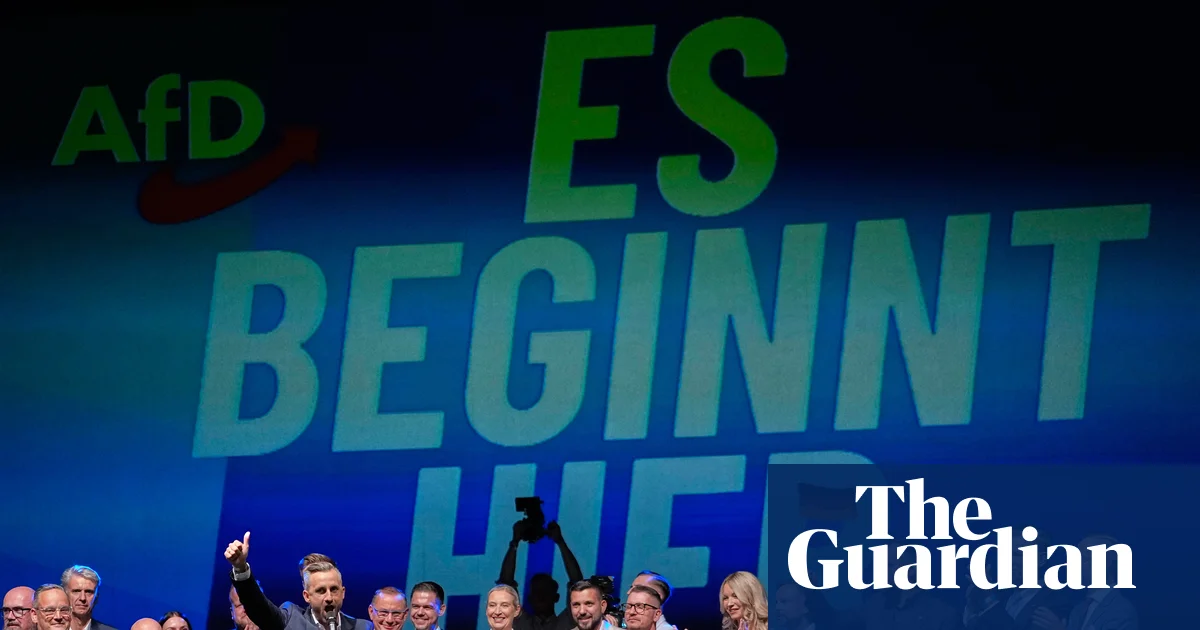
The numbers speak for themselves: Alternative für Deutschland (AfD), a party that dabbles in Nazi imagery, distinguishes between “biological” and “passport” Germans, and is too extreme even for France’s far-right leader Marine Le Pen, nearly doubled its score in Sunday’s state election in Saxony-Anhalt to 43.8% of the vote.
Meanwhile, the centre-right CDU of the chancellor, Friedrich Merz, collapsed to 17.2%, less than half its total in the same race five years ago, and the centre-left SPD – Germany’s other main party of government for the past 60-odd years – scraped 9.3%. The least that can be said is that the centre did not hold.
It is not yet clear whether the AfD, whose local branch in the east German state of Saxony-Anhalt is officially classified by the country’s domestic intelligence service as “confirmed rightwing extremist”, will be able to form a government: it has 39 lawmakers in the 83-member parliament, just short of an outright majority.
But the score is the party’s strongest-ever state result and puts it closer to governing a German state than any far-right party since the second world war. It has sent shock waves round Europe, with nationalists cheering a “historic win” that is “just the beginning” and mainstream leaders warning of a “grave moment” for Europe.
Sweden holds legislative elections next weekend. France faces a crunch presidential ballot next spring. Key parliamentary races will follow there, as well as in Italy, Spain and Poland, later in the year. Far-right parties are polling strongly in all of them, and Europe’s centre fears a continent-wide nationalist wave.
It would be wise not to read too much into one election result in one quite particular German state. Saxony-Anhalt, analysts note, is home to barely 1.8 million voters and has long been a far-right stronghold: in federal and state elections over the past decade, support for the AfD there has consistently been double the national average.
“A far-right party winning a regional election in Germany is not more scary than a far-right party winning a regional election in France, the UK or the Netherlands,” said Tarik Abou-Chadi, a professor of European politics at Oxford University. “Saxony-Anhalt should not be the basis for sweeping conclusions about the electoral sociology of the AfD.”
Nonetheless, the AfD leads in national polls. It is also ahead – although in a far tighter race, with the SPD – in Mecklenburg-Western Pomerania, where state elections are due later this month, and it is lying second even in liberal Berlin. Its rise is part of a decade-long march by far-right parties across Europe.
Almost one in four voters in Europe now cast their ballot for far-right parties, according to research led by Matthijs Rooduijn, a political scientist at the University of Amsterdam, a proportion that has grown nearly fivefold since the mid-1990s and climbed particularly steeply over the past three years.
This analysis, by more than 150 political scientists in 31 countries, found that the proportion of Europeans voting for a far-right party in their country’s most recent national elections had risen in 2026 to more than 23%, from about 10% a decade ago and roughly 5% in 1995.
Far-right populist parties are now in government as part of ruling coalitions in Croatia, Czechia, Italy and Finland, propping up a rightwing minority government in Sweden, and leading in the polls in Austria, Belgium, France and Germany (and, until very recently, the UK).
They have also suffered recent defeats, including in the Netherlands, where Geert Wilders’s Freedom party (PVV) lost nearly a third of its seats to finish second last year, and Hungary, where Viktor Orbán’s Fidesz was comprehensively beaten by his centre-right rival in April.
after newsletter promotion
But the trend seems clear. As Cas Mudde of the University of Georgia, a leading expert on Europe’s far right, put it after Orbán’s defeat: “The far right is here to stay, and many of its parties are as established as the (former) ‘mainstream’ parties. Like other parties, their electoral support fluctuates.”
That steady electoral advance has been achieved despite a refusal by mainstream parties in countries such as France and Germany to collaborate with far-right parties, prompting some commentators to argue that the “cordon sanitaire” or “firewall” has now failed, or even been counterproductive.
By keeping the AfD out, they argue, Germany’s mainstream parties have actually boosted it: the party has been protected from the compromises and failures inherent in government. At the same time, the centre has been “hollowed-out”: forced into uncomfortable, unstable alliances that agree on and – vitally – accomplish little, further frustrating voters and driving support for the extremes.
“There’s a self-reinforcing political dynamic that feeds the AfD’s rise,” said Mujtaba Rahman, of the Eurasia Group risk consultancy. “The weaker the election results, the less common ground in the coalition, the fewer the policy results. The fewer results, the bigger the frustration in the electorate, the bigger the AfD’s share of the vote.”
Many political scientists, however, say blaming the firewall is an excuse, and data suggests far-right parties do not in any case get weaker when they are in government, but become stronger: one recent study of more than 1,300 different governments in 57 countries found far-right parties that entered government averaged a score six percentage points higher come the next election.
Besides the persistent inability of mainstream governments to deliver for disillusioned voters hit by a spiralling cost of living crisis, it is above all the gradual mainstreaming and normalisation of the far right’s ideas that has driven – and continues to drive – its steady advance, political scientists argue.
Research suggests voter attitudes towards core far-right themes such as immigration have not changed significantly over time, but have become much more significant in their voting decisions: normalisation by the media and by mainstream parties that readily embrace far-right framing have legitimised far-right views.
“The entire debate about whether the cordon sanitaire is ‘successful’ or contributes to strengthening the far right completely misses the point,” said Gabriela Greilinger, an Austrian-Hungarian political scientist. “Far-right politics and policies already constantly take centre stage, whether or not the far right is in power. There is no cordon around their ideas.”
