


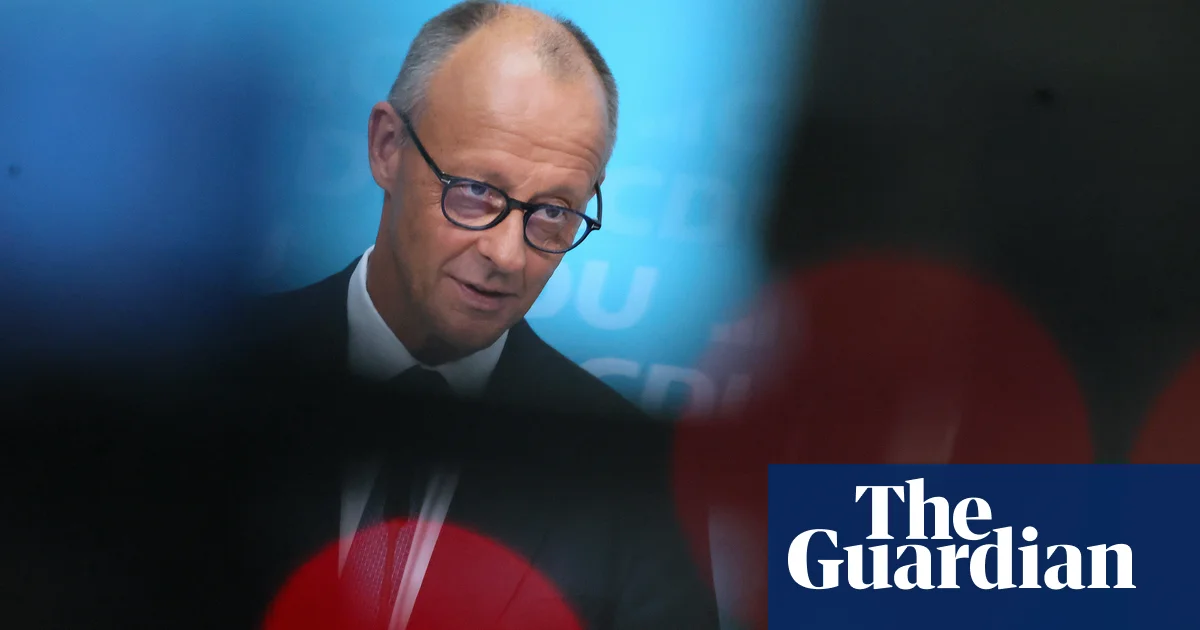
A “shocked” and chastened Friedrich Merz has vowed to stay in office despite the far right’s triumph in a state election that has brought anti-immigrant, pro-Kremlin politicians within striking distance of power.
The German chancellor, appearing ashen-faced in front of reporters in Berlin, said on Monday that the landslide victory by the Alternative für Deutschland (AfD) in Saxony-Anhalt had shaken his conservative Christian Democratic Union (CDU) “to its very foundations”.
The unpopular Merz, who had pledged to halve the AfD’s support at the national level, has watched the nativist party rack up electoral gains, none as convincing as its utter rout of the CDU in the eastern region on Sunday with nearly 44% of the vote.
The AfD and its candidate Ulrich Siegmund fell short of an absolute majority but could yet create Germany’s first far-right state government since the Nazi period.
Merz appeared contrite and willing to work on his “communication” with voters. “This is the worst electoral defeat the [CDU] has suffered in years, in decades,” he said. “Of course this will have to have consequences.”
Exit polls indicated the state’s voters were driven by deep dissatisfaction with the political establishment and its stewardship of Europe’s biggest economy, with one showing that only 9% approved of Merz’s performance.
Siegmund, a media-savvy former fragrance salesman, was also able to tap into a sense of grievance in the former communist east, where complaints abound that voters there are treated as “second-class citizens” more than three decades after the fall of the Berlin Wall.
Siegmund, 35, mocked the 70-year-old Merz as “a very good campaigner” for the AfD.
Only 16 months in office, Merz conceded his own low poll ratings had played a role in his party’s loss. “I know that I personally was a constant topic in this election campaign,” he said. “We must try – myself included – to reach people more effectively, in the full range of their emotions.”
The CDU’s junior coalition partner, the Social Democrats, indicated a willingness to water down contentious measures to shore up the statutory healthcare and pension schemes.
However, Merz insisted: “My determination to continue on the path of reform is unbroken,” saying a sustainable system was essential for the sake of “our children and grandchildren”. He added: “Giving up is not an option for me.”
Merz said he wanted to assure Germany’s allies that “our institutions are resilient and stable” and its own vulnerable minorities that the country would stick to its values and constitution even if the AfD took power in Saxony-Anhalt. “We know that Germany carries special responsibility because of its history,” he said.
He also promised to stay the course on Ukraine, stressing he would “not budge a single millimetre from my fundamental conviction that we must defend our freedom against Russia as well”.
Merz said Moscow would cheer the AfD’s success in Saxony-Anhalt and accused it of lending support to the far right’s campaign, with another two German state elections still to come this month amid alleged Russian interference and sabotage.
Although the CDU rallied behind its chancellor and party leader, several influential commenters openly called for his immediate replacement – a complex step under German law.
after newsletter promotion
Germany “needs a clean slate, a fresh start, and that starts with Friedrich Merz”, said the Der Spiegel editor-in-chief, Dirk Kurbjuweit. “He is evidently the wrong man for this office in these times.”
The AfD’s Saxony-Anhalt chapter is listed as “confirmed rightwing extremist” by the domestic intelligence service. It has pledged mass deportations of unwelcome immigrants and asylum seekers, which critics have said would be illegal, while promising massive boosts in social welfare spending with unclear financing.
The AfD has also taken aim at state support for public broadcasters and cultural institutions it deems “unpatriotic”, sparking fears of “cultural hegemony”.
The party did not win enough seats to elect Siegmund as state premier, but AfD leaders said they seek to pick off rebel lawmakers from other parties willing to play kingmaker. It is only three seats short of a majority.
The conservative-left populist BSW party, which also favours restoring ties with Russia and largely blocking immigration, signalled an openness to working with the AfD but before the election ruled out joining the state government.
In the 13 years of the AfD’s existence, the mainstream parties have maintained a “firewall” against the far right, refusing any formal cooperation that would allow it take power. The strategy meant to sideline the party has appeared to backfire, however, as the permanent “outsider” role appeals to legions of voters fed up with politics as usual.
The CDU state premier, Sven Schulze, acknowledged his party had “no mandate” to govern given its humiliating 17% result, even if it managed to cobble together an unwieldy coalition with all the other parties in the legislature.
Although Saxony-Anhalt forms part of the AfD heartland as a relatively poor, ex-communist region, the party has begun making inroads in the west as well amid alarming signs of decline in the steel, chemicals and automotive sectors.
Germany faces another two regional elections on 20 September, in Berlin and in another eastern state, Mecklenburg-Western Pomerania, where the AfD is also strong.
The party co-leader Alice Weidel, beaming after Sunday’s vote, said the AfD was now targeting 40% at the next general election, due in 2029. It is polling at about 28%.
