


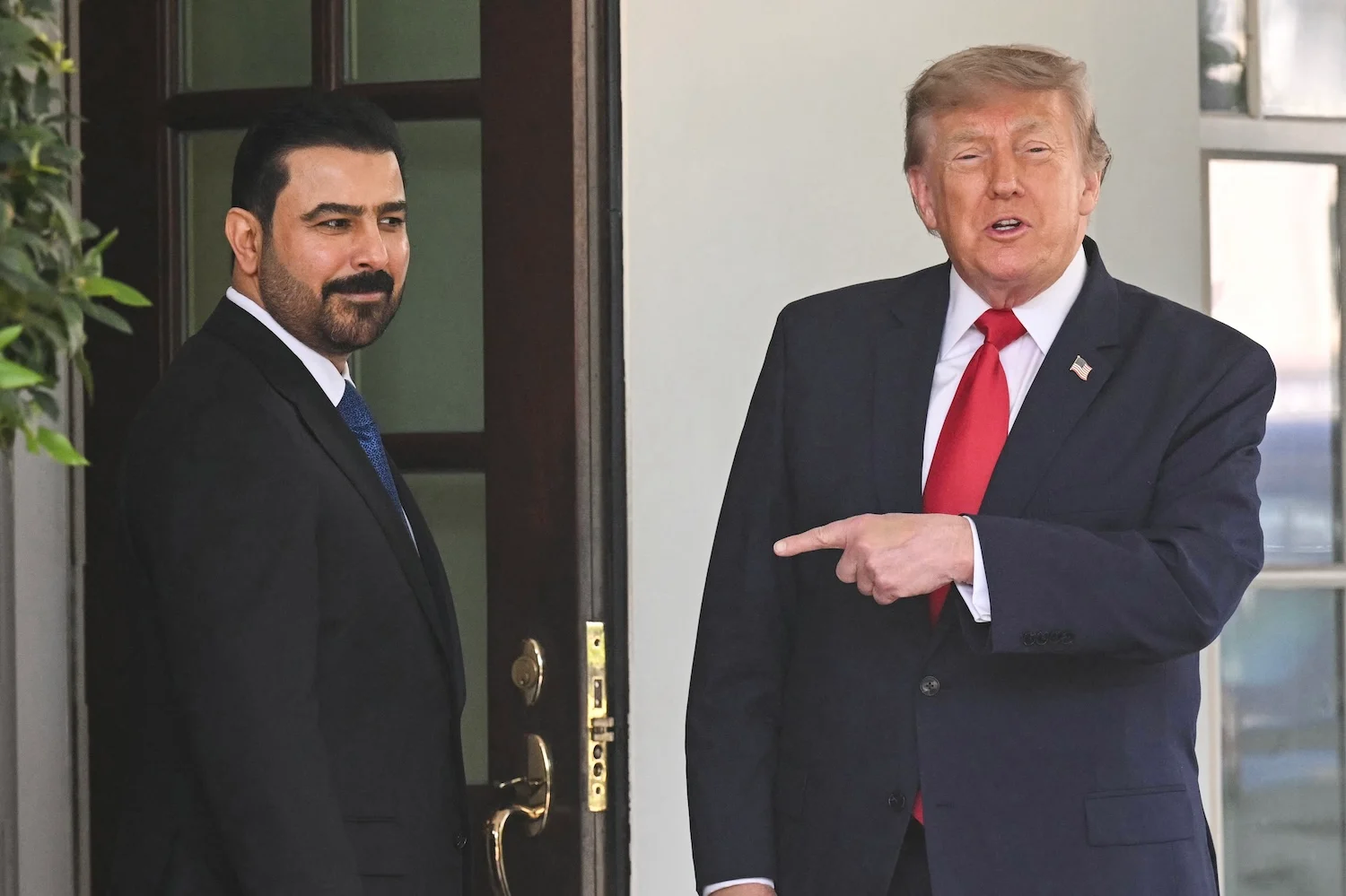
Standing beside Iraq’s new prime minister at the Oval Office in mid-July, U.S. President Donald Trump was effusive. Ali al-Zaidi had “tremendous chemistry” with him, Trump declared, going on to imply he was “good for America.” Then—twice in the space of a few minutes—Trump said Zaidi was going to be there “for a long time.” Iraq, Trump added, had “tremendous wealth, not only potential.” The president also joked that his guest was “young, and he’s handsome, which I don’t like.”
The warmth is not incidental. It reflects an emerging U.S. approach to the Levant, cultivated above all by Trump’s envoy and longtime friend Tom Barrack: Identify leaders who can centralize state power, back them personally, and then count on them to serve U.S. interests by pushing back against Iranian influence and opening their economies to American business.
Where recent U.S. governments often spoke of power sharing and negotiated political settlements when discussing Middle East governance, the Trump administration is openly wagering on strongmen. Zaidi is not an isolated case. Earlier in the summer, Trump met with Syrian President Ahmed al-Sharaa on the sidelines of the NATO summit. Saying that Syria had been “a very disjointed place,” he praised Sharaa for having “unified the country in a very short period of time.” Sharaa, Trump said, was “a strong person” and “a great leader.”
Finally, this week, Trump hosted Lebanese President Joseph Aoun, the first Lebanese head of state invited to the White House in more than 15 years. He clearly seemed eager to fold Aoun into the same project, saying, “you have tremendous spirit on your side.” Then, when asked how the Lebanese leader compared to Zaidi, Trump offered that he too was “handsome.”
But as Trump doubles down on Middle Eastern strongmen, the question has already emerged: Will these bets pay off? The region’s recent and long-term history suggests that the answer is no.
For Trump, the appeal of these leaders lies in their promise of durability and control. A single interlocutor who commands the state, its security forces, and its economy is worth more to Washington than a shaky coalition, because such a leader can personally advance U.S. interests. For Trump, this means rolling back Iran’s allies and aligning with the United States’, Israel included.
It also means signing oil and reconstruction deals with American firms and maintaining stability without U.S. troops or attention. In this form of personalized diplomacy, where relationships substitute for institutions, the measure of a partner is not how he governs but what he can deliver.
Syria has become the template. Sharaa’s image has changed dramatically since the days when he had a $10 million bounty on his head. Trump announced in Riyadh in May 2025 that he would end Assad-era sanctions on Syria, and Washington later removed the terrorist designations on Sharaa himself ahead of his historic visit to the White House. Sharaa knows his audience: His early pitch to Washington reportedly included a proposal for a Trump Tower in Damascus, detente with Israel, and cooperation to enable U.S. access to Syria’s oil and gas.
Barrack, who works closely with Damascus, has pushed for a centralized state: “We all need to reconcile and come to this conclusion: one nation, one people, one army, one Syria,” he declared in July 2025, arguing that “federalism does not work” in the region. This marks a break from early thinking following the overthrow of Bashar al-Assad, which held that Syria’s stability required guaranteeing its communities, whether Kurds, Druze, or Alawites, a share of power and a measure of autonomy.
“We don’t owe them the ability to have their own independent government within a government,” Barrack said of the Kurdish-led Syrian Democratic Forces, Washington’s partner against the Islamic State. Their political role had “largely expired,” he announced in January, now that Damascus was “willing and positioned to take over security responsibilities.”
For Sharaa, of course, centralizing the state and rejoining the world economy served his own project of consolidation as much as Washington’s designs.
In Lebanon, Israel’s campaign against Hezbollah shattered the group’s military capabilities and undermined its long-held veto over Lebanese politics. Into the vacuum stepped a new government of independent technocrats who are more critical of Hezbollah’s state-within-a-state.
One figure in particular caught the Trump administration’s eye: Joseph Aoun. Aoun was elected president in January 2025 after commanding the Lebanese Armed Forces, the internationally backed national army long imagined as the alternative to Hezbollah’s arsenal. On taking office, Aoun made it clear that disarming Hezbollah would be an aim of his government, a statement that was also connected to rolling back Iran’s foothold in Lebanon.
Barrack had tried to cultivate Aoun through repeated visits to Beirut. In August 2025, Aoun’s government committed to disarming all groups possessing heavy weapons, notably including Hezbollah, tasking the army with establishing a monopoly on weapons by the end of the year. The U.S.-backed road map also drew Aoun toward negotiations with Israel that would have been unthinkable a few years ago, even as Israel has pulverized much of the country’s south, at times displacing more than a million people. As with Syria, there is an economic carrot: the promise of U.S.-backed postwar reconstruction for Aoun’s struggling country.
In Iraq, the search for Washington’s man began with a veto. After the November 2025 elections, the ruling Shiite Coordination Framework spent months deadlocked before nominating former Prime Minister Nouri al-Maliki in late January. Trump, considering him to be far too close to Tehran, publicly vetoed the candidacy. Because Iraq’s oil revenues sit in an account at the U.S. Federal Reserve, flown to Baghdad as cash shipments, Washington controls Iraq’s access to its own money. When the Treasury froze that lifeline, the resulting pressure was significant.
Iraq’s political class got the message and nominated Zaidi. Then a 40-year-old banker with no political base and no experience of government, Zaidi’s weakness was his appeal. Baghdad’s ruling elites saw a compromise candidate who would implement their policy rather than act independently, while Washington found its man in Baghdad. Barrack praised Zaidi’s “fresh leadership” and “bold new agenda,” and Trump placed early calls to bolster him.
Trump would later claim that Zaidi “won the election very soundly.” He did not. In fact, he was never even a candidate. But Zaidi played the role assigned to him, making Washington his first foreign trip. He also committed to disarm and integrate the Popular Mobilization Forces, including Iran-aligned groups such as Kataib Hezbollah and Harakat al-Nujaba, while launching an anti-corruption drive sold to Americans as part of the same project.
And here too, Barrack has turned against Washington’s commitment to pluralism. Where U.S. policy once treated Kurdish autonomy as a pillar of the new Iraq, Trump’s men are betting on a centralizing Baghdad instead. Now, according to Barrack, the Baghdad-Erbil federal model represents not moderation but “Balkanization.”
Trump and his supporters have presented this approach to the Middle East as a matter of smart, cynical realism. But there is every reason to think that it will prove naïve. The reality is that Trump’s strongman doctrine has been tried before in these very countries—and failed. The region’s history is filled with strongmen who delivered fragility: Saddam Hussein centralized Iraq so completely that his rule produced ruinous wars. The Assads held Syria together for five decades through a coercive apparatus that hollowed out its institutions and ultimately drove Syrians to revolt.
Today, these states remain unlikely to centralize in the way Washington imagines.
After the experience of Saddam, Iraq’s political system was deliberately fragmented so that no single actor can dominate. Zaidi’s disarmament push will likely reproduce the failure of past efforts to integrate armed groups: granting them state salaries and patronage while their loyalties stayed with their own commanders and not the central government.
While pro-government groups, such as the Sadrists or Asaib Ahl al-Haq, have announced committees to inventory their weapons and coordinate with the government, the more Iran-aligned groups, Kataib Hezbollah and Harakat al-Nujaba, have refused. These groups are not only willing to attack U.S. interests in Iraq and the region, but they have also signaled that they will turn on the Iraqi state itself if it pushes too far. The killing of a government intelligence officer in March, attributed by some government officials to resistance groups, highlights the ongoing danger.
And where the “axis of resistance” had grown more decentralized in recent years, the war with Iran has reversed the drift: The Islamic Revolutionary Guard Corps (IRGC) has taken a more active and commanding role in Iraq, directing the resistance factions and using the country as a launching pad in Tehran’s regional strategy.
Many in the Iraqi government want to rein in the militias: Armed groups outside the formal chain of command undermine Baghdad’s sovereignty and risk dragging the country into wars it wants no part of. But wanting sovereignty and being able to enforce it are different things. For Baghdad, they are irreconcilable, particularly on Washington’s timeline.
Syria is different because Sharaa has gone furthest in actually consolidating power. But he is a new ruler trying to centralize a country that has always resisted central rule. In July 2025, clashes in the Druze-majority province of Suwayda killed hundreds, and when Sharaa sent in his forces, local leaders accused them of widespread abuses while Israel, casting itself as the Druze’s protector, bombed Syrian government troops. Since then, Israel has been paying the salaries of some 3,000 Druze militia fighters and supplying them with weapons, helping to unify the very factions that Sharaa is meant to absorb.
More fundamentally, Sharaa is unlikely to simply align with Trump’s vision. In fact, he has already begun saying no to Washington. Trump previously floated the idea of Syria taking on Hezbollah in Lebanon, but Sharaa objected, clarifying that Damascus is not preparing any military intervention. On Israel, Sharaa has rebuffed Barrack, telling the envoy that compromising on the Golan would mean the end of his rule. As one Syrian official put it, “the basic elements of trust are simply not there.” Sharaa is using U.S. backing to consolidate his rule, not subordinating it to U.S. designs.
Finally, Lebanon is in a different and more challenging category. The country was built to prevent central political dominance. Instead, its confessional system dispersed power so thoroughly that when the balance collapsed, the result was 15 years of civil war.
Today, the country remains decentralized and the threat of civil war real. When it comes to Hezbollah specifically, neither the group nor its Iranian backers are giving up easily. Despite its massive setbacks, Hezbollah has refused disarmament. Instead, Iran’s IRGC officers have arrived in Lebanon to oversee the rebuilding of Hezbollah’s military infrastructure, filling the gaps left by the group’s decapitated leadership.
Meanwhile, the conditions on the ground undercut Aoun. Israel has continued near-daily attacks despite the November 2024 cease-fire and still occupies multiple positions in the south, while Lebanon’s Shiites, the community that bore the brunt of a war that killed more than 4,000 people and displaced 1.2 million, see a national government that struggles to protect or represent them. The army has itself acknowledged its limited capabilities to carry out disarmament. Moving aggressively against Hezbollah while Israel bombs and occupies the country would not extend the state’s authority; it would fracture it. What’s more, negotiating with an occupying power only strengthens Hezbollah’s rhetoric of resistance.
The strains are already showing: When Barrack warned that if Lebanon failed to move on disarmament it would cease to exist as a state, Aoun publicly dismissed the remarks, insisting that the process would proceed at the army’s pace, not Washington’s.
Trump’s approach is fundamentally transactional, prioritizing quick, visible wins over long-term settlements. Yet the region’s entrenched political dynamics are not necessarily susceptible to quick wins. These states cannot be transformed on Washington’s timetable, and Trump’s men in the region will not bear the costs of trying. As a result, Trump’s gamble is more likely to reignite conflict and weaken U.S. interests than to produce lasting political change.
