


Welcome back to Foreign Policy’s Latin America Brief.
The highlights this week: Nicaragua’s president announces a plan to cancel elections, the United States imposes new tariffs on Brazil, and the International Energy Agency gives an update on Latin America’s critical mineral prospects.
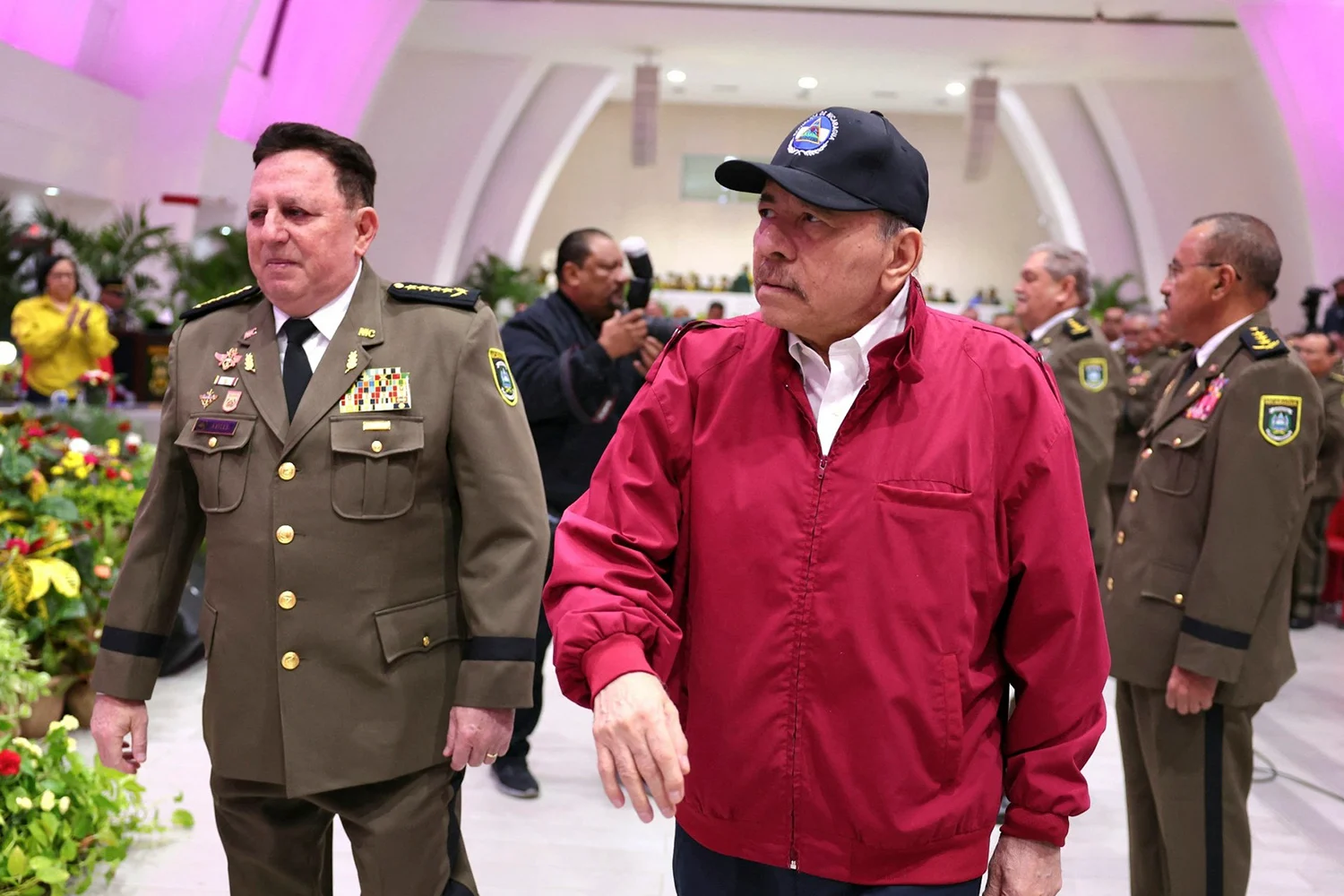
On Sunday, Nicaraguan President Daniel Ortega—who has been in power since 2007 and named his wife Rosario Murillo “co-president” last year—announced that there would be no more elections in the country. Democracy experts have long classified Ortega’s government as an autocracy, but even its peers in Cuba and North Korea continue to stage elections.
The declaration marks the culmination of years of democratic backsliding, during which Ortega’s administration has dismantled opposition parties, jailed political rivals, and shuttered independent media while facing little consequential resistance from either domestic institutions or the international community.
Although it has fluctuated over time, cross-border pro-democracy advocacy has been a feature of Latin American and broader Western Hemisphere politics since at least the post-World War II period. Yet the failure to form an effective regional coalition against Nicaragua’s backsliding shows how much the cause has weakened today.
International organizations and a handful of Latin American democracies issued statements condemning Ortega’s declaration. But among Nicaragua’s key trading partners—the United States, Mexico, China, and Guatemala—only the United States and Guatemala immediately spoke out. (China does not promote democracy abroad, and Mexico’s leftist government includes longtime ideological allies of Ortega’s Sandinista movement.)
On the economic front, no country has more leverage over Nicaragua than the United States. In keeping with a bipartisan tradition, U.S. Secretary of State Marco Rubio released a statement on Tuesday calling on the international community to show that the Ortega government “cannot expect to maintain business as usual with other nations when it is thwarting the basic tenets of our democratic hemisphere.”
Washington has imposed successive rounds of sanctions against Nicaragua since 2018, during President Donald Trump’s first term. But it has stopped short of the comprehensive economic embargo that it maintains against Cuba, another left-wing autocracy. It has likewise refrained from threatening military action against Ortega, even though it has made such threats with other left-wing governments in the region.
One explanation may be migration. The Ortega regime has quietly cooperated with Washington by accepting third-country deportees and restricting a northward Cuban migration route to the United States. Moreover, unlike Venezuela, Nicaragua offers few potential natural resource spoils, nor does Rubio, a Cuban American, have the same personal connections to Nicaragua’s pro-democracy movement as he does with Cuba’s.
Although the United States could still resort to economic or military escalation, it is far from clear that those forms of pressure would produce democratization. Historians Antonio Monte and Gema Kloppe-Santamaría argued in Americas Quarterly last year that Washington should instead consider restoring funding for Nicaraguan civil society groups and that efforts to restrict humanitarian migration from the country have only weakened the opposition further.
Ultimately, external actors have shown there are limits to the steps they are willing to take. “The United States is not going to solve our problem. They can contribute if we act,” Nicaraguan historian and human rights activist Dora María Téllez told Confidencial this week. “The only alternative [Nicaragua’s] opposition has is … to organize ourselves better and better, and to awaken a message of hope.”
Sunday, July 26, to Saturday, Aug. 1: South Korean President Lee Jae-myung visits Brazil, Chile, and Argentina.
Tuesday, July 28: Keiko Fujimori is sworn in as president of Peru.
Friday, Aug. 7: Abelardo de la Espriella is sworn in as president of Colombia.
New Brazil tariffs. On Wednesday, the Trump administration hit Brazil with a new round of 25 percent tariffs. There are several exempted goods, including beef, coffee, and certain aircraft parts, but the final package will affect an estimated 18 percent to 26 percent of Brazilian exports to the United States. Unlike previous tariffs, which were overturned by the U.S. Supreme Court in February, this round is the product of a lengthy investigation over allegations of unfair trade practices.
Although the investigation’s legal proceedings centered on technical issues, the dispute remained deeply political. Rubio accused Brazilian President Luiz Inácio Lula da Silva on social media of not negotiating in good faith, a charge that Brazil’s government rejects. Brazilian public opinion, however, appears to favor Lula’s account over that of the right-wing opposition, which blamed him for the duties. Lula’s approval rating has ticked upward in recent weeks.
On Thursday, Washington announced an additional 12.5 percent tariff on Brazil as part of a forced labor probe into dozens of countries, which Brasília sharply criticized as unjustified.
U.S.-China rivalry. A new Pew Research Center survey conducted in six Latin American countries between February and May found that in five of them—Argentina, Brazil, Chile, Mexico, and Peru—more respondents viewed China as a reliable partner than they did the United States. Colombia was the lone exception. While views of China have held steady in those countries since last year, the survey found that views of the United States have deteriorated.
The findings challenge the notion that Trump is strengthening U.S. influence in Latin America. Although a series of Trump-friendly presidents have won elections across the region—many of which Trump personally weighed in on—his administration has said that it has also made countering “non-Hemispheric competitors” a priority. The survey suggests that, despite those electoral results, distrust of the United States could complicate relations in the long term.
Gustavo Dudamel, seen hugging a member of BTS, conducts the combined orchestras of the New York Philharmonic, the Simón Bolívar Symphony Orchestra, and the Muppets during the Men’s World Cup final halftime show in East Rutherford, New Jersey, United States, on July 19. Jeenah Moon/Reuters
World Cup spotlights Venezuelan orchestra. Colombia-born pop star Shakira headlined Sunday’s FIFA Men’s World Cup final halftime show, but she was not the only Latin American musician onstage. Joining her was Venezuela’s Simón Bolívar Symphony Orchestra, which draws on talent from El Sistema, the country’s national music education system famous for bringing classical training to children from underprivileged areas.
The performance was led by Gustavo Dudamel, a star conductor who got his start with the orchestra and who will lead the New York Philharmonic beginning in September. Known for bringing classical music beyond the concert hall—including at the 2016 Super Bowl halftime show—he has also championed Latin American composers, such as Mexico’s Gabriela Ortiz, whose work blends orchestral sounds with folk and Indigenous rhythms.
El Sistema was thrust into Venezuela’s political spotlight during anti-government protests in the 2010s, when one of its trainees was killed at a demonstration. The incident prompted Dudamel to write an open letter condemning government repression. What year were those protests?
2016
2017
2018
2019
Viola player Armando Cañizales was killed that year, inspiring other musicians to bring their instruments to subsequent demonstrations. He had recently been accepted to medical school.

Copper smelting is seen at El Teniente mine, the world’s largest underground copper mine, in Machali, near Rancagua, Chile, on April 2, 2025.Raul Bravo / AFP via Getty Images
The International Energy Agency’s (IEA) 2026 critical minerals report finds that Latin America could play a much larger role in global critical mineral supply chains—but only if governments move quickly to develop the sector.
The strategic importance of these minerals became clear last year, when China implemented export controls on rare earths—a subset of critical minerals—to pressure Washington to back down on its trade war. Although some of those restrictions are currently suspended, the pause is set to expire in mid-November.
The IEA warned that such measures would snarl supply chains for $6.5 trillion worth of goods outside China each year, adding urgency to global diversification efforts. According to the IEA, Latin America “is well positioned to play a larger role” in those efforts given its rich reserves.
The agency estimates that if the region refined its own lithium, nickel, cobalt, graphite, and rare earths as well as two-thirds of its copper production, it could capture an extra $35 billion in economic value by 2035.
Whether Latin America can seize that opportunity is an open question, because it requires policymaking agility that governments have failed to display. Brazil, for example, has spent years debating a national critical mineral policy but has yet to approve one. The country has a “massive bargaining chip under the ground that it hasn’t yet exploited” and is “without the institutional framework to back its exploration,” economist Monica de Bolle told FP’s Christina Lu.
