


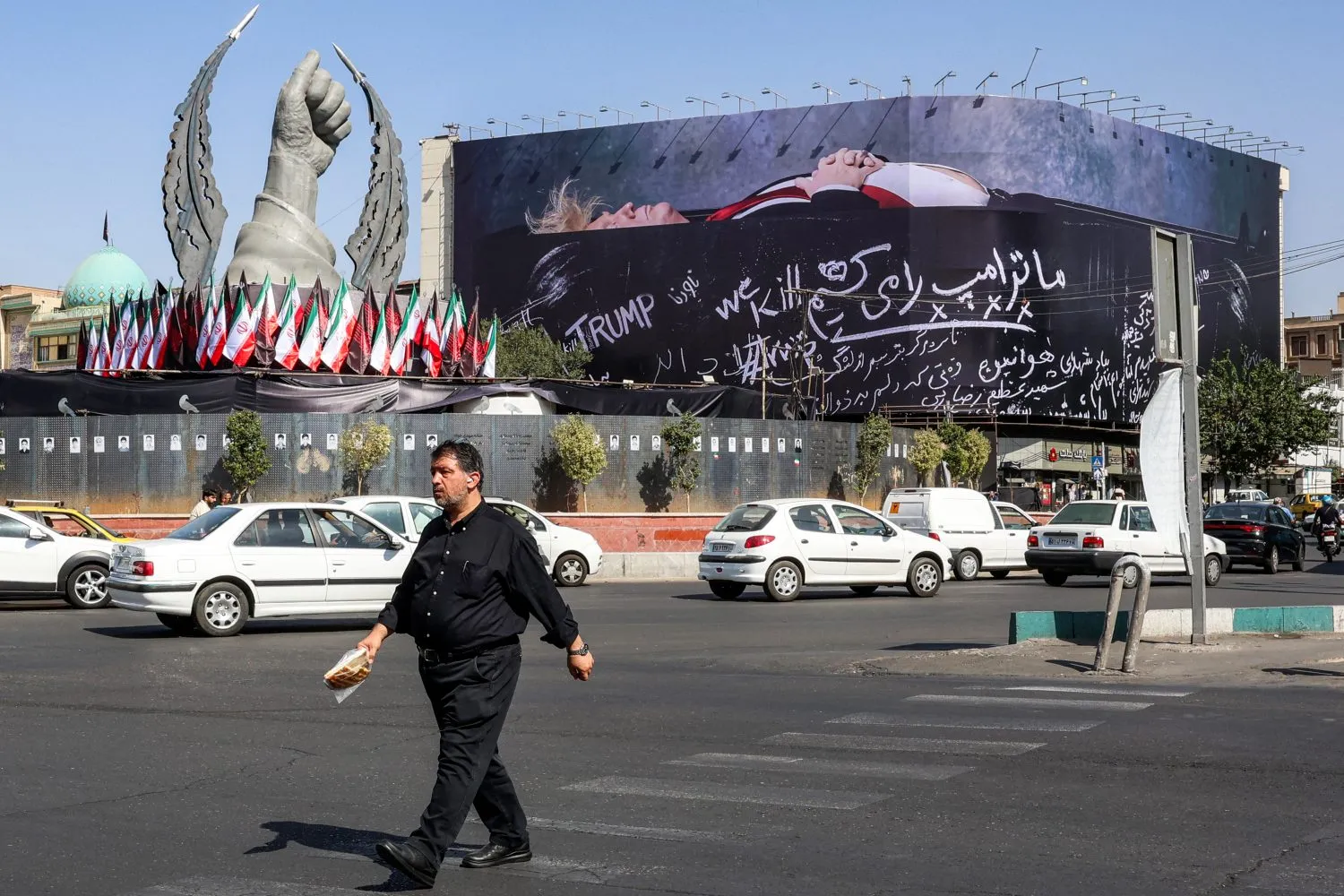
One of the most striking things about the ongoing conflict in Iran is how leading experts accurately predicted Tehran’s response to a U.S. attack, from shutting down the Strait of Hormuz to attacking U.S. bases in the region. Why didn’t U.S. President Donald Trump heed their advice? One can only surmise, but one reason could be that his administration had in fact fired several of the specialists who had studied Iran’s politics and history.
One of those experts is Nate Swanson, a career diplomat who served under multiple Democratic and Republican administrations over more than two decades. Swanson was a director for Iran at the National Security Council in the Biden White House. He then served as a member of the Iran negotiating team in Trump’s second term before he was purged from government, along with many other diplomats.
Out of office, Swanson has publicly predicted Iran’s likely response to an attack and also how Tehran might eventually overplay its hand. On the latest episode of FP Live, I spoke with him to get his sense of where things might be heading next. We discussed why the memorandum of understanding failed, Trump’s unique management style, and why American policymakers have struggled to meet their goals in the Middle East. Subscribers can watch the full discussion in the video box atop this page. Readers can also set the free FP Live podcast to download on their favorite audio platform. What follows here is a lightly edited and condensed transcript of our conversation.
Ravi Agrawal: So Nate, take us back to when we had a memorandum of understanding (MOU) between Iran and the United States. We can all agree that that was a flawed document, but it stopped the fighting. I want to understand how we got from there to here. What happened?
Nate Swanson: It’s a great question. As you said, this was a very flawed MOU. But it was the best-case scenario because the war had proven that both sides were basically in a stalemate and with diminishing returns. So, the document was flawed, but it would beat the alternative.
What’s happened, though, from the signing of the MOU to where we are now, is that both sides view the document as a surrender: Each side thinks the other is surrendering. The U.S., with all of its overwhelming military strength, believes that Iran should ultimately capitulate to their demands, whereas Iran feels like they won the war. They have the Strait of Hormuz, this new leverage they didn’t have before; they put tangible costs on the U.S., and more importantly, on the global economy. So these mindsets coming into the talks were very different and were looking past each other. Add those two components with a very weakly, ambiguously framed document, and this was inevitable. It was too volatile to stay.
RA: After the MOU was signed, you wrote that while Trump lost the war, Tehran might overplay its hand and then lose the peace that follows. Is that what happened?
NS: For there to be any sustainable peace from Iran, you have to have two very low-common-denominator things. You need the strait to be open and flowing, because absent that, it doesn’t work for the U.S. or the world. You can’t have 20 percent of the world’s oil and energy cut off. And you have to have a minimum level of confidence that they’re not going to pursue a nuclear weapon. Absent those two things, you’re just going to have some form of conflict come up again.
My worry with the MOU, in particular, is it resolved none of these issues. It didn’t even resolve the strait issue. As it played out, both sides could read it how they wanted. The U.S. wanted the free flow of energy, and Iran thought they had control. And the problem is those two things don’t really work. The MOU was not ready for prime time. The U.S. pushed the timing of this but didn’t actually get any substance. So unless Iran was going to over-comply with the terms of the deal, something like this was inevitable.
RA: Strategically, how long can Iran continue to use the strait as leverage in this manner before weakening its own hand? Because countries and companies are going to seek other routes and other means to get their stuff out there.
NS: You’re right, it is a diminishing asset, because there are already attempts to try to build infrastructure that bypasses the strait or seeks alternate routes. But that’s really time-consuming. These are going to be three-, five-, 10-year projects. So while I do think that’s happening and should happen, it would have been in Iran’s interest to get traffic back up to peak levels to disincentivize that from being done, because it’s just so much cheaper to go through the strait. They didn’t do that; instead, for some understandable reasons—it wasn’t completely irrational—they took a short-term approach as opposed to a medium- or long-term approach. That will weaken their leverage over a longer period of time, but it’s not going to be immediate.
RA: There’s this general sense that the White House doesn’t have great options to stop Tehran from controlling the strait right now. And that’s partly why there’s renewed chatter in D.C. about potentially escalating this to the point of a ground invasion or pushing for regime change in some form. How seriously are you taking that kind of talk right now?
NS: Seriously. You can feel it building, both in what’s online and as you talk to people here in D.C. A lot of people didn’t like the MOU for understandable reasons—it gave Iran a lot of benefit, and the U.S. got nothing up front. So now that it’s collapsed, I’ve heard a number of people say that we need to double down on the military option, we need to do a ground invasion, we need to continue airstrikes. I think we need to take those calls seriously. But if you’re really being honest with yourself, I don’t see how a half-hearted military campaign really changes Iran’s decision-making calculus. The only thing that would actually lead to a regime change, or a significant change in Iran’s approach, is a massive ground campaign that is aimed at regime change, a la 2003 Iraq. I think that would be a disaster, and I would advocate against that.
Ultimately, time is on their side—it’s basically a race, a test of wills, to see who is willing to endure more for a longer period. From an American perspective, I don’t see how we think it’s in our interest to sacrifice American lives and our economy for no clear strategic upside. Not everyone agrees with that, and obviously I’m not going to defend the regime at all—they’ve done some horrible things, and we’d all be better off if there was significant change in the way they acted, or who the regime was composed of. But it’s a really high price to pay without a clear payoff.
RA: You’ve had a long, bipartisan career, advising both Democratic and Republican administrations, working on issues for American interests, but you were ousted from your last role in which you were part of the Iran negotiating team. Who is currently advising the White House, the president, on key issues regarding Iran?
NS: I started at the tail end of the [George W.] Bush administration and went through [Barack] Obama, Trump 1.0, [Joe] Biden, and Trump 2.0, and the second Trump administration was a uniquely top-down enterprise. The president is more involved in day-to-day decision-making than I’ve seen on any other issue, especially related to Iran. I believe he went to war because he thought it was in his best interest, and if you look at the reporting surrounding this, it was clear that some of the cabinet secretaries had hesitations about this, but they didn’t speak up because this is the president.
The group around him is narrow. This is not a bottom-up system where you have a normal bureaucracy working through a working level, deputies, and principals to go to the president. You basically have a few select cabinet principals who are advising him. [Secretary of State] Marco Rubio is there, [Vice President] J.D. Vance, and you have the president’s son-in-law [Jared] Kushner and [Steve] Witkoff. And maybe [Defense Secretary Pete] Hegseth on military matters. But the room is significantly smaller than anything I’ve ever seen before. And as you look at the New York Times reporting about [Israeli Prime Minister Benjamin] Netanyahu’s pitch to Trump to go to war, that’s not a new pitch. This is a pitch that’s been made in some form or another for over 20 years. What I think was unique about this, though, is that even though these principals harbored real doubts about whether it would work, they were afraid to share it with the president. So instead, they just leaked it out after the fact to try to clear their own name.
The other dynamic that is unique to this administration is that Trump likes to be lobbied from the outside. He likes outside players—as we’ve seen in the Iran war, the Gulf, Turkey, and Israel—to make suggestions and basically pitch him on ideas. And he also takes feedback, as we learned from the late [U.S. Sen.] Lindsey Graham. Graham was very open about pitching the president on Iran plans, Ukraine and Russia, Israeli normalization. So this is a unique way of doing business—it’s just unique to Trump—and again, it’s fine if the results are there, but the results have not been there.
RA: When you were in the administration, this particular administration, a little over a year ago, and you were representing the White House in Iran negotiations, did you have a sense then of what Trump wanted? And do you imagine that that has significantly changed now?
NS: My perception was that he wanted something historic. He either wanted a historic deal or something big and splashy. To some extent, the 12-day war provided that to them. It was this unprecedented bombing campaign that took out a big portion of Iran’s nuclear program with no cost. There’s been a lot of commentary that Trump was never serious about an Iran deal in the first part of his administration, and I don’t think that’s accurate. My perception from where I sat was that he was serious about it. He just knew it needed to look different than Obama’s deal, and that was complicated, and ultimately, he just lost focus and was fine with the 12-day war instead.
RA: There are two sides in any negotiation. You’ve spent time with the Iranians, of course. What is your sense of what they might see as an acceptable outcome to the conflict right now?
NS: That question gets harder to define; I had an answer last week that might not work now, after we’ve gone after all this civilian infrastructure. With that caveat aside, I think they entered the war with one or two clear strategic goals. In their words—I heard this from a European diplomat—they didn’t want to become Lebanon. They didn’t want Israel going in every six months and hitting them over and over again. And that is where this was trending. There was a lot of talk prior to this war that the June 2025 war was the first Iran war, and this was going to be a second. They expected this to happen every six or so months to go after Iran’s missile capabilities. So goal no. 1 was to keep that from happening. And I think, arguably, that may have been achieved. It’s hard to say that definitively at this point. But if they emerge from this with some kind of peace deal, I can’t imagine any president will be eager to go back to war with Iran.
Goal no. 2 became money. Once it was clear they were going to survive this war, and that Trump wanted out, they were looking for opportunities to cash in on it. They have a huge economic crisis that predates this war and the June war, so they really needed to do this. They really needed to do something, eventually a deal with the U.S. that opens up sanctions relief and their access to full oil sales. And then as they saw an opening, they added Lebanon, and now they’ve added the control of the strait. The list of demands have gone on and on as the war goes on. They have access to funds that help them survive. And now that they’ve talked themselves into this corner, they need some kind of rhetorical victory surrounding the strait.
