


In the 1974 film The Land That Time Forgot, the crew of a British ship torpedoed by a German U-boat in World War I crash upon the shores of a mysterious island. Though preoccupied with their ongoing geopolitical struggle, the British and Germans quickly discover something even stranger: a world full of dinosaurs and cavemen, untouched by the modern world or the passage of time, preserved perfectly in amber like a fossil.
At last week’s Aspen Security Forum, the dinosaurs were certainly less wondrous but no less untouched by time.
In the 1974 film The Land That Time Forgot, the crew of a British ship torpedoed by a German U-boat in World War I crash upon the shores of a mysterious island. Though preoccupied with their ongoing geopolitical struggle, the British and Germans quickly discover something even stranger: a world full of dinosaurs and cavemen, untouched by the modern world or the passage of time, preserved perfectly in amber like a fossil.
At last week’s Aspen Security Forum, the dinosaurs were certainly less wondrous but no less untouched by time.
Perhaps I should not have been surprised by this. Aspen, after all, is a bastion of the foreign-policy establishment, a place where policymakers and politicians go to hear their own groupthink reflected back to them. It is the natural habitat of the entity that Obama advisor Ben Rhodes once described as “the Blob.”
Yet it was still jarring to hear how out-of-date the conversations were at one of the United States’ premier foreign-policy conferences. Even as policy debates in Washington and elsewhere begin to shift toward the reality of a more multipolar world and a more nationalist, “America First” foreign policy, the conversations in Aspen remained encased in a feel-good atmosphere of bipartisan liberal interventionism.
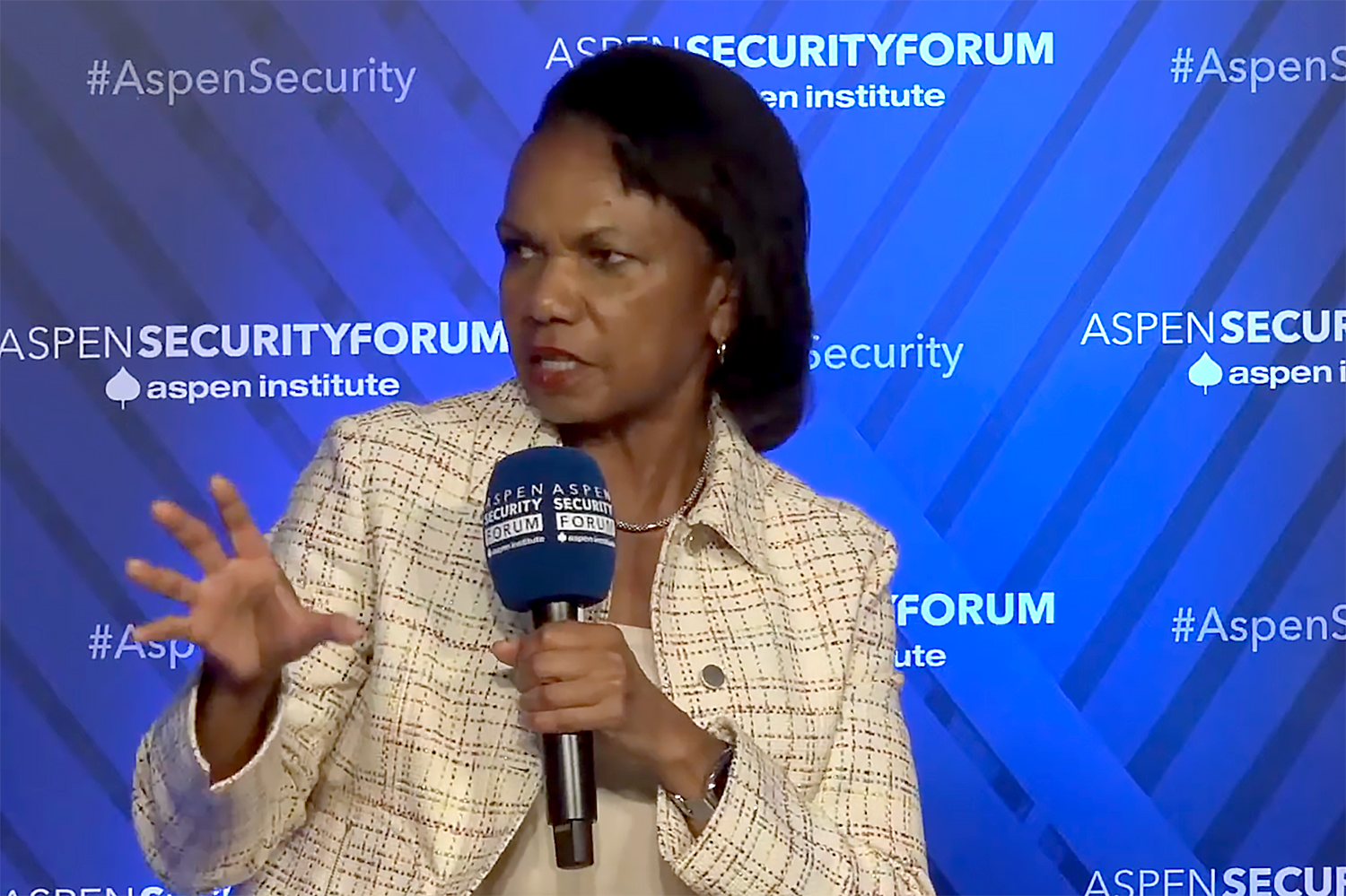
The conference’s opening panel drew attention on social media thanks to former U.S. National Security Advisor Condoleezza Rice’s remarks. Rice endorsed President Donald Trump’s decision to bomb Iran, asking whether it would really have been better to wait for an “imminent” threat. She criticized European leaders for opposing the Iraq War back in 2002, relitigating a debate that ended decades ago. As Rhodes—one of the few dissenting voices among the speakers—noted near the end of the conference on Friday morning, this is despite votes as far back as 2008 showing an electorate that wanted an end to the Bush administration’s war on terrorism.
It would not be fair to judge an entire conference by one set of outdated comments. Instead, we should judge it by the insidious theme that ran throughout many panels: that public opinion does not really matter. Various speakers spoke about the importance of explaining foreign policy to Americans in order to change their views, repeating the old argument that the primary reason U.S. foreign policy is unpopular is because the people affected by it simply don’t understand.
Some speakers went much further, blaming generational shifts toward restraint in foreign policy on foreign influence campaigns, primarily by Russia and China on social media. In short, in the Aspen bubble, there is no need to think about public opinion, which can be protected from opposing views—or simply reshaped through clever communication.
Nowhere was this more visible than the stilted discussion of the ongoing U.S. war against Iran. The war itself is profoundly unpopular, with a recent poll suggesting that only 30 percent of Americans think it’s a good idea. But most of the speakers at the conference argued instead in favor of doubling down and finishing the job, even if this comes with higher energy prices for Americans.
Indeed, there was a notable lack of urgency in how speakers discussed the war. Former U.S. National Security Advisor Stephen Hadley advised the president to “stop chasing after the Iranians for an agreement on the nuclear issue,” noting that the situation “will stabilize over time.” Rice, meanwhile, argued that the only thing to do was to let the Iranians “stew in their lousy economy,” presumably until they concede or collapse.
Read More
-
Canadian Prime Minister Mark Carney (R) welcomes NATO Secretary General Mark Rutte during the Group of Seven (G7) Summit at the Pomeroy Kananaskis Mountain Lodge in Alberta, Canada, on June 17, 2025. Canadian Prime Minister Mark Carney (R) welcomes NATO Secretary General Mark Rutte during the Group of Seven (G7) Summit at the Pomeroy Kananaskis Mountain Lodge in Alberta, Canada, on June 17, 2025. NATO Is Splitting in Two
Mark Carney and Mark Rutte offer competing visions for the future of the trans-Atlantic alliance.

-

Rep. Alexandria Ocasio-Cortez speaks with reporters on the contentious vote for speaker of the House for the 118th Congress in Washington, D.C. Rep. Alexandria Ocasio-Cortez speaks with reporters on the contentious vote for speaker of the House for the 118th Congress in Washington, D.C. AOC Meets World
The congresswoman’s rise was powered mostly by domestic issues. But she is slowly expanding to foreign affairs.
-

An illustration of a vintage-style map featuring North America and parts of Europe and Africa. Overlaid on the map are 3D red brick walls shaped exactly like the borders of the contiguous United States and Alaska, casting long shadows to the right. An illustration of a vintage-style map featuring North America and parts of Europe and Africa. Overlaid on the map are 3D red brick walls shaped exactly like the borders of the contiguous United States and Alaska, casting long shadows to the right. America, the Once Global Nation
At 250, the country is struggling to come to terms with the world it created.
Some of this praise for Trump’s war can be explained by the fact that participants generally leaned Republican, yet even notable Democratic participants criticized the war on process grounds. Former Undersecretary of Defense for Policy Michèle Flournoy, for example, criticized the lack of a clear strategy this spring from the Trump administration while declaring herself supportive of last year’s 12-day war. Nicholas Burns, former President Joe Biden’s ambassador to China, argued that this year’s initial strike on Iran war was a “hit to Chinese credibility.”
Democrats were also happy to hit Trump on those areas where he is less hawkish. Rahm Emanuel managed to dodge a succession of questions from the moderator about a potential 2028 presidential candidacy while describing Trump’s foreign policy as “punch down and kiss up,” where “Xi’s the person he’s kissing.” The few dissenting voices, such as U.S. Sen. Chris Murphy, were badly outnumbered. After Murphy attempted to defend the Iranian nuclear deal and called for diplomacy with Iran, a question from the audience accused him of merely wanting to “retreat.”
Some panels were substantive. The closer one got to regional expertise, whether on the Middle East, China, or space and technology, the more likely you were to hear nuanced opinions. Discussions on trade and tariffs—areas where there is genuine inter-elite contestation on the value of free trade—were much better balanced. The Israel panel became heated, reflecting how contentious and political the issue has become.
And current politics leaked in from time to time. Speakers repeatedly praised Trump’s ability to get allies to pay more for their defense, even as they bemoaned his lack of decorum. The Europe panel featured Western European politicians who framed defense as an end to “woke” politics. There was no defense of immigration as a core liberal value, as one might have seen a decade ago.
But across so many discussions, the overarching worldview in Aspen last week remained stuck in the 1990s or early 2000s. A panel on the Western Hemisphere was introduced by asking whether the United States should intervene in Cuba or intervene further in Venezuela. Panels on U.S. foreign policy toward Europe and Latin America prominently featured dissidents from those regions, along with discussions of how best to promote democracy there.
The crowd of attendees—a mixture of bright young “rising leaders,” aging former officials, journalists, defense contractors, and foreign embassy officials—mostly seemed content with the discussions, though some described them to me with terms such as “stale.” But I’d put it more bluntly: Participants at Aspen were stuck in a time warp. A time traveler from 2003, 2008, or 2011 would hardly have known they were in a different year.
This is problematic. The event remains one of the premier spaces for foreign-policy discussion in the United States. But it has become a sealed epistemic bubble: a place where it is always the unipolar moment, where U.S. credibility is always on the line, and where, if military force or economic coercion does not work, one simply needs to resort to more of it.
This does a huge disservice to Americans and to future U.S. policymakers. One suspects that if you were to ask the average American voter how Congress should reassert itself on foreign policy, he or she would not suggest—as former U.S. Rep. Jane Harman did, on a panel celebrating America’s 250th birthday—that more Russia sanctions and increased military spending were the way to do it.
It may still be true, as Hadley put it, that one of the “dirty little secrets” of foreign policy is that there is more continuity between different administrations than one might expect. The Aspen Security Forum lauds this ideal of bipartisanship. But it is a bipartisan consensus that is fossilized and out of step with the public at large. The American people deserve better.
