


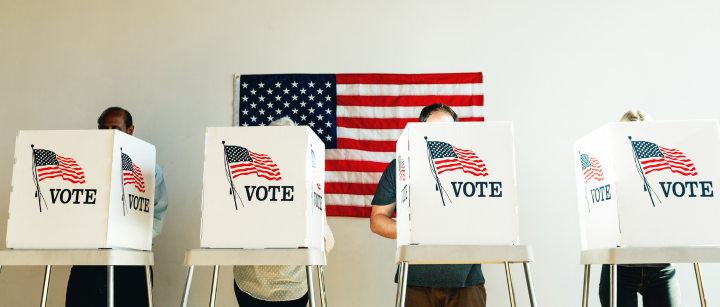
In claiming that American voting machines are vulnerable to manipulation, President Donald Trump provided an incomplete and distorted summary of the CIA’s reporting about Venezuelan efforts to manipulate electronic voting machines in that country.
“Today, we are releasing documents that show the CIA obtained reporting of a specific plot to do a big number in favor of the corrupt Maduro regime in Venezuela,” Trump said in his primetime address to the nation on July 16, referring to Venezuelan President Nicolás Maduro. “And that’s exactly what happened. Conspiring to digitally rig their own country’s elections in 2020. And that’s what they did. This reporting included precise details about methods to regime develop, to digitally alter vote totals in ways that could not be detected, even with an audit, no matter how deep they went.
“This intelligence underscores why we must take urgent action to ensure that our own system can never, ever be hacked or compromised like it was in the past,” Trump said.
The documents the Trump administration released don’t say “that’s exactly what happened,” as Trump said. One of the documents released prior to Trump’s address was a recent CIA report, “Summary of Select Intelligence Reporting from 2004-2020 on Venezuela’s Electronic Voting Manipulation Capabilities,” that concluded Venezuelan President Hugo Chávez and his successor, Maduro, “developed sustained interest and likely some capability” to manipulate voting machines. But the CIA’s assessment about the ways in which Venezuela could accomplish such manipulation was more of a “theoretical” exercise, and the report stopped short of alleging Venezuela actually carried out plans to alter voting machine tallies.
Moreover, the report concluded that even if Venezuelan officials had the ability to manipulate voting machines in-country, they lacked the capability to alter voting machines outside Venezuela.
“[T]he 2006 Intelligence Community assessment concluded that neither [voting machine maker] Smartmatic nor the Venezuelan Government had the capability — that is, the level of control or access required — to manipulate the outcome of an election outside of Venezuela in a predictable fashion,” the CIA report stated. “The Venezuelan Government’s ability to manipulate the results of voting in Venezuela rested in part on its ability to control every stage of the electronic voting process, from initial acquisition of the machines to pre- and post-voting machine security, to programming, to storage of paper voting receipts, to control of the audit process. Neither the Venezuelan Government nor Smartmatic would have such a complete spectrum of access during an electoral process outside Venezuela.”
We wrote about other claims in Trump’s speech last week.
What the CIA Assessment Said
The summary of intelligence over a 16-year period — declassified on July 1 — included a 2006 CIA analysis that concluded “electronic voting manipulation” in Venezuela — including artificial intelligence components that could alter votes without being detected via auditing — was “technically possible and operationally feasible.”
“According to this reporting, the technique involved creating a second set of virtual machines that would replicate legitimate voting machine results, then substitute manipulated data while making votes appear to originate from legitimate machines,” the CIA report said.
In the lead-up to Venezuela’s 2012 election, intelligence sources indicated that Chavez’s intelligence services worked with election software designers “to develop plans to manipulate election results using preprogrammed voting machines.” Specifically, the plan called for “deploying altered machines to approximately 300 voting centers in traditionally pro-Chavez areas to ensure victory by approximately 1.5 million votes,” the report stated.
A 2013 CIA analysis used a “‘Devil’s Advocacy’ methodology” to outline “a plausible scenario for how large-scale electronic manipulation could have occurred in Venezuela’s 2012 election without detection.” A section on “Limitations and Analytic Caveats” later in the report noted that this “Devil’s Advocacy Report” was “explicitly an alternative analysis exercise rather than a definitive finding.” The assessment noted that there was “conflicting” CIA reporting and “limited insight into key elements of the electronic voting system.”
“While CIA analysts judged these capabilities were theoretically achievable, this assessment focused on technical feasibility rather than confirmation that such features were actually implemented,” the report said.
And, indeed, CIA assessments concluded there was no evidence such a plan was ever carried out.
CIA “reporting indicated that electronic voting systems contained vulnerabilities that could theoretically be exploited by sophisticated actors with insider access,” the report said. “However, while the intelligence validated significant concerns about foreign-linked voting technology vendors, it did not definitively confirm that large-scale electronic fraud was successfully executed in specific Venezuelan elections.”
The report noted that it was the CIA’s “baseline assessment” that “large-scale electronic fraud did not occur” in Venezuela in 2012, despite “reporting of manipulation plans.” That assessment was based on “pre-election polling showing Chavez ahead by approximately 10 percentage points, a 24% increase in government spending before the election, the opposition’s concession of defeat, and CIA quantitative analysis showing no irregular voting patterns indicative of systematic manipulation.”
By 2020, intelligence sources reported that Venezuela “had developed detailed technical plans to manipulate the December 2020 National Assembly elections.”
But contrary to Trump’s claim that a plan to manipulate voting machines is “exactly what happened” in 2020, a September 2020 CIA report “judged the regime did not need to resort to gross fraud to win the December 2020 National Assembly elections, given that virtually the entire opposition boycotted and the regime had already co-opted opposition party leadership.”
Even if Venezuelan leaders were able to manipulate voting machines in Venezuela, U.S. intelligence concluded Maduro did not have the capability to pull that off outside Venezuela.
A declassified version of an Intelligence Community assessment on “foreign threats” to the 2020 election, released in March 2021, noted: “The Venezuelan regime of Nicolas Maduro had an adversarial relationship with the Trump administration and we assess that Maduro had the intent, though probably not the capability, to try to influence public opinion in the US against the former President.” The assessment continued, “We have no information suggesting that the current or former Venezuelan regimes were involved in attempts to compromise US election infrastructure.”
In his primetime address, Trump did not “even purport to show … that any voting machines were actually compromised,” Rick Hasen, director of the Safeguarding Democracy Project at UCLA School of Law, wrote for the Election Law Blog on July 16.
Smartmatic
At the center of speculation about voting machine manipulation in Venezuela is a cybersecurity company called Smartmatic, founded in 2000 in Florida by people with Venezuelan citizenship. The small company took on international prominence when it was tapped by Venezuela to provide voting machines for its 2004 election.
According to a New York Times story in October 2006, “Smartmatic was a little-known firm with no experience in voting technology before it was chosen by the Venezuelan authorities to replace the country’s elections machinery ahead of a contentious referendum that confirmed Mr. Chavez as president in August 2004.”
Using money from those Venezuelan contracts, the Times noted, Smartmatic in March 2005 bought the “much larger and more established” Sequoia Voting Systems, which at the time provided voting equipment to 17 states and the District of Columbia.
Given Smartmatic’s role in Venezuela, and concerns about possible ties to the Chavez government, the Committee on Foreign Investment in the United States in late 2006 opened an investigation into Smartmatic’s purchase of Sequoia. According to the Times, Smartmatic and the Chavez administration at the time both denied the Venezuelan government had any role in the company, other than Venezuela contracting with Smartmatic for its elections.
According to the report released by the CIA this month, intelligence reporting in April 2004 “indicated Chavez stated his objective was to prevent the reelection of a sitting US president, suggesting intent to influence US domestic politics.” In April 2004, then President George W. Bush, a Republican, was campaigning for a second term in office.
That finding, the report said, “was part of the basis for the Intelligence Community’s 2006 assessment that Smartmatic’s acquisition of US voting systems company Sequoia posed a ‘moderate threat’ to US national security.”
In December 2006, the New York Times reported that Smartmatic announced it was selling its U.S. subsidiary, Sequoia Voting Systems, thereby ending the ongoing federal investigation.
Then Rep. Carolyn Maloney, a Democrat of New York, who was the first to call for the federal investigation, said at the time that the sale of Sequoia Voting Systems seemed to be an acknowledgement by Smartmatic that it “could not overcome the cloud of doubt surrounding this deal.”
“There clearly remained doubts surrounding this company, and as long as those doubts lingered, many people would have legitimate questions about the integrity of these voting machines,” said Maloney.
Smartmatic sold Sequoia in 2007, and Sequoia filed for bankruptcy in 2014.
Smartmatic ended its business with Venezuela in 2018 after accusing Maduro’s government of manipulating voter turnout data in a 2017 election, inflating the vote tally by more than 1 million votes. The figures from Maduro were at odds with the tallies indicated by the voting machines, Smartmatic said.
Nonetheless, Trump’s legal team in 2020 repeatedly raised baseless claims that Smartmatic had used its technology to switch votes in the 2020 U.S. presidential election, costing Trump the win.
By that time, though, as we noted, Smartmatic had sold Sequoia and was no longer doing business with Venezuela. In the 2020 election, only one U.S. county used Smartmatic voting equipment. Los Angeles used the company’s VSAP touchscreen machines, according to the California secretary of state’s list of certified voting equipment used in each county.
As District Court Judge Jeffrey M. Bryan wrote in an order in September 2025 in Smartmatic’s defamation case against Trump supporter and election denier Mike Lindell, “[G]iven the margin of victory in Los Angeles County and California … it is mathematically impossible” for the Smartmatic equipment “to have changed the results of the 2020 Election in California.”
Bryan added that “the only evidence in the record before the Court concerning Smartmatic’s involvement in elections in other countries shows that Smartmatic has never stolen any election, and its technology has never been used to manipulate ballots.”
Though Trump did not mention in his July 16 speech any information provided by Hugo “El Pollo” Carvajal, the president’s claims partially echo those of the former head of Venezuela’s military intelligence.
In December, Carvajal, who pleaded guilty in the U.S. in 2025 to narcoterrorism, drug-trafficking and weapons charges, wrote Trump a letter (first published by the conservative Dallas Express), stating, “Smartmatic was born as an electoral tool of the Venezuelan regime but soon derived into a tool to help keep the regime stay in power forever. I know this because I placed the head of IT of the National Electoral Council (CNE) in his position, and he reported directly to me. The Smartmatic system can be altered—this is a fact. This technology was later exported abroad, including to the United States. Regime operatives maintain relationships with election officials and voting-machine companies inside your country. I do not claim that every election is stolen, but I state with certainty that elections can be rigged with the software – and has been used to do so.”
Carvajal’s sentencing has been postponed, CNN noted this month, “a possible sign he may be cooperating with prosecutors” and could be a witness against Maduro.
Smartmatic denied Carvajal’s claims, CNN reported, saying, “Trump allies have long falsely accused Smartmatic of rigging the 2020 US election.”
In a meeting with reporters the day before Trump gave his primetime address, David Becker, the executive director and founder of the Center for Election Innovation & Research, a nonpartisan nonprofit, also dismissed the idea that Smartmatic equipment could have swayed the 2020 election.
“Smartmatic is a company that does not sell or have voting machines anywhere in the United States, with the exception of Los Angeles County,” Becker said. In the swing states of “Georgia, Arizona, Nevada, Michigan, Wisconsin, Pennsylvania — not a single Smartmatic device [was used], not a single device that could have possibly been under the control of Venezuela or any other dead despot anywhere else in the world.”
“The reality is that, like every piece of technology, our voting machines are not invulnerable to attack, and we don’t trust them,” Becker said in a press conference two days later. “We build in systems by design that confirm and verify everything those machines do. Those machines are not connected to the internet. Those machines are kept under strict lock and key and chain of custody. They are tested before and after every election. And then even after that, every voter in the United States, with the exception of Louisiana, votes on paper ballots. Those paper ballots are auditable. Every state conducts audits. … They check and make sure through hand audits, reading the ballots, confirming the counts by hand under transparent observation … and then they compare it to the machine count to make sure it worked. We know that our voting machines have accurately counted the results. We know the results are accurate because of those audits.”
Trump alluded to the Venezuelan government “having some ability to interfere with Venezuelan voting machines,” Becker said, but beyond one county, those machines “aren’t even used in the United States.”
Editor’s note: FactCheck.org does not accept advertising. We rely on grants and individual donations from people like you. Please consider a donation. Credit card donations may be made through our “Donate” page. If you prefer to give by check, send to: FactCheck.org, Annenberg Public Policy Center, P.O. Box 58100, Philadelphia, PA 19102.
