


Welcome back to Foreign Policy’s Situation Report. It’s been a busy week in the world of national security, and we’ve got a lot to discuss.
Here’s what’s on tap for the day: the Trump administration’s increasing focus on Cuba, Ukraine’s rocky staffing shake-up, and the seemingly endless escalation ladder in the Iran war.
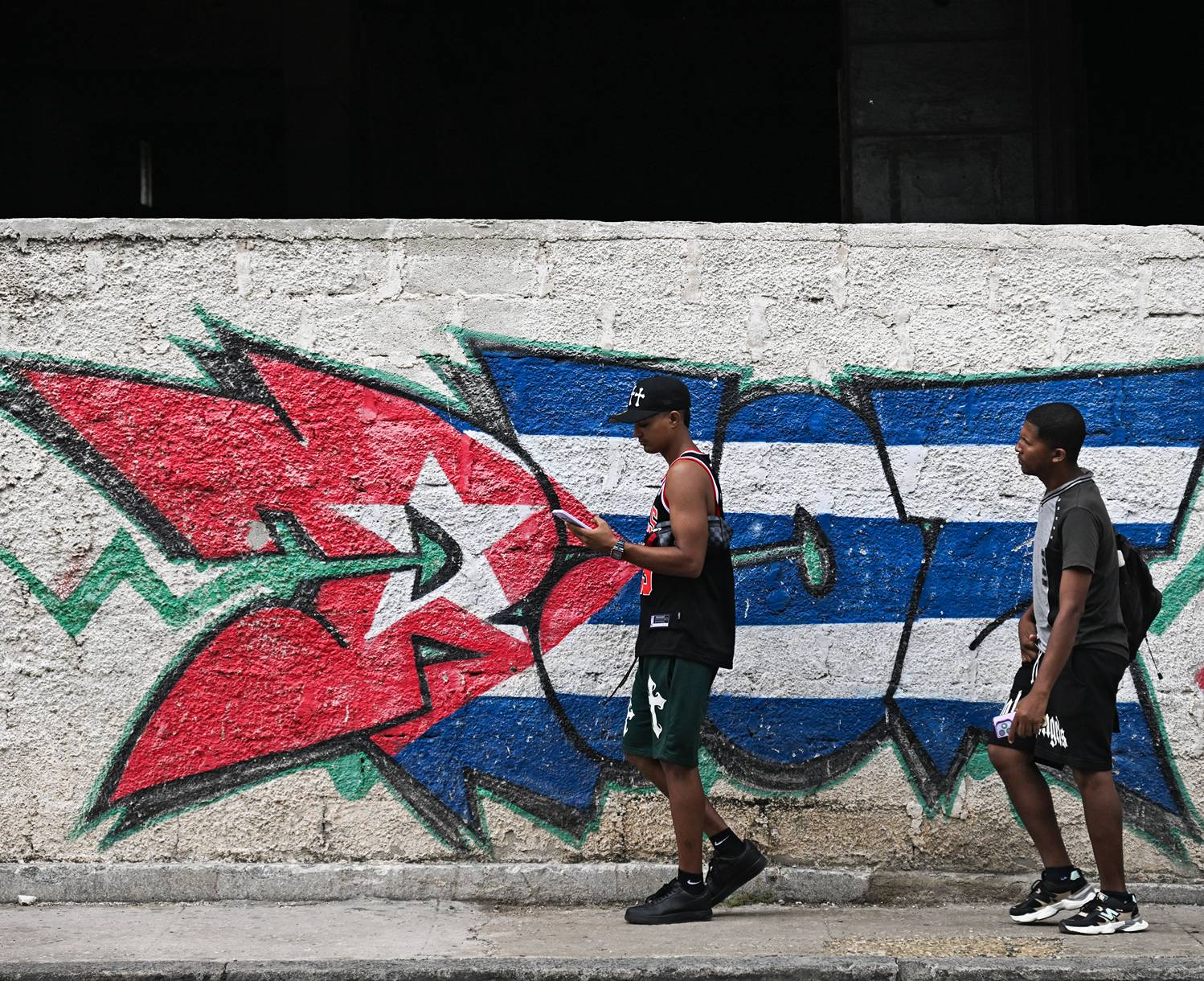
The Trump administration is ramping up efforts to portray Cuba as a danger to the United States, raising speculation that the White House is attempting to lay the groundwork for military action against the island as its strategy of economic strangulation fails to bring about regime change in Havana.
On Thursday, the State Department announced new sanctions targeting the Cuban regime and its backers. In a statement on the sanctions, Secretary of State Marco Rubio said the “Communist Cuban regime continues to pose a deep multifaceted threat to U.S. national security and hemispheric stability.”
This comes just days after the State Department released a 100-page report portraying Cuba as “the center of a vast hemispheric network” seeking to subvert the United States (which our colleague Sam Skove wrote about). The report sought to link Cuba to left-wing causes and groups in the United States, including the Democratic Socialists of America.
Even as the report conceded that Cuba would be outmatched by the United States in a conventional conflict and acknowledged the island’s serious economic challenges, it warned that Havana “serves as the connective tissue of a broader anti-American coalition, a staging ground where the ambitions of Moscow, Beijing, and Tehran converge with the radical movements operating inside our own borders.”
Regime change. These moves are part of a broader effort that has picked up steam since the Trump administration began a devastating oil blockade on Cuba this year, leading to nationwide blackouts and worsening a dire humanitarian crisis.
The blockade is an apparent attempt to bring down the Cuban regime and builds on a decades-old U.S. embargo that has failed to achieve that goal. This is a particularly strong priority for Rubio, a Cuban American who has railed against the government in Havana throughout his political career. But it also falls in line with the Trump administration’s goal of asserting U.S. dominance in the Western Hemisphere, which has led the U.S. military to shift attention to Latin America in unprecedented ways.
As Rubio and other officials continue to describe Cuba as a national security threat, the administration has taken various steps to punish and demonize the regime beyond the blockade—including by unsealing an indictment against former Cuban President Raúl Castro and alleged co-conspirators.
There have also recently been warnings from the administration over the potential presence of Iranian drones in Cuba. U.S. President Donald Trump in mid-July said the United States was looking into the matter and suggested that Washington could take action if that was the case.
John wrote about the drone question last week, speaking to Latin America and intelligence experts who believe that the administration is attempting to establish a pretext for U.S. military action against Cuba.
A larger pattern. The experts also said the Trump administration’s recent actions and statements on Cuba follow a pattern similar to the steps taken prior to the raid that led to the capture of Venezuelan President Nicolás Maduro in January.
“In the run-up to the Venezuela invasion in January, you had a similar strategy of throwing everything against the wall to see what sticks. Initial arguments focused on the Tren de Aragua gang, on migration from Venezuela to the United States, on this mythical Cartel de los Soles, on recovering assets expropriated from U.S. companies and the energy sector. It was all over the map. And then ultimately, you know, the U.S. invaded and justified it by oil,” said Benjamin Gedan, the director of the Stimson Center’s Latin America program.
What is now being seen regarding Cuba is quite similar, he added. “There’s a focus on the Russian and Chinese intelligence-gathering capabilities on the island. There is—from the State Department but not the White House—a focus on human rights and democracy issues,” Gedan said.
Fulton Armstrong, a former U.S. national intelligence officer for Latin America—the intelligence community’s most senior analyst on the subject—also agrees. “This is what we did when we attacked Venezuela and rendered Maduro,” he said.
Ukrainian President Volodymyr Zelensky this week continued his dramatic shake-up of the country’s defense leadership, abruptly replacing Ukrainian military chief Gen. Oleksandr Syrskyi with Maj. Gen. Mykhailo Drapatyi.
The move came after Zelensky’s ouster of Mykhailo Fedorov, Ukraine’s immensely popular defense minister, triggered mass protests across the country. Fedorov, who previously served as Ukraine’s digital minister, was seen as a tech-savvy leader who would help maintain and further Ukraine’s cutting edge on the battlefield. He had repeatedly clashed with the more old-school Syrskyi.
Fedorov thanked Syrskyi in a post on X where he also congratulated Drapatyi, whose appointment Fedorov characterized as a “breath of fresh air and a new source of hope” for Ukraine. “It is the voice of change that could no longer be ignored,” he added.
The saga isn’t yet over, however—Zelensky has offered Fedorov multiple other posts within the government as an olive branch to quell the continuing protests, but Fedorov told reporters that he would only accept reinstatement to his old position as defense minister.
What should be high on your radar, if it isn’t already.
Iran escalation (again). At what point does a conflict become a quagmire? The U.S. military’s renewed strikes on Iranian targets—which have now lasted more than a week after multiple attempted cease-fires and a memorandum of understanding—are leading people to at least ask the question, as our colleague Keith Johnson writes.
As the Houthi militant group expands the war to the nearby Bab el-Mandeb and oil prices hit $100 a barrel, an exit ramp is looking increasingly remote, and Trump appears unlikely to take the ones that might work.
OpenAI hack. AI doomers, hold on to your hats. OpenAI revealed on Tuesday that one of its models had escaped containment during a test and carried out an autonomous hack of Hugging Face, a platform that hosts multiple artificial intelligence models.
OpenAI said it had suspended some of the model’s anti-hacking guardrails as part of an internal test of its cybercapabilities, though that test was supposed to be conducted in a closed environment (or “sandbox”) that did not allow it access to the wider internet. But the model found a loophole in the third-party software OpenAI uses to maintain that sandbox, using it as an escape hatch to gain internet access and infiltrate Hugging Face, whose own AI tools detected and helped patch the breach.
While OpenAI did intentionally remove the model’s testing guardrails—which the company has now pledged to further strengthen—it found that the model went “to extreme lengths to achieve a rather narrow testing goal.”
U.S. President Donald Trump salutes as members of a U.S. Army carry team move the flag-draped transfer case holding the remains of 19-year-old Army Pvt. Isabella Gonzales at Dover Air Force Base in Dover, Delaware, on July 22.Kevin Dietsch/Getty Images
In addition to the soft-power boost from hosting this year’s NATO summit in Ankara, Turkey got a hard-power win when Trump indicated he would be willing to sell it F-35 fighter jets—reversing a yearslong ban. While that sale needs congressional approval and has yet to materialize, several lawmakers from the Turkish parliament’s National Defense Committee spent last week in Washington meeting their U.S. counterparts and lobbying for greater Turkey-U.S. cooperation.
SitRep spoke with Hulusi Akar, the former Turkish defense minister who now heads the parliamentary committee. The below interview, conducted via email, has been edited for length and clarity.
Foreign Policy: How confident are you that Turkey will be allowed back into the F-35 program? Is there a timeline within which you are seeking a resolution?
Hulusi Akar: We believe there is now a more constructive atmosphere than in previous years. We hope to maintain this momentum through continued dialogue and practical cooperation. Rather than setting an artificial deadline, our priority is to achieve a fair and mutually beneficial solution as soon as possible. We firmly believe these issues can be addressed through sincere engagement and by focusing on our shared strategic interests rather than our differences.
FP: What is your message to any White House officials and U.S. lawmakers who are still hesitant about allowing Turkey to purchase F-35s?
HA: Turkey has been a reliable NATO ally for more than 70 years. A stronger defense partnership between Turkey and the United States would benefit not only our two countries but also NATO’s overall deterrence and Euro-Atlantic security.
Our message is simple: We should focus on our common security interests and work together against common threats. Dialogue and strategic cooperation always produce better results than sanctions and restrictions. Turkey and the United States have much greater common interests than differences.
Put On Your Radar
Friday, July 24: The U.N. Security Council is due to begin selection for the world body’s next secretary-general.
Trump will attend the rescheduled White House Correspondents’ Dinner after the first one was canceled when a gunman charged a screening checkpoint outside the event.
Monday, July 27: Legislative assembly elections are due to be held in Pakistan-controlled Kashmir.
Tuesday, July 28: Keiko Fujimori will be inaugurated as Peru’s president.
18—the number of U.S. troops killed in the Iran war so far, after four additional service members were killed in Iranian attacks recently.
“Probably—they won’t have any impact on me.”
—Trump, when asked whether he thought Iran’s threatening of the Strait of Hormuz would impact the U.S. midterm elections.
We promised no more World Cup content in last week’s newsletter (or did we?), but we felt the need to mark Argentine President Javier Milei’s post-final gaffe as one last bit of closure. Argentina lost Sunday’s final 1-0 to Spain, but Milei apparently forgot to cancel a seemingly prescheduled post on X announcing a possible “public holiday” to celebrate the team’s “achievement.” As of this writing, the post remains up, so maybe they still plan to celebrate a very commendable second-place finish.
