


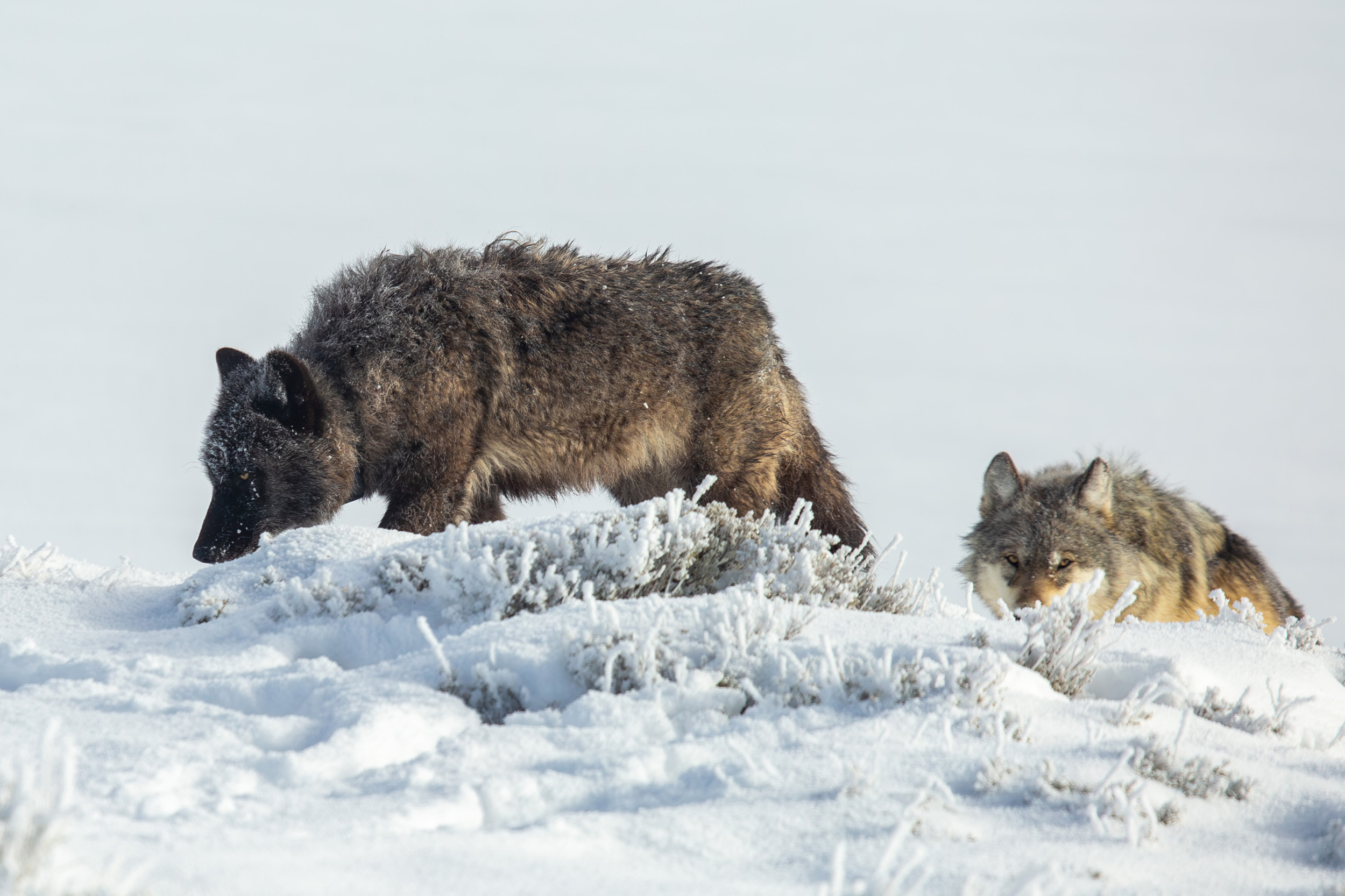
America’s centuries-old conflict with wolves took another turn earlier this month when President Donald Trump ordered the animals be stripped of federal protections across several U.S. states, claiming the action will provide economic relief for ranchers.
Alongside a suite of regulatory reviews to “promote financial viability” for ranchers, Trump ordered the Interior secretary to begin the process of removing gray and Mexican wolves from the endangered species list, and directed the Agriculture secretary to encourage states to make it easier for ranchers to shoot wolves.
But an Inside Climate News review of state and federal data indicates that wolves account for a tiny percentage of total cattle deaths. And while some individual ranchers in areas with intense wolf-livestock conflicts may face significant losses, other factors, like climate-fueled droughts, high fuel prices, persistent inflation and the Trump administration’s decision to pause levies on hundreds of thousands of pounds of beef imports are likely applying far more economic pressure to the industry than wolves.
A wolf pack’s presence near a ranch can impact a rancher’s bottom line, even if the animals don’t kill any cattle. But the Trump administration’s focus on delisting the predators and reducing their numbers with lethal management is misdirected, experts say.
“Wolves are going to be around, listed or not listed, because they are tough. So I was surprised the White House focused so heavily on wolves’ legal status when there is so much else federal agencies could do to reduce conflict,” said Arthur Middleton, a professor of wildlife management at the University of California, Berkeley. “The Agriculture and Interior departments could tweak and expand their technical and financial assistance for affected ranchers almost overnight. Focusing just on [wolves’] legal status is a big missed opportunity, and in my view, it doesn’t actually help ranchers that much.”
Gray wolves are federally protected in all lower 48 states except Idaho, Montana and Wyoming, where they have been removed from the endangered species list and are under state management. Gray wolves also live in California, Michigan, Minnesota, Oregon, Washington and Wisconsin.
In 2023, Colorado reintroduced gray wolves within its borders, a population managed by the state.
Mexican wolves have federal protection across their habitat in Arizona and New Mexico.
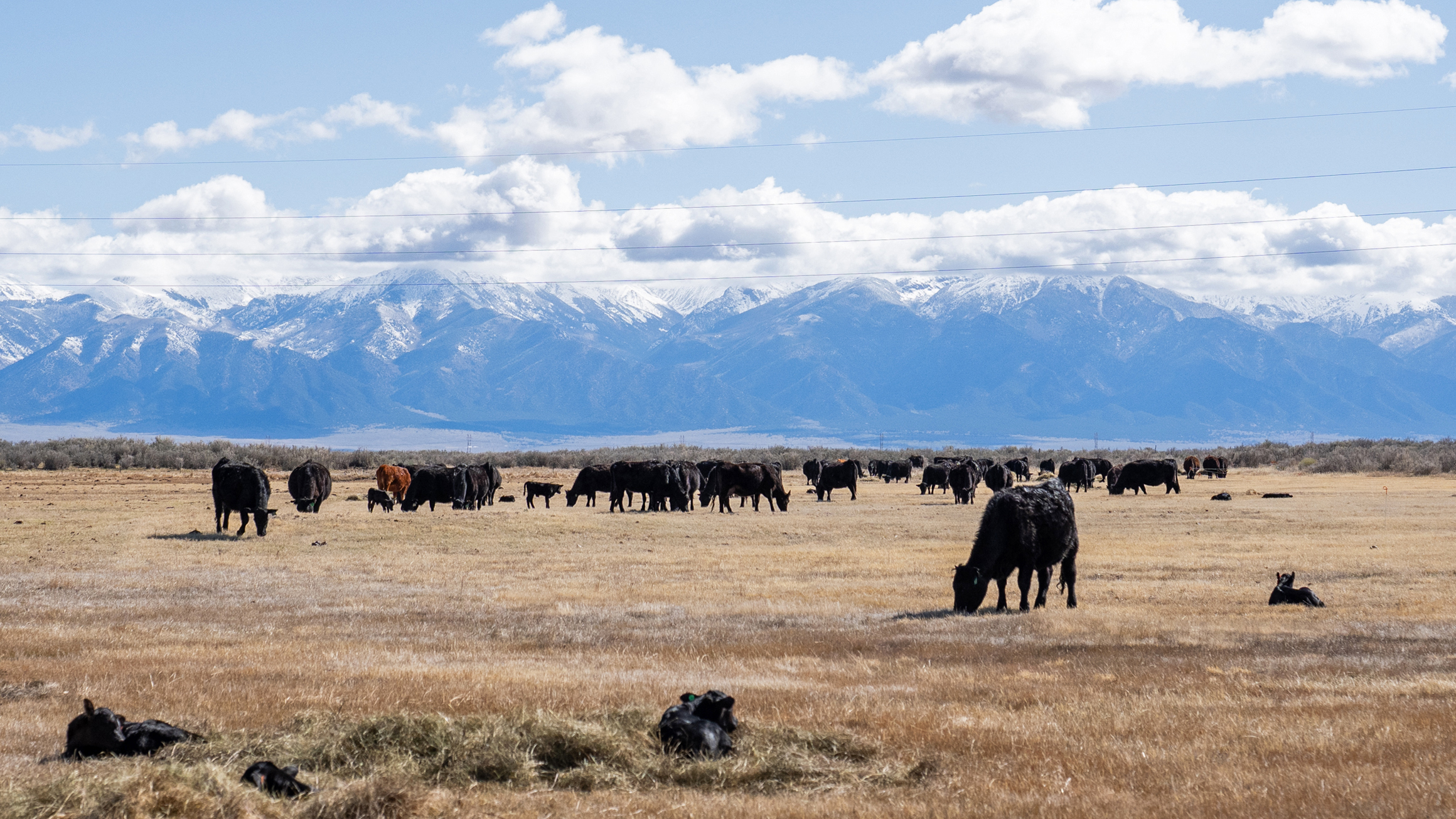
Inside Climate News reviewed data on cattle confirmed lost to predation by gray wolves published by states across the West. In 2025, those numbers varied from just nine animals in Washington to 155 killed or injured in California, a number that rose to 197 when including probable wolf attacks in that state. The true numbers are likely somewhat higher, as some wolf kills are never discovered and some carcasses are so decomposed that it’s impossible to determine how the animals died.
Still, wolf predation represents a tiny percentage of all cattle losses in states that are home to the predators. In Oregon, confirmed losses to wolves accounted for just 0.2 percent of total statewide cattle losses and deaths recorded by the U.S. Department of Agriculture in 2025—the highest proportion across the six Western states for which Inside Climate News found published 2025 data on gray wolf predation on cattle.
Most cattle are raised in circumstances in which they will never encounter a wolf, so those statewide figures mask problems faced by the worst-affected ranchers. Where free-ranging cattle overlap with wolf packs, the percentage of losses attributable to wolves will be much higher. But even in the counties with the most severe wolf-livestock conflicts, total losses to wolves are still relatively small.
Across the six California counties with confirmed losses to wolves in 2025, the total cattle population stood at 176,600 at the start of 2024—the most recent data available. Sierra County, with 38 cattle confirmed lost to wolves in 2025, had 6,600 head of cattle the previous year, giving it the highest proportional predation losses. That’s still well under 1 percent.
This story is funded by readers like you.
Our nonprofit newsroom provides award-winning climate coverage free of charge and advertising. We rely on donations from readers like you to keep going. Please donate now to support our work.
In Northern California, wolves seem to have acquired a taste for beef. In a recent peer-reviewed study from the University of California, Davis, researchers found cattle DNA in 72 percent of collected scat samples from northern California wolves in 2022 and 2023. Beef is “the predominant dietary item of wolves in Northeastern California during the summer months,” the authors wrote, though they noted that their work showed what wolves are eating, but not necessarily what they are killing—wolves could also be scavenging the carcasses of cattle that died from other causes.
Ranchers largely support wolf delisting but are having a hard time seeing how it connects to the broader economic pressures their industry faces.
“I don’t know if there’s any harm lumping them [together], but it doesn’t make sense,” said Jim Magagna, executive vice president of the Wyoming Stock Growers Association. “The rhetoric that the president’s put out in the last couple of weeks with importing foreign beef and the way he’s done it has been harmful to anybody who’s marketing cattle this time of the year.”
Last month, Trump announced his administration was temporarily pausing tariffs on 300,000 pounds of lean beef imports, claiming this would help lower beef prices for U.S. consumers. The National Cattlemen’s Beef Association, an industry trade group, released a statement opposing the decision, noting that beef markets had “already turned sharply lower” in response to Trump’s message.
“The cattle market is sort of like the stock market,” Magagna said. “It reacts as much to rhetoric as it does to reality sometimes.”

Jason Thornock, a rancher in southwest Wyoming, estimated ranchers who sold cattle shortly after Trump made his announcement probably lost $200 to $300 dollars a head. Thornock said he supports much of Trump’s agenda, including delisting wolves, but he struggled to make sense of the president’s executive order.
“To pretend that [delisting wolves] somehow makes up for taking $300 a head out of ranchers’ pockets, yeah, that doesn’t make any sense,” he said.
Wolves occupy a special niche of the ecosystems where they reside and are commonly referred to as a “keystone species.” As top predators, they can affect the behavior and size of moose, elk and deer populations; those species flourished in the wake of European colonists’ decades-long extermination campaign against many North American predators and altered vegetation across the West.
Researchers and wildlife managers continue to explore ways wolves, ranchers and their cattle, which are not native to North America, can coexist. Collette Adkins, carnivore conservation director at the Center for Biological Diversity, believes Trump’s executive order would get in the way of this work.
“[Delisting] wolves isn’t gonna do anything to help ranchers out. This really was just political posturing,” she said. “It makes coexistence so much harder. It sends a message that wolves aren’t valuable, which absolutely contradicts the science.”
As part of his order, Trump has directed the Agriculture secretary to pressure states to revisit the circumstances under which a rancher could shoot a wolf, but that also may change little on the ground.
“Shooting a wolf in the act is not that easy,” said Carter Niemeyer, a former U.S. Fish and Wildlife Service wolf biologist. “If agencies thought it was, that’s how they would remove problem wolves.”
It is unclear what authority the president has to delist a species—an executive order is not one of the criteria in the Endangered Species Act for removing a species from the list. Instead, an animal’s status is determined by recovery targets established by the Fish and Wildlife Service and based on the best available science.
Environmental groups have promised to challenge any wolf delisting decision stemming from Trump’s order.
About This Story
Perhaps you noticed: This story, like all the news we publish, is free to read. That’s because Inside Climate News is a 501c3 nonprofit organization. We do not charge a subscription fee, lock our news behind a paywall, or clutter our website with ads. We make our news on climate and the environment freely available to you and anyone who wants it.
That’s not all. We also share our news for free with scores of other media organizations around the country. Many of them can’t afford to do environmental journalism of their own. We’ve built bureaus from coast to coast to report local stories, collaborate with local newsrooms and co-publish articles so that this vital work is shared as widely as possible.
Two of us launched ICN in 2007. Six years later we earned a Pulitzer Prize for National Reporting, and now we run the oldest and largest dedicated climate newsroom in the nation. We tell the story in all its complexity. We hold polluters accountable. We expose environmental injustice. We debunk misinformation. We scrutinize solutions and inspire action.
Donations from readers like you fund every aspect of what we do. If you don’t already, will you support our ongoing work, our reporting on the biggest crisis facing our planet, and help us reach even more readers in more places?
Please take a moment to make a tax-deductible donation. Every one of them makes a difference.
Thank you,

Reporter, Wyoming and the West
Jake Bolster reports on Wyoming and the West for Inside Climate News. Previously, he worked as a freelancer, covering climate change, energy, and the environment across the United States. He holds a Masters in Journalism from Columbia University.

Data Journalist
Peter Aldhous is a science and data reporter based in San Francisco. He got his break in journalism in 1989 as a reporter for Nature in London, fresh from a Ph.D. in animal behavior. Later he worked as European correspondent for Science, news editor for New Scientist and chief news & features editor with Nature, before moving to California in 2005 to become New Scientist’s San Francisco bureau chief. From 2015 to 2022 he worked on the science desk at BuzzFeed News. Peter also teaches investigative and policy reporting, data visualization, and news features writing in the Science Communication Program at the University of California, Santa Cruz. He is a two-time winner in the Global Editors Network Data Journalism Awards. His reporting has also been honored by the Association of British Science Writers, the Association of Health Care Journalists, the Society of Environmental Journalists, and the Royal Statistical Society.
