


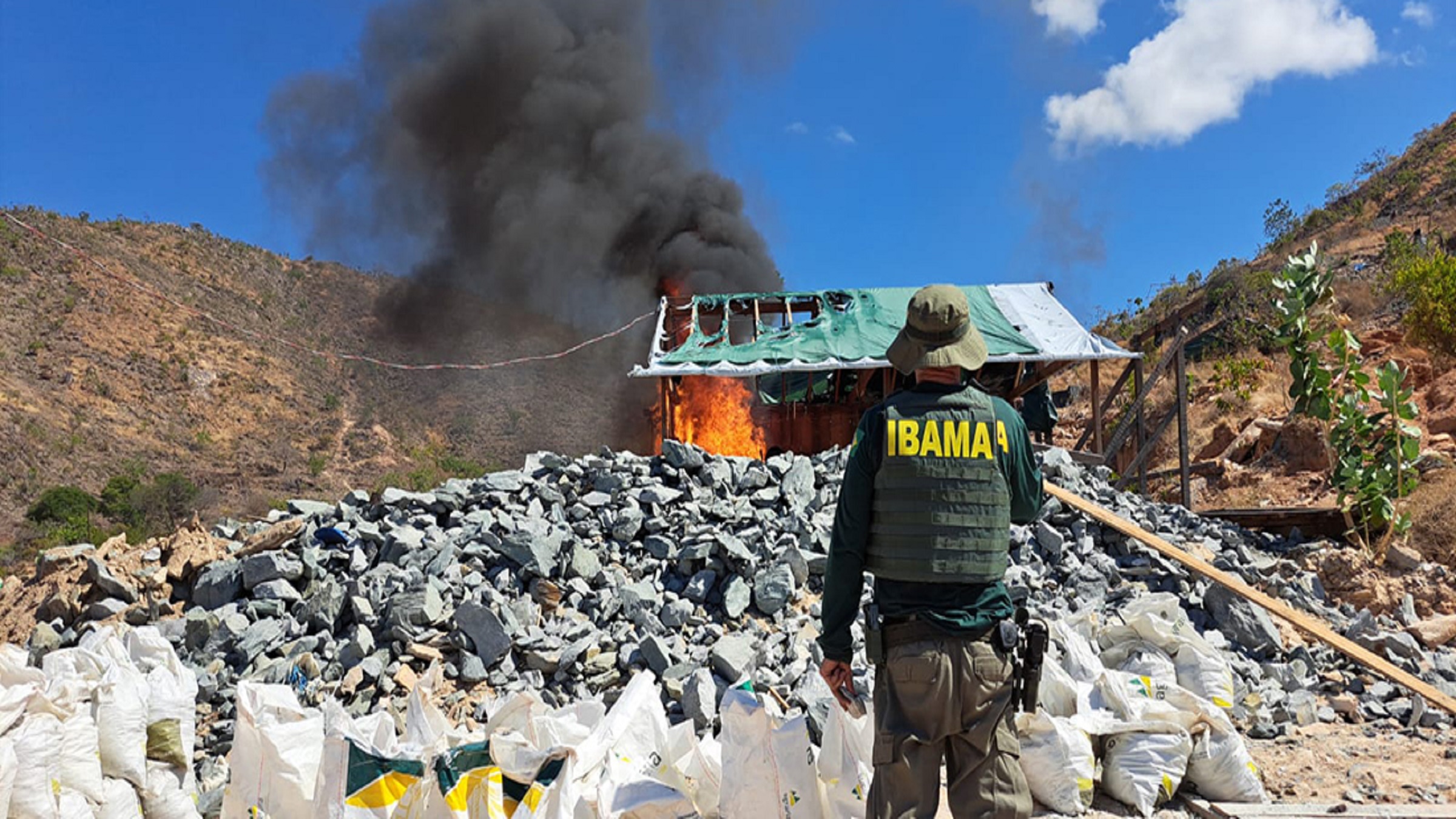
- Federal prosecutors are demanding an action plan after authorities found cyanide-contaminated ponds in the Raposa Serra do Sol Indigenous Territory in the Brazilian Amazon.
- A cheaper and more profitable alternative to mercury for miners, cyanide can kill by asphyxiation within minutes and severely contaminate soil and water.
- As crackdowns on mercury drive miners toward cyanide, a regulated chemical, officials say they hope Brazil’s legal cyanide supply chain will allow them to trace the sources and cut off the flows.
Cyanide use in illegal gold mining in the Brazilian Amazon is posing a new threat to people and animals in the Raposa Serra do Sol Indigenous Territory. The territory, in the state of Roraima, has been invaded by illegal miners who use cyanide to dissolve gold out of crushed ore, leaving behind ponds of cyanide-contaminated water.
In July, the Federal Police arrested two men and seized from them approximately 375 kilograms (827 pounds) of a “chemical compound with characteristics consistent with cyanide,” as well as 1,250 kg (2,756 lb) of activated charcoal — another substance used in gold processing in Roraima. According to the police, the seizures are linked to illegal gold mining in the Indigenous territory.
A year earlier, in July 2025, the Federal Police closed down an illegal laboratory in Boa Vista, the state capital, where rocks thought to have come from gold mining and areas of water contaminated with cyanide were found. According to the G1 news outlet, the rocks reportedly came from Raposa Serra do Sol, with miners sending them to the capital for the gold-washing and separation process.
Traditionally, illegal miners extract gold from ore using mercury — a toxic substance whose trade is illegal in Brazil. With intensified environmental raids, mercury availability on the informal market has fallen dramatically, according to Brazil’s environmental agency, IBAMA. Because no companies are authorized to legally sell mercury in the country, the product has become significantly more expensive on the black market, where a 1.5-liter (50-ounce) bottle can cost as much as 30,000 reais ($6,000), according to academic and civil society sources who requested anonymity for security reasons. Cyanide has become a cheaper alternative for separating gold from other materials in the ore.
In Brazil, the cyanide trade is controlled by the Army and authorized for industrial purposes, which ultimately creates loopholes. In addition to being more readily available than mercury, the substance offers criminals a significant efficiency boost: the cyanide method can achieve gold recovery rates exceeding 90%, much higher than the 30-50% rate obtained with mercury, according to IBAMA.
Despite this economic viability for criminal networks, the substance comes at an extremely high cost to human health and the environment. Without the proper technical controls required in the industry, cyanide is lethal in the short term, capable of killing humans and animals through cellular asphyxiation in a few minutes, according to the Center for Studies on Occupational Health and Human Ecology (Cesteh) at Brazil’s federal health research institute, Fiocruz.
Mercury has long-term effects because it doesn’t degrade in the environment and bioaccumulates throughout the food chain. According to Fiocruz, cyanide poisoning occurs mainly through the ingestion of water and food from affected areas or through direct skin contact with mud and sediments — a vulnerability that increases if the individual has skin lesions. Once in the body, the substance is absorbed rapidly, with a lethal dose for adults estimated at 1.5 milligrams per kilogram of body weight.
Depending on the water’s pH level, cyanide transforms into hydrocyanic acid, which is volatile and significantly more toxic, according to Fiocruz. “Because it has a low molecular weight and is in its non-ionized form, this molecule rapidly crosses biological membranes through passive diffusion, resulting in extremely rapid absorption,” Cesteh said in a note sent to Mongabay.
In cases of acute poisoning, the agency warns that rapid intervention is essential, while chronic exposure (multiple exposures at low concentrations) requires removal from the exposure environment and long-term care.

New challenge
The increasing use of cyanide in illegal gold mining has caught the attention of the Federal Public Prosecutor’s Office (MPF), which recommended urgent environmental remediation of several areas resembling open-air ponds contaminated with cyanide in the Raposa Serra do Sol Indigenous Territory. The MPF also demanded an assessment of the contamination — through the collection of soil, water, and sediment samples — for laboratory analysis and to determine the scope of remediation efforts, as well as an action plan. “IBAMA submitted a plan that is currently under review,” Alisson Marugal, a federal prosecutor, told Mongabay.
Marugal described the situation as “very concerning.” He said ongoing operations have identified 12 sites contaminated with cyanide in the Indigenous territory.
According to IBAMA, the presence of cyanide at an illegal gold mine “does not prove that the product was smuggled.” Further testing can help determine its origin, including identifying the substance and its concentration through forensic analysis, as well as tracing back to the manufacturer or importer the batch, the packaging, the invoices, the authorizations, the purchase records, the carriers, the recipients, and any intermediaries.
Since there’s a legal chain of distribution for cyanide in the country, IBAMA emphasizes that only after this investigation is it possible to determine whether there was smuggling, theft, fraud, or diversion of legally authorized sales in Brazil. However, the agency said that “its use in illegal mining — without a mining title or environmental permit — remains unlawful and may result in administrative, civil, and criminal liability.”
IBAMA reported that it still has no estimate for cleaning up the contamination in the Raposa Serra do Sol Indigenous Territory. Home to Brazil’s second-largest Indigenous population and officially recognized in 2005 following a long-running conflict with rice farmers that reached Brazil’s Supreme Court, the territory is home to 26,000 individuals from the Macuxi, Taurepang, Patamona, Ingarikó, and Wapichana ethnic groups. It’s also one of the country’s largest Indigenous territories, covering 1.75 million hectares (4.3 million acres) across three municipalities on Brazil’s border with Guyana and Venezuela.
Within the territory, the communities of Napoleão, Raposa I, and Parnasio, in Normandia municipality, are considered the most severely affected by cyanide contamination from gold mining.

Currently, non-Indigenous businesspeople are investing in part of the territory, according to three sources from academia and civil society in Roraima, who asked to remain anonymous for security reasons. According to the sources, these businesspeople have been co-opting and training a small group of Indigenous people who support gold mining to work under precarious conditions and at an economic disadvantage. This activity has taken place mainly in the mountainous part of the territory, where environmental degradation is altering the landscape.
According to the sources, criminal groups are involved in these operations, which — in addition to being illegal and causing significant environmental and public health impacts — are violating human rights through child labor and conditions analogous to slavery; some young people are being recruited for sexual exploitation, and community conflicts have also flared up.
“In the municipality of Uiramutã, these networks have been driving the trafficking of fuel, firearms, and drugs,” one of the sources said. “The problems are clearly visible in everyday life.”
Sources also reported that Indigenous children are involved in crushing rocks to extract gold obtained from the mine through blasting. By September 2025, media outlets such as G1 had already reported on these issues, and in December, estimates released by the Indigenous Council of Roraima (CIR) indicated there were approximately 500 illegal miners in the territory.
Gold mining has gradually taken hold in Raposa Serra do Sol since 2022, when illegal miners began migrating there from the Yanomami Indigenous Territory — Brazil’s largest and most populous Indigenous territory, home to 31,000 inhabitants. Approximately 20,000 miners invaded the territory during the administration of former president Jair Bolsonaro (2019-2022), who publicly advocated for opening up Indigenous territories to mining, and caused a serious ecological and humanitarian crisis.
With 10,000 raids carried out by April since Luiz Inácio Lula da Silva assumed the presidency in January 2023 — having promised during his campaign to protect Indigenous rights — thousands of illegal miners were removed from the Yanomami Indigenous Territory and migrated to less closely monitored areas in Roraima and Guyana, where, in addition to their proximity and ease of access to areas bordering the state, gold mining is an authorized activity.
In late October, Lula won the 2026 presidential elections for a new term until 2030, on a historic comeback against Bolsonaro’s son, Senator Flávio Bolsonaro.
Indigenous people against mining
Although some Indigenous people have been involved in illegal mining in the Raposa Serra do Sol Indigenous Territory, the majority oppose the activity, known locally as garimpo, according to Amarildo Macuxi, general coordinator of the CIR. “Ninety-nine percent of Indigenous people are against garimpo,” Amarildo told Mongabay.
He said the small group involved in this activity doesn’t represent the wider ethnic groups in the territory, where there’s a militant Group for Protection and Surveillance Against Illegal Mining (GPVITI).
Amarildo warned that while lobbyists advocate for political initiatives promoting mining extraction and other unsustainable activities on Indigenous territories, cyanide-contaminated ponds have been overflowing on rainy days, reaching rivers and other water sources in Raposa Serra do Sol. Horses, cows, and other animals have already died after drinking from water sources in the territory, where fear has disrupted traditional ways of life. Fishing and hunting have been suspended out of concerns over contamination. Artesian wells are being used to draw water, but the Indigenous people say they fear that the groundwater will inevitably be affected too if the mining isn’t stopped.
“Entire families have reported skin irritation,” Amarildo said. The CIR has already called on health agencies to conduct examinations to assess the current situation in the communities affected by the use of cyanide and mercury. But as of the date of this interview, there had been no response to the request.
“We need a long-term plan to put an end to garimpo,” Amarildo said. “Most communities do not depend on this activity. There are other economically viable alternatives. The CIR, for example, has been supporting agriculture, as well as handicraft production and cultural initiatives.”
Banner image: In March, IBAMA dismantled an illegal mining operation in the Raposa Serra do Sol Indigenous Territory in Roraima. This image from Operation Xapiri shows rocks resulting from bedrock blasting. After being crushed, the ore is processed using cyanide to separate the gold from other minerals. Image courtesy of IBAMA.
New analysis maps mercury threat to 951 Amazon communities in three countries
FEEDBACK: Use this form to send a message to the author of this post. If you want to post a public comment, you can do that at the bottom of the page.
Cite this article
Elizabeth Oliveira (2026). Cyanide ponds from illegal mining threaten Amazon Indigenous territory. Mongabay Conservation news. DOI: https://doi.org/10.66709/news-333213

