


- Conflict between small-scale fishers and industrial vessels can threaten food security and livelihoods in coastal communities, including via direct competition for species, disputes over fishing grounds or damage to gear.
- A new study introduces an index that scores 126 countries on their vulnerability to such conflicts.
- The scores are based on factors such as how much industrial activity occurs near shore, how reliant countries are on small-scale fishing for food and income and the strength of their governance systems.
- West Africa and East Asia are the most vulnerable subregions, according to the index, with Guinea, Sierra Leone and Mozambique the most vulnerable countries.
Competition between small-scale fishers and industrial vessels can threaten food security and livelihoods in coastal communities especially in the Global South. A new study looks at which countries are most vulnerable to this competition and other forms of conflict between the two sectors, such as disputes over fishing grounds or damage to gear.
The study, published Oct. 22 in the journal Nature Food, introduces an index that scores 126 countries on their vulnerability to such conflicts. The scores are based on factors such as how much industrial activity occurs near shore, how reliant countries are on small-scale fishing for food and income, and how weak their governance systems are.
Africa ranked as the most vulnerable region, followed by Oceania, Asia and Central and South America. West Africa and South Asia are the most vulnerable subregions, according to the index. At the country level, Guinea, Sierra Leone and Mozambique received the highest conflict vulnerability scores worldwide.
“There are lots of diverse ways that industrial fisheries can impact small-scale fisheries,” Melissa Cronin, an assistant professor of fisheries oceanography at the University of Massachusetts Dartmouth in the U.S. and lead author of the study, told Mongabay.
One of the most straightforward ways is via competition for the “exact same target fish species,” she said. “Because industrial vessels or large-scale vessels are so efficient technologically, they can fish much more quickly and … be this kind of bigger predator in the system and outcompete those small-scale fishers.
Cronin said she’d become interested in the topic after speaking to small-scale fishers in Mexico and Ecuador who were “enraged” at industrial vessels, which they perceived to be taking their catch and, in some cases, using it for fishmeal rather than human consumption.
Katherine Seto, an associate professor of marine sciences at the University of California Santa Cruz (UCSC) in the U.S., told Mongabay in an email that the study was “unique in its global reach and use of large scale datasets to consider these conflicts, which have previously only been studied through in depth case studies and regional comparisons.” Seto wasn’t involved with this study but has worked with Cronin before.

Trawling through the data
Small-scale fishing accounts for at least 40% of global catch, employs 60 million people and brings economic and nutritional benefits to hundreds of millions more, according to a 2025 study in the journal Nature.
The high stakes for coastal people can lead to intense competition with large vessels. In the new study, “conflict” refers to clashing interests, not necessarily physical violence, though that can also arise.
The study doesn’t look at reported conflicts between small-scale fishers and industrial fishing vessels. Comprehensive global data on such conflicts are lacking; they often go unreported. In April, a study in the journal One Earth did catalog marine resource conflicts — not just fisheries disputes — in Africa, but its database was limited to conflicts documented in the media or academic publications.
Cronin and her co-authors instead estimated in which countries fishing conflicts are to occur based on industrial and small-scale activity, calling this component of the index “exposure.” For each country, they measured the density of apparent industrial fishing within 25 kilometers (16 miles) of the shore for 2017-2021, using satellite data of ships’ positions (AIS) visible on Global Fishing Watch, a vessel tracking platform. For vessels not broadcasting AIS, they supplemented with radar imagery.
Most small-scale vessels aren’t visible on the Global Fishing Watch platform. To estimate potential overlap between industrial and small-scale activity, the researchers then factored in the intensity of small-scale catch, as determined in prior research by some of the same authors. They didn’t determine whether industrial and small-scale vessels operated in precisely the same fishing grounds, at the same depths or for the same species.
“Exposure can be really heightened if a country is more reliant on small-scale fisheries in its waters,” said Cronin, who started this work while a postdoctoral researcher at Duke University. Conflicts with industrial vessels have greater consequences in places where “many people on the coast literally live and eat from the small-scale fishery every day,” she added.
Another component of the index was effective governance. Low U.N. scores on corruption, regulatory quality, and human development contributed to higher vulnerability scores.

One increasingly common policy tool to try to protect small-scale fishers is the preferential access area (PAA), also called an inshore exclusion zone, which generally prohibits industrial fishing or certain gear types within a specified distance from the shore. More than 40 countries have PAAs, though they don’t always enforce them well. The study found that countries with PAAs had higher estimated exposure to conflict, possibly because governments adopted the policy in response to existing competition, the authors suggest.
Seto of UCSC said the finding made sense while cautioning that it doesn’t tell us anything about the effectiveness of PAAs, though her own work in Ghana has highlighted shortcomings. “In my experience, PAAs are only effective if they preserve the exclusive rights of small-scale fishers through complete exclusion of industrial vessels and provide robust, consistent, and prompt penalties for industrial violations,” she added.
Not all of the negative effects of competition run in one direction. Small-scale fishers can also affect industrial catch if, for example, they catch large numbers of a species’ juveniles inshore. But power imbalances favor industrial fleets in most documented conflicts between the two sectors, according to a 2025 review in the journal Fish and Fisheries. Small-scale fishers generally have less sophisticated equipment, fewer alternative fishing grounds and greater dependence on their catch for food and income — and often less political influence.
Both large and small-scale fishing can kill marine life and disturb ecosystems, though some forms of industrial fishing, such as bottom trawling, are particularly destructive. The study, though it doesn’t include ecological data, raises questions about ecological impacts: The authors found that 90% of the industrial vessels broadcasting AIS that they could identify in their five-year study of nearshore activity were trawlers, which can catch substantial amounts of nontarget marine life. The data doesn’t show what proportion of these were bottom trawlers, which drag their nets along the seafloor, as opposed to midwater trawlers, which operate higher up in the water column and generally cause less damage to seafloor habitats.


Takeaways from the research
Cronin said understanding conflicts between small and large-scale fishers is especially important because these conflicts are likely to increase over time due to the expansion of “blue economy” development agendas, which can include industrial fishing initiatives.
To reduce conflict, the study recommends that countries: secure tenure and access rights for small-scale fishers, including through well-enforced PAAs; implement the U.N. Food and Agriculture Organization’s voluntary guidelines for small-scale fishing rights, which were published in 2015 but haven’t been widely implemented; reduce government subsidies that contribute to industrial fishing overcapacity; and negotiate fairer fishing agreements with foreign countries that better serve their citizens.
Seto said these were “great recommendations” and emphasized that past governance choices helped set the table for today’s conflicts, including in West African countries.
“Many of these countries have had strong small scale fishing practices for hundreds or thousands of years,” she said. “However, the particular policy choice by many colonial and post-colonial governments to subsidize, develop, and collaborate with industrial fishing enterprises for revenue generation, instead of small scale fisheries, has led to the current context where two very different sets of interests — small scale and industrial — are now targeting the same resources in the same spaces.”
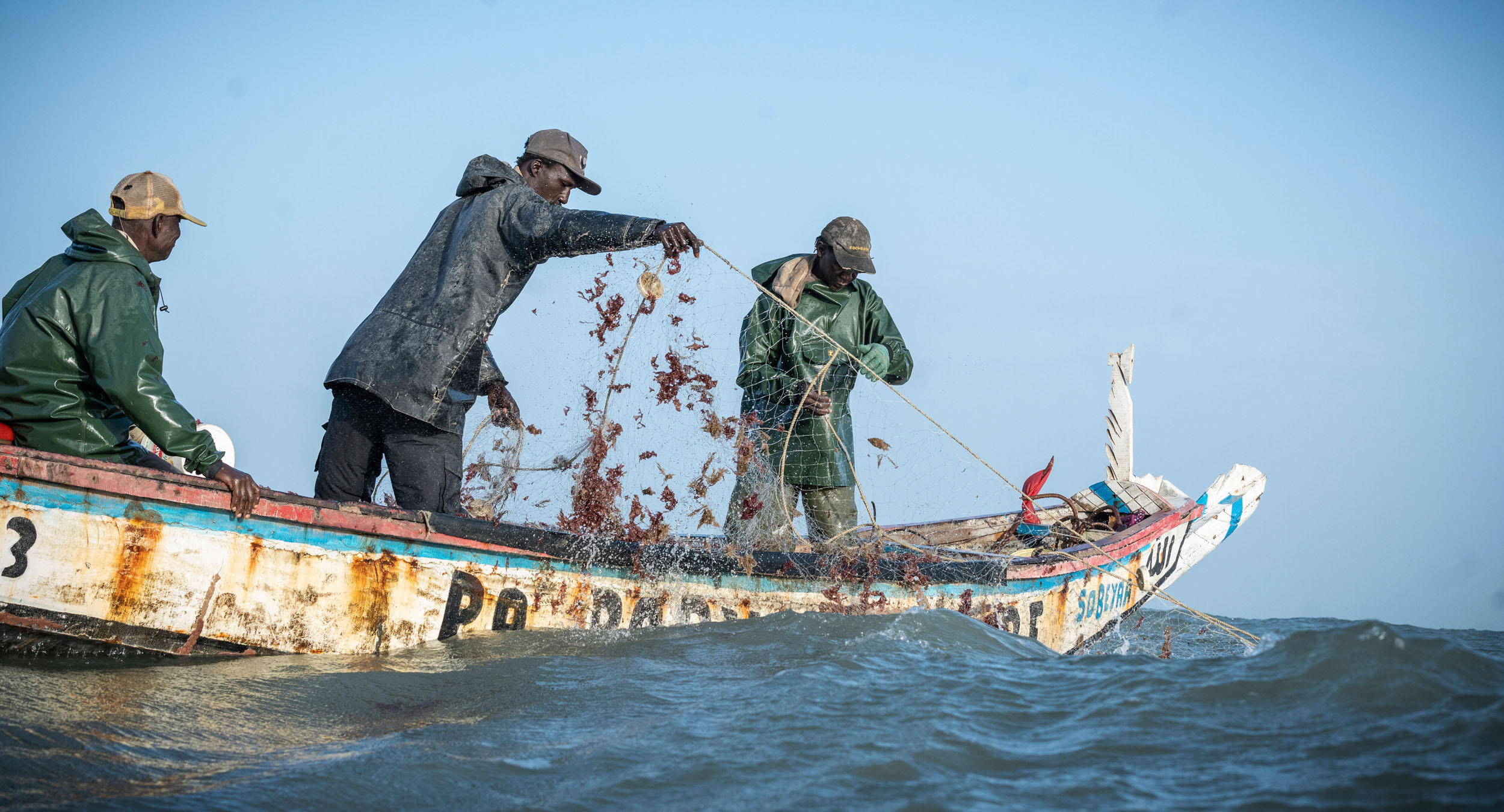
Banner image: Small-scale fishers cast their nets in the waters off the coast of Gambia in March 2025. Image by AP Photo/Grace Ekpu.
Marine resource conflicts in Africa revolve mostly around access: Study
Citations:
Cronin, M. R., Finkbeiner, E., Virdin, J., Carmine, G., Dalton, K. H., Fitzpatrick, J., … Basurto, X. (2026). Conflict with industrial fleets undermines the contributions of small-scale fisheries to sustainable development in vulnerable regions. Nature Food, 7(10), 999-1010. doi:10.1038/s43016-026-01431-z
Basurto, X., Gutierrez, N. L., Franz, N., Mancha-Cisneros, M. D. M., Gorelli, G., Aguión, A., … H. Thilsted, S. (2025). Illuminating the multidimensional contributions of small-scale fisheries. Nature, 637(8047), 875-884. doi: 10.1038/s41586-024-08448-z
Selig, E. R., Achi, N. G., Sundnes, F., Wabnitz, C. C., Nakayama, S., Hjermann, D. Ø., … Tollefsen, A. F. (2026). Patterns of marine resource conflicts across Africa highlight need for fair access and benefit sharing for a blue economy. One Earth, 9(4), 101644. doi:10.1016/j.oneear.2026.101644
Basurto, X., Virdin, J., Franz, N., DeLand, S., Smith, B., Cleary, J., … Halpin, P. (2024). A global assessment of preferential access areas for small-scale fisheries. npj Ocean Sustainability, 3(1), 56. doi:10.5194/oos2025-1544
Seto, K., Easterday, K., Aheto, D., Asiedu, G., Sumaila, U. R., & Gaynor, K. (2023). Evidence of spatial competition, over resource scarcity, as a primary driver of conflicts between small-scale and industrial fishers. Ecology and Society, 28(1). doi:10.5751/es-13650-280106
Cánovas Molina, A., & Gourguet, S. (2025). Untangling Conflicts in Small‐Scale Fisheries. Fish and Fisheries, 26(6), 1198-1212. doi:10.1111/faf.70026
Feedback: Use this form to send a message to the author of this post. If you want to post a public comment, you can do that at the bottom of the page.
Cite this article
Edward Carver (2026). New index tracks countries’ vulnerability to conflict between large and small-scale fishers. Mongabay Conservation news. DOI: https://doi.org/10.66709/news-334678

