


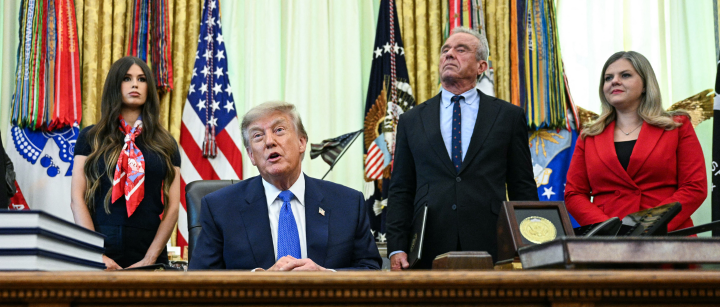
During the signing of an executive order on vaccines, President Donald Trump and Health and Human Services Secretary Robert F. Kennedy Jr. made a deluge of false and misleading claims about the U.S. childhood vaccine schedule.
The executive order establishes “Gold Standard Childhood Vaccine Recommendations” and directs federal agencies and states to advance them. The new recommendations attempt to repeat prior administration changes to the routine vaccine schedule through the Centers for Disease Control and Prevention, reducing it from targeting 17 to 11 diseases. At the time, we explained that HHS had justified this decision with a variety of incorrect or misleading assertions. A judge subsequently blocked these changes after the American Academy of Pediatrics sued HHS.
During the Aug. 10 signing, Trump repeated claims about the childhood vaccine schedule and autism that he has made in the past, often bolstered by comments from Kennedy.
- Trump misleadingly claimed that the changes to the vaccine schedule align the U.S. with peer nations. When counting diseases the schedule protects against, the changes would put the U.S. at the low end of peer nations in the size of its vaccine schedule, exceeding only Denmark.
- The president falsely claimed that the U.S. requires “72 jabs for our beautiful, healthy, lovely, delicate little children.” States require certain vaccinations to attend school, but none come close to mandating 72 doses. And there are no federal vaccine mandates.
- Trump said children don’t need to be vaccinated against hepatitis B until adolescence. That ignores what medical experts say are good reasons to vaccinate every newborn at birth.
- He falsely claimed that children and infants are being injected with massive volumes of fluid during routine immunizations, referring at one point to “vats of vaccine.” Doses of childhood vaccines are generally about a tenth of a teaspoon, and there’s no evidence that the size or number of doses under the current vaccination schedule is harmful.
- Trump baselessly suggested rising rates of autism are connected to the growth of the childhood vaccine schedule over time. A number of studies have found no connection between vaccines and autism, and the contention that there has been a massive rise in autism is also faulty.
It’s unclear what the practical results of the executive order will be. “It should not be valid legally, and CDC should not be changing its immunization schedule table,” Dorit Reiss, a vaccine law expert at University of California Law San Francisco, wrote in a Substack post.
The new order additionally recommends splitting up combination vaccines into separate doses given on separate medical visits. In another article, we wrote about Trump’s false claims about splitting up the combination measles, mumps and rubella, or MMR, vaccine.
Misleading Country Comparisons
Trump justified his Gold Standard Childhood Vaccine Recommendations by misleadingly claiming that the U.S. has been out of step with peer nations in the number of vaccines it recommends.
“For long — and far too long — a long period of time, America has recommended more childhood vaccines than any peer nation and even twice as many doses as some European countries, and even more than that,” he said during the Aug. 10 signing. He later claimed that “this updated recommendation finally aligns the United States with other advanced and developed nations around the world.
The U.S. childhood vaccine schedule historically has recommended a relatively high number of vaccines, routinely protecting against a few more diseases than the median among other high-income nations, according to our previous analysis. Reducing the number of routinely recommended vaccines to 11, as the executive order suggests, would put the U.S. schedule at the low end compared with peer nations’ recommendations.
HHS previously attempted to limit universal recommendations to these same 11 childhood vaccines in January, although this change was subsequently blocked in court. HHS backed the decision to pare down the schedule with a 33-page assessment comparing the U.S. schedule with recommendations in 20 peer nations. Among these countries, only Denmark has a smaller number of universally recommended vaccines than put forward in the proposed 11-vaccine schedule.
HHS at the time justified these changes with a variety of incorrect or misleading claims about the vaccines and the diseases they target. For example, in no longer recommending universal vaccination against rotavirus — diverging from recommendations in 17 of the 20 peer nations — the assessment minimized the significant impact of hospitalizations and the risk of death from this gastrointestinal illness. The assessment also made misleading assertions about the safety of the hepatitis A vaccine and the effectiveness of pediatric flu vaccination, while claiming that the low incidence of meningococcal disease in the U.S. was reason not to vaccinate.
“[L]ow incidence in the context of a vaccination program is what we want,” Dr. David S. Stephens, an expert on bacterial meningitis at Emory University, told us in an email at the time. “Even though polio is very low in the US we still recommend routine vaccination.”
No Requirement for 72 ‘Jabs’
Trump erroneously claimed that the U.S. is “requiring 72 jabs for our beautiful, healthy, lovely, delicate little children.” States mandate that children get certain vaccines to attend school, but the number of shots needed to meet these requirements is nowhere near 72.
The CDC’s vaccine schedule recommends a broader set of vaccines than the states require for school. The CDC vaccine schedule does not constitute any sort of vaccine requirement, as we’ve written before.
There are various ways one could count the number of recommended injections or oral doses in the CDC’s routine childhood vaccine schedule. It is only possible to reach the 70s if counting annual flu and COVID-19 vaccines through age 18, while also opting to get some available combination vaccines as separate shots. The current schedule, however, does not recommend COVID-19 shots for all children.
No states require flu vaccines for school-age children, nor do any states require COVID-19 vaccination for school.

Kennedy claimed an even higher number of recommended shots, stating that there were “72 jabs before 18, but it actually could be up to 94 jabs.”
But getting above 90 injections and oral doses would require counting each component of each combination vaccine separately. This includes separating out vaccines, such as the MMR vaccine, that are currently only available in combination. Kennedy’s inflated shot number would therefore only be near possible if Trump prevails in getting vaccine companies to break up combination vaccines, as he advocated in the executive order, while continuing to count annual flu and COVID-19 doses.
Dr. Paul Offit, a physician and director of the Vaccine Education Center at the Children’s Hospital of Philadelphia, pointed out the contradiction in criticizing large numbers of injections for children while simultaneously advocating that combination vaccines be separated.
“Here you have this administration constantly talking about how children get too many shots and then they say they want more shots,” he told us.
Infant Hepatitis B Vaccines
Trump also criticized the longstanding practice of vaccinating infants against hepatitis B at birth, saying that vaccination isn’t necessary until adolescence. But that ignores the reasons medical experts have cited for why every newborn should be vaccinated.
Health care providers, Trump said, are “giving the hepatitis B shot to infants and newborns on top of many other vaccinations. The hepatitis B shouldn’t be given until they’re 14 or 15 years old. They were given early.”
Hepatitis B is a viral liver infection that can cause serious long-term complications, including death from cirrhosis and liver cancer. Infants and children face much higher risks than adults of developing a chronic hepatitis B infection if exposed to the virus, making it especially important to prevent infections in kids. Most childhood infections result from mothers passing the virus to newborns during pregnancy or birth, though caregivers and other close contacts can also transmit the virus.
As we’ve written before, hepatitis B can also spread in adults via sex or injection drug use, and some activists have invoked the disease’s association with those risk factors to question the need for universal vaccination at birth.
The CDC first recommended a universal birth dose of the hepatitis B vaccine in 1991. As explained in a 2025 review by the Center for Infectious Disease Research and Policy at the University of Minnesota, the agency did so after narrower approaches — which focused on screening pregnant women and vaccinating the newborns of those who tested positive — proved ineffective at reducing childhood hepatitis B infections.
Since that time, according to the review, hepatitis B infections in infants and children have fallen by about 99% — from around 16,000 cases a year to fewer than 20.
The CIDRAP review notes several reasons why the previous frameworks based on maternal screening proved insufficient, including gaps in prenatal care and false negatives. Vaccinations at birth can also protect children from catching the virus if someone else in their household is infected.
Late last year, the CDC dropped its longstanding recommendation that all newborns receive a hepatitis B vaccine, saying only those born to mothers who had tested positive for the virus, or had an unknown infection status, needed a vaccine at birth, and other parents could decide “when or if” to vaccinate — which is among the changes blocked in court. As we’ve written previously, that decision came after HHS Secretary Robert F. Kennedy Jr. dismissed the members of the CDC’s Advisory Committee on Immunization Practices and appointed new ones.
Leading medical groups continue to recommend hepatitis B vaccination for all newborns.
‘Vats of Vaccine’
Trump also claimed, falsely, that children are being injected with massive volumes of fluid when they get their shots, comparing it to “a bottle of soda poured into a little child’s body” or “a large glass of something.”
“Vats of vaccine are currently pumped into your child’s body,” Trump said, echoing language he’s used before. He added that appointments should be further apart “so the body can handle this massive amount of fluid being pumped in.”
This is false. The volume of vaccines given to children is nowhere near what Trump is describing. Moreover, as we’ve written before, there’s no evidence that the number or size of doses that kids receive under the current vaccination schedule is harmful, or that the shots need to be further spaced out.
Offit told us that doses of MMR and other vaccines given to young children are typically around 0.5 milliliters, or a tenth of a teaspoon. So even if a kid gets several vaccines at one appointment, the volume probably wouldn’t exceed one teaspoon.
Multiple studies have looked at the effects of giving different combinations of vaccines at once and found it to be safe, according to a CDC page dated December 2024. As the Children’s Hospital of Philadelphia explains, kids’ immune systems are responding to thousands of bacteria from the moment of their birth, and the vaccines they receive before age 2 “are just a drop in the ocean when compared with the tens of thousands of challenges their immune systems successfully manage every day.”
Delaying routine vaccinations, meanwhile, can leave children vulnerable to preventable diseases, according to the CDC.
Offit also noted that even though children today receive more vaccines than previous generations, those vaccines actually contain a smaller total quantity of immunologic components — components such as proteins that stimulate an immune response — thanks to advances in vaccine science.
“I had a greater challenge to my immune system with the vaccines — two vaccines — I got as a child than my four grandchildren are getting today,” he said.
Baseless Connection of Vaccines and Autism
Trump repeated the baseless suggestion that the increasing number of recommended vaccinations is linked to a rise in autism.
“Decades ago, children received only a small fraction of the vaccines required today,” he said. “In those times, people were much healthier. And, of course, the high rates of autism now observed did not exist. So there’s a reason for such epidemic rates of autism. And we’re going to bring it back to much closer to where it was.”
Autism is “many, many times what it used to be years ago,” he later said. “And it gets progressively worse. And we add progressively more and more vaccines.”
As we’ve written many times before, scientists have researched the question of whether vaccines cause autism in multiple ways, looking at the MMR vaccine, vaccine ingredients shared across multiple vaccines and the vaccine schedule as a whole. None of these efforts has uncovered a link between vaccines and autism.
Trump’s underlying assumption that there has been a massive rise in autism is also highly flawed.
Experts have previously explained to us that while there may have been some true increase in autism, evidence indicates a large portion of the rise in cases comes from increased recognition of the condition. Factors driving this include broadening definitions of autism, as well as increased screening and awareness of the condition. Researchers have also suggested that the growing availability of services for children with autism contributed to a rise in diagnoses.
Rather than recognizing these factors, Kennedy and Trump made a misleading comparison between an estimate from a 56-year-old study and today’s autism prevalence figures.
“In 1970, the biggest epidemiological study at that time in history was performed,” Kennedy said. “And the university scientists from across this country looked at all the 8-year-olds in Wisconsin, about 900,000 children, and they were looking for autism, and they knew what autism looked like. And they came back with an incident rate of 0.8 per 10,000, so less than 1 in 10,000. The rate according to CDC today in this country is 1 in every 31 children.”
Trump repeated a version of these statistics. “When you hear that number, where it was 1 in 10,000 20 years ago and now it’s 1 in 30 … it’s something — something happened in the meantime. Something happened environmentally or otherwise,” he said.
Dr. Eric Fombonne, a professor emeritus of psychiatry at Oregon Health & Science University, previously told us that it was “completely absurd” to compare the autism prevalence estimate from the 1970 Wisconsin study to estimates today. At the time of the Wisconsin study, few people were aware of autism, and the researchers looked at children using different diagnostic criteria than are used today. Fombonne added that even at the time, other studies estimated a higher autism prevalence, and that people claiming a large rise in autism cite the Wisconsin study “because it gives them a very low starting point and accentuates the trend.”
Also, the researchers did not do autism evaluations on all the 8-year-olds in the state. They looked at records of children in certain medical settings, such as health clinics and hospitals.
Kennedy then repeated an incorrect claim that autism must be increasing because it’s not being seen in older adults. “If we were just noticing it more, we would notice it in older groups, but we’re not,” he said. “We’re only noticing it in kids who were born around 1989 or after.”
As we explained in 2023 in response to Kennedy’s claims, there are in fact autistic people across all generations, although the CDC doesn’t systematically monitor autism prevalence in adults. There are various factors that may lead autism in older generations to go unrecognized.
Jessica McDonald contributed reporting.
Editor’s note: FactCheck.org does not accept advertising. We rely on grants and individual donations from people like you. Please consider a donation. Credit card donations may be made through our “Donate” page. If you prefer to give by check, send to: FactCheck.org, Annenberg Public Policy Center, P.O. Box 58100, Philadelphia, PA 19102.
