


In April 1917, the German submarine UC-30 was making its way through waters near Rømø after abandoning a mission to Ireland because of engine problems. The vessel had turned back toward Germany and was close to reaching home.
It never arrived.
UC-30 was carrying 18 mines and six torpedoes, leaving the submarine packed with explosives. On April 19, it struck a British mine and sank. All 27 crew members died.
For nearly a century, the wreck remained lost beneath the sea. Danish diver Gert Normann Andersen finally discovered it in 2016.
TNT Pollution Around a WWI Submarine
UC-30 later became one of the wrecks examined through the major NorthSeaWrecks research project. Katrine Juul Andresen, a professor at the Department of Geoscience at Aarhus University, helped investigate the site.
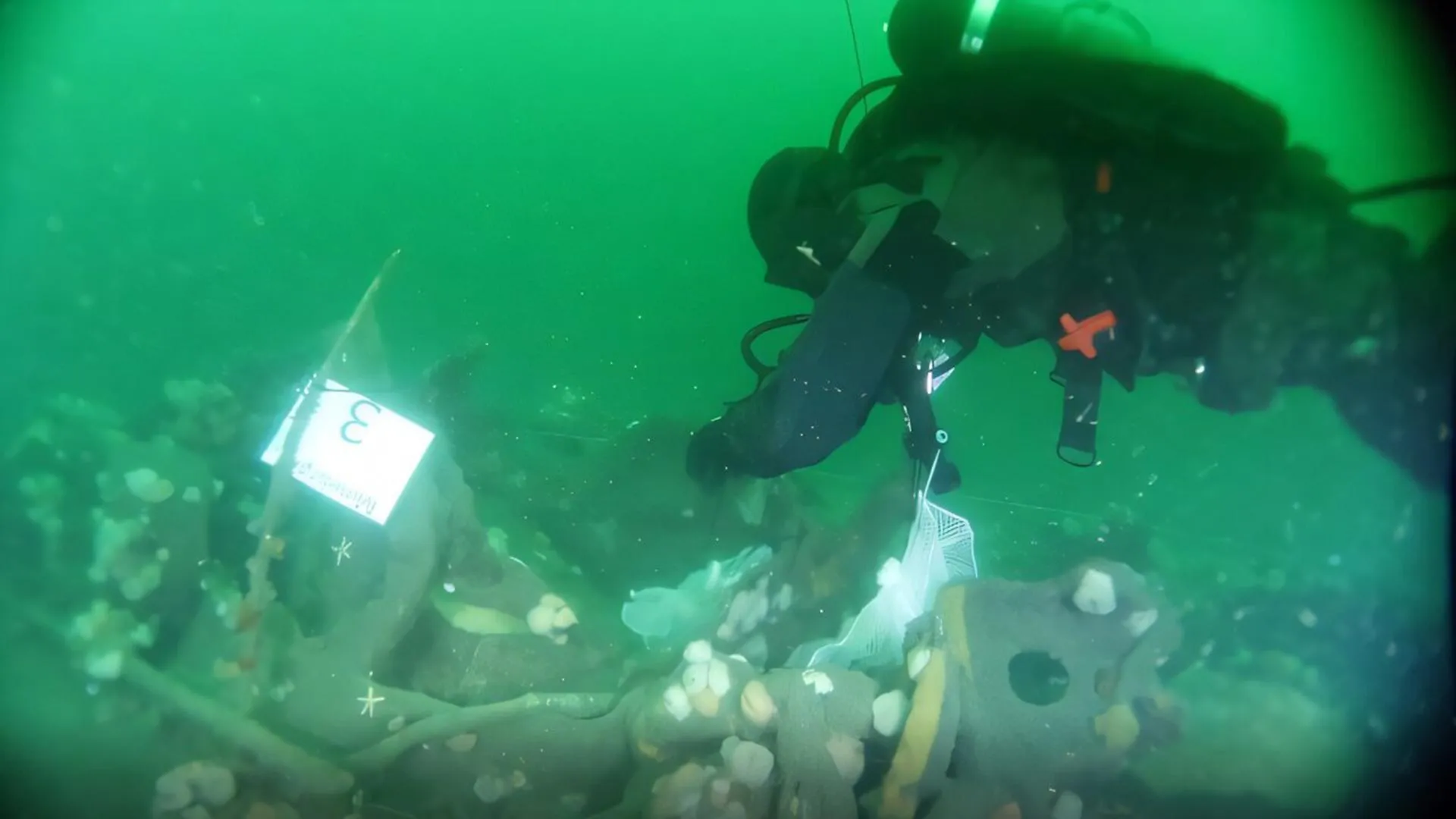
Working with navy divers, Andresen and her colleagues collected water and sediment from around the wreck. They also sampled starfish and mussels living on or near the submarine.
“Civilian diving is not permitted on the wreck, so we received great assistance from navy divers. After receiving instructions, they dove down and collected sediment samples, water samples, and wildlife samples from various locations on the wreck and from the surrounding seabed.”
“The divers also recorded video and took photos, which we subsequently used to assess the exposure of the mines and the condition of the wreck.”
The results showed that explosive material from the wreck is entering the surrounding marine environment.
“We found traces of TNT in the wildlife, the seabed, and the water column. Pollution is definitely occurring. The question is how significant the effect is and how far from the wreck the pollution impacts the marine environment. It is likely a relatively localized source of pollution, but it will worsen as the wreck continues to deteriorate and expose more of the explosive material inside the mines,” she says.
The Battle for the North Sea
During World War I, control of the North Sea was strategically vital to both Germany and Britain. Dominating the region meant controlling the movement of supplies into and out of each country, giving either side the ability to place enormous economic and military pressure on its opponent.
Germany had a smaller surface fleet than Britain, so submarines became an important part of its strategy. German submarines attempted to approach British vessels unseen and destroy them.
Both countries also relied heavily on naval mines. An estimated 190,000 mines were placed in the North Sea during WWI in hopes that enemy ships would strike them.
The region was also the site of the Battle of Jutland, fought off Hanstholm in Northern Jutland. It became the largest naval clash in history. German and British fleets battled across the North Sea, more than 25 ships were sunk, and nearly 10,000 sailors died.
Those wartime losses helped leave the North Sea seabed scattered with wrecks, many of which remain there today.
More Than 10,000 Wrecks in Danish Waters
UC-30 represents only a small part of the problem.
In 2024, Andresen prepared a report for the Danish Environmental Protection Agency examining the environmental risks posed by historical wrecks in Danish waters. The work also considered possible ways to prevent or reduce the pollution they can cause.
“In the report, I found that there are 10,127 wrecks in Danish waters. Around 15 percent of them date back to the years around and during the two world wars [1910-1920 and 1940-1945, ed.]. That is quite a high number,” she says.
The Danish Environmental Protection Agency commissioned the report as part of its effort to determine how Denmark can meet the requirements of the EU Water Framework Directive.
The findings suggest that authorities may eventually need to take more direct action to address pollution from certain wrecks.
“I am not aware of whether the agency has taken the work further since the report was published in 2024. However, research shows that the wrecks represent a source of pollution for the local marine environment,” she says.
Removing Explosives Is Not Simple
Germany has already committed substantial funding to recovering some wrecks and WWII munitions from the Baltic Sea.
After the Second World War ended, the Allies disposed of tons of ammunition by dumping it into the ocean so it could not fall into the wrong hands. Decades later, those weapons have become another source of marine contamination.
“The Germans are further ahead with this than we are in Denmark. They sometimes retrieve explosives from the wrecks and neutralize them, but doing so is very costly,” she notes.
Destroying explosives where they lie is not always the safest option.
When munitions are detonated underwater, the blast can spread contaminants through the surrounding environment. In some locations, that could make pollution worse rather than solve the problem.
“It depends on the area where the wreck and munitions lie. Currents and seabed morphology play a major role. In some cases, detonating them can do more harm than good,” she explains.
Seabed Robots Could Help Find Dangerous Munitions
Andresen is also working with international researchers through the EU-funded REMARCO project, which is exploring safer ways to deal with submerged munitions and historic wrecks.
“We are trying to identify the most gentle solutions to the problem, as there is unfortunately no easy way to clean it up,” she says.
One approach being tested involves robots that can crawl across the seafloor. These machines could map the precise locations of dangerous munitions and help researchers monitor deteriorating wrecks more closely.
Some of the robots may eventually be able to do more than observe.
“In some cases, the robots can also pick up items, retrieve them from the sea and neutralize them. That could be one viable solution for the future.”
Still, researchers say removing material from every wreck would neither be practical nor necessary.
Some shipwrecks are partly or completely buried beneath sediment, which can greatly reduce their ability to release pollutants into the surrounding water.
“Some wrecks are fully or partially buried in the seabed. When covered by sand, the risk of polluting the surrounding sea is significantly lower. It is a matter of identifying where the environmental threat is greatest – and then deciding whether the munitions on the wrecks should be removed,” she concludes.
