


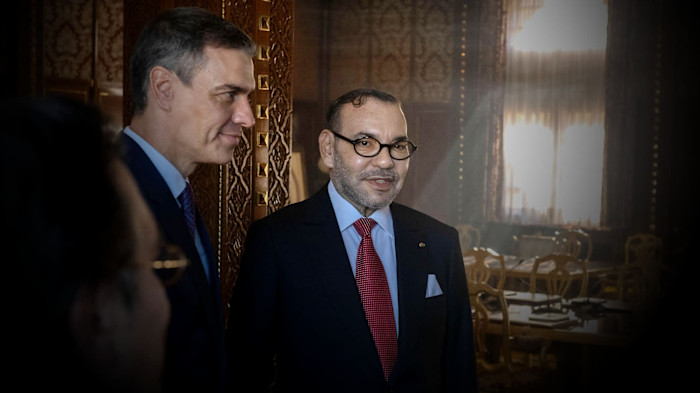
Morocco’s all-powerful monarch and Europe’s most prominent leftwing leader make for uneasy bedfellows in a relationship of mutual dependence. But the migration crisis that erupted at Spain’s borders has signalled where King Mohammed VI holds leverage over Prime Minister Pedro Sánchez.
Although Morocco’s economy is one-tenth the size of Spain’s, the two countries are bound by a dense web of commercial ties. Yet they diverge on big geopolitical issues. King Mohammed has cultivated close ties with Donald Trump, while Sánchez has become one of the US president’s main antagonists in Europe.
The desire of many young Moroccans to leave their country, and the presence of two vulnerable Spanish exclaves on the north African coast, make migration a powerful bargaining chip for King Mohammed.
This was clear long before last Thursday, when about 60,000 people swam from Morocco into the exclave of Ceuta. But the unprecedented influx — equal to three unauthorised migrants for every four Ceuta residents — marked the culmination of a five-year period in which Madrid has found it harder to manage an increasingly emboldened Rabat.
Pol Morillas, director of Cidob, a Barcelona think-tank, said Ceuta was a clear example of the “weaponisation of immigration”, likening it to how Turkey allowed Syrian refugees to try to cross the Greek border and to Belarus attracting Iraqi migrants to push them into Poland.
“In today’s geopolitical landscape it’s not always the largest powers that matter most. Those that are able to leverage interdependencies often hold a significant advantage,” Morillas said.
Sánchez has sought to avoid a serious rupture with the reclusive king in recent years by staying calm and cordial, including in the past week. The Spanish leader still needs Morocco’s help to limit the flow of unauthorised migrants from Africa to the Canary Islands, a far more significant entry point for irregular arrivals than Ceuta.
But a senior Spanish official in a former Socialist government said Sánchez was failing to recognise that episodes of tension in a bilateral relationship were normal and even healthy. “The government’s philosophy is: ‘Let’s not upset the Moroccans.’ And I think what’s happening here is that the Moroccans are reading that as weakness,” the ex-official said.
The relationship became more difficult for Madrid after a diplomatic crisis in 2021.
Brahim Ghali, head of the Polisario Front, which is fighting for Western Sahara’s independence from Morocco, arrived in Spain for hospital treatment, sparking Moroccan fury. Rabat accused Spain of “colluding” with its adversary. A few weeks after Ghali’s arrival, Ceuta got a taste of being overwhelmed: Morocco relaxed border policing and at least 8,000 migrants swam or used makeshift boats to reach the exclave.

Riccardo Fabiani, north Africa director of the International Crisis Group, said Morocco’s reaction to the Ghali episode was “the fact you didn’t tell us shows a lack of respect, therefore from now on we want to completely reset this relationship”.
“Morocco decided that Spain would need Morocco more than Morocco would need Spain,” Fabiani added.
In 2022, Rabat secured a win. Spain shifted its position on Western Sahara, a contested desert region the size of the UK, by endorsing a Moroccan plan to give the territory more autonomy but keep it under Rabat’s grip. Madrid’s move, which was announced by Morocco, mirrored the positions of other European powers.
Omar Brouksy, a professor of political science in Morocco, said Rabat’s relationship with Madrid then entered a new — more positive — phase.
In 2024, Spain and Morocco were confirmed as co-hosts of the 2030 football World Cup along with Portugal. When devastating floods hit Valencia in the same year, it was Morocco that sent dozens of specialist trucks to pump out mud.
But Sánchez’s bid for harmony is being tested by the fact Spain and Morocco remain at odds over three pivotal geopolitical issues.
First, Spain wants to maintain good relations with Algeria — Morocco’s arch-rival — because it is an important gas supplier. Sánchez was in Algiers to meet President Abdelmadjid Tebboune 10 days before the Ceuta incident and hailed a “new phase” in their relations.

Second, Morocco does not recognise Spain’s sovereignty over the exclaves of Ceuta and Melilla, which fell under the Spanish crown in the 16th century and are the only slices of European territory in mainland Africa. Some in Morocco refer to “occupied Ceuta” — and Spain’s military planning includes the potential need to fight to defend them.
Third, Spain and Morocco disagree wildly over the Trump administration. Sánchez and the US president have clashed over Spain’s limited defence spending, its opposition to the war in Iran and the prime minister’s espousal of a liberal immigration policy.
King Mohammed, by contrast, locked in Trump’s good favour near the end of his first term in 2020 by normalising the kingdom’s relations with Israel, part of the US-brokered Abraham Accords. In return, the US recognised Western Sahara as part of Morocco.
As a sign of his “deep appreciation”, the king recently announced he would name a motorway into the territory after Trump.

Michael Walsh, an academic at the University of Alaska, said Trump’s ties with the king — and animosity towards Sánchez — gave Morocco an opportunity to try to get the White House on its side over Ceuta and Melilla.
“I would say it was rational for Morocco to push as far as it can to achieve its own policy objectives between Trump’s inauguration and the midterms in November,” Walsh said.
“It has longstanding claims over the sovereignty of the two cities and now it has a small window of opportunity to advance them that doesn’t come along all that often.”
The 60,000 migrants could have been a warning shot. But Sánchez did not blame Morocco. Instead, he said Rabat’s help had enabled a large majority of them to be returned within 24 hours. The culprits, the prime minister said, were human traffickers and social media misinformation, a line echoed by the Moroccan government on Sunday.
But it is hard for Sánchez to communicate directly with King Mohammed, who rarely meets foreign leaders, said one analyst. The two have seen each other only twice since 2022.
In 2023, when Sánchez travelled with a large delegation to Morocco, he did not meet the king and had to make do with a phone call. At the time King Mohammed was reportedly away, enjoying a holiday in Gabon.
Additional reporting by Carmen Muela
