


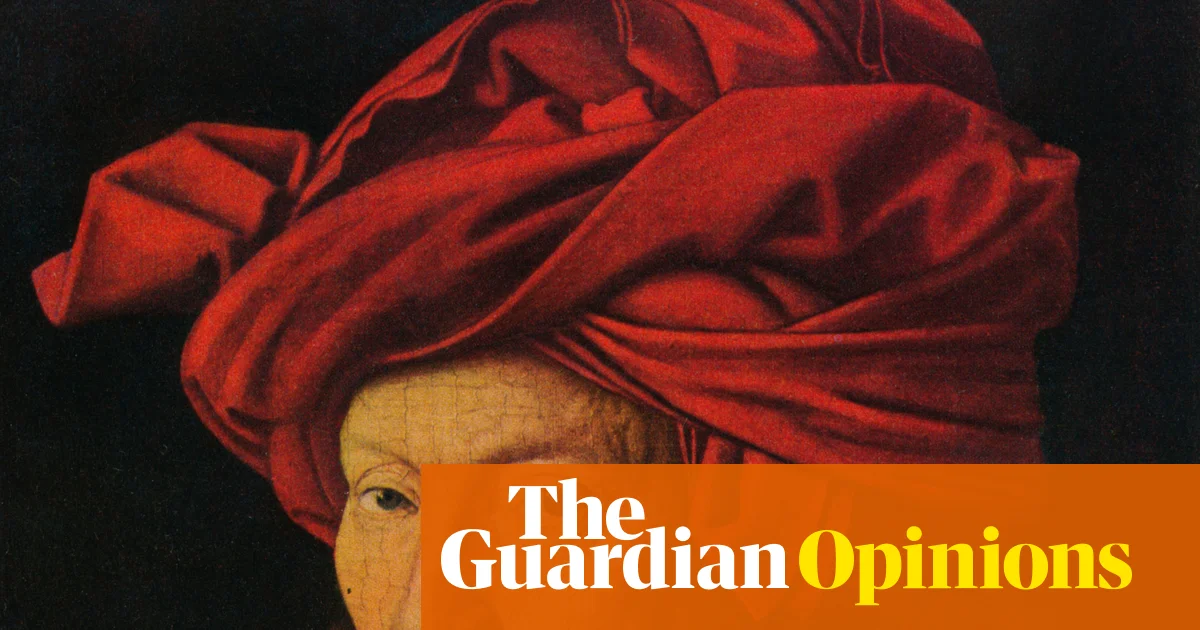
The word “human” may have been crowned the Cambridge dictionary’s word of 2026, but its meaning is nowhere more manifest than in an exhibition of paintings from almost 600 years ago. Humanness is captured in every pore and wrinkle of all nine of Jan van Eyck’s portraits, united for the first time by the National Gallery. The paintings have been loaned from Berlin, Vienna, Dresden, Bruges and Sibiu in Romania, in a triumph of cultural exchange that proves the blockbuster show is still very much alive. And so, it almost seems, are the people depicted in it, who appear so real we might “recognise them on the tube”, as the exhibition’s co-curator Nicholas Flory put it, even given their extravagant headgear.
A purplish wart, a tiny scar, bloodshot eyes, sagging jowls and dirty fingernails – it is the intimate details of Van Eyck’s likenesses that transformed Renaissance portraiture and make his sitters so relatable, in modern parlance, today. Like a novelist, the artist wanted to create the impression of capturing his subjects in a moment in time.
“While standing in front of a painting by Jan van Eyck we … believe he succeeded in rendering the inexhaustible wealth of detail that belongs to the visible world,” the art historian Ernst Gombrich wrote in Art and Illusion (1960). An exact replica is unachievable to a painter “however patiently he worked with a magnifying glass” – artistic virtuosos are only human too. From 15th-century Netherlandish paintings to 19th-century Victorian novels to the hyper-realism of Grand Theft Auto VI, mimetic art, at its best, immerses us in artificial worlds so absolutely we forget the hands that created them.
“Jan van Eyck was here, 1434” the artist playfully reminds the viewer in an inscription on The Arnolfini Portrait, a treasure of the National Gallery’s permanent collection. Despite centuries of speculation it remains a mystery. Is the woman pregnant? Who are the figures glimpsed in the mirror? Might it be a self-portrait of Van Eyck and his wife, as a catalogue essay suggests? Or is that the artist under swathes of vermilion cloth in another portrait? What is truth and what is fiction, these pictures ask.
It is no wonder that single portraits have inspired whole novels. Maggie O’Farrell’s The Marriage Portrait (2022), partly based on a painting of a 16th-century Italian duchess, explores this slippery relationship between art and artifice. Vermeer’s masterpiece Girl with a Pearl Earring sparked Tracy Chevalier’s bestseller and an acclaimed film. We long for such luminous figures to step out of their canvases and tell their stories.
With their mottled skin and sideways glances, Van Eyck’s faces are as revealing as Lucian Freud’s unflinching portraits or Jenny Saville’s colossal nudes. If, as Oscar Wilde observed, “Every portrait that is painted with feeling is a portrait of the artist and not of the sitter,” it is also a portrait of the viewer. These strangers confront us with our own humanity and mortality: “Look, we were once flesh and blood like you!”
The Cambridge dictionary editors had something more 21st century in mind when they defined “human” as “having the qualities, faults, and feelings that people have, as opposed to gods, animals, or machines”. To come face to face with Van Eyck’s portraits, often barely the size of a laptop, is a timely reminder of human creativity. This is what “human” means, warts and all.
-
Do you have an opinion on the issues raised in this article? If you would like to submit a response of up to 300 words by email to be considered for publication in our letters section, please click here.
