


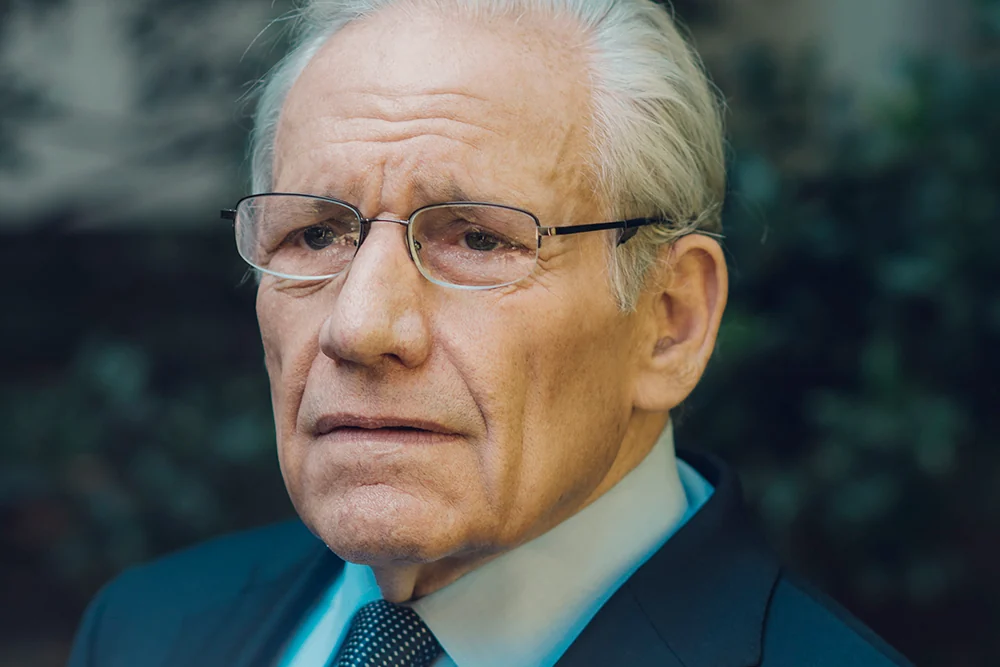
These are questions that run like a baleful subplot through Secrets, the new memoir from Bob Woodward, the Washington Post investigative reporter who, by delivering stunning scoops through 11 presidencies over a half century, has become a Washington institution in his own right. In his new book, he reveals for the first time the many deep-background sources on which he based his reporting over the decades.
Woodward, of course, became famous as one half of the reporting duo that broke open the Watergate story (the other being Carl Bernstein), prompting the 1974 resignation of President Richard Nixon. Since then, he’s produced books on everything from the Supreme Court (The Brethren) to the doomed comedian John Belushi. But starting with his 1991 book, The Commanders, Woodward has spent a good part of his later career exploring what he calls “the most serious action a president can take”: declaring war.
Much has been written about President Donald Trump’s ill-justified war against Iran that began earlier this year, and whether his controversial defense secretary, Pete Hegseth, should bear the blame for giving Trump far-too-optimistic assurances of success. But this bumbling process, such as it was, has ample precedent going back to the Vietnam War. Time after time, presidents have botched it badly, Woodward writes, for almost always for the same reasons: a failure to thoroughly hash out the pitfalls before they pull the trigger, and a commensurate failure by their senior staff to deliver tough, honest assessments of the risks.
With a couple of exceptions, such as Brent Scowcroft, President George H.W. Bush’s national security advisor, or Colin Powell, George W. Bush’s first secretary of state, presidents rarely get the straight story from their advisors, Woodward writes.
“I have seen clearly over a half century of reporting on 11 presidents how crucial it is that a president understand that part of their job is to find ways to puncture the treacherous curtain of deference around them,” he writes. “Others might call it Oval Office Freeze, not wanting to bring bad news to a president or framing something in a way that panders to their ego or worldview.”
This deep dysfunction, Woodward suggests, is the throughline from Lyndon Johnson in Vietnam, who was ill-served by his defense secretary, Robert McNamara, and other senior military officials; to George W. Bush, who was fraudulently persuaded to invade Iraq by Vice President Dick Cheney, Defense Secretary Donald Rumsfeld, and CIA Director George Tenet.
U.S. President Lyndon B. Johnson and Defense Secretary Robert McNamara react during a meeting at the White House in Washington on Feb. 7, 1968. Yoichi Okamoto/Johnson White House Photographs/NARA/PhotoQuest/Getty Images
Trump’s ill-advised aggression against Iran—which has degenerated into a draining, nine-month conflict with no end in sight—is only the latest example of governmental ineptitude at the highest level, resulting in the unnecessary loss of innocent lives and a decline in U.S. prestige and power. Trump launched “a destructive and bloody war with no legal authority,” Woodward writes. “His impulsive decision to start a war with Iran is the clearest example of what happens when there is no one to say, ‘Wait a minute, what are the consequences?’”
What’s most unnerving, perhaps, is that this ego-driven impulse to launch unnecessary wars may have grown more haphazard at a time when war has grown more dangerous. AI-driven autonomous systems are increasingly coming to dominate command and control, and presidential decisions to respond to threats sometimes must be made in minutes or seconds. Under recent concepts like the Defense Department’s Joint All-Domain Command and Control—which connects all branches of the armed forces into a unified, AI-powered network—conventional and nuclear war strategy is being combined in new ways, experts say. And in an era when many missiles are “dual use,” strategists may not know if an incoming missile has a conventional or a nuclear warhead.
Beijing appears to be implementing similar systems, and despite the historic trilateral summit this week between Trump, Chinese President Xi Jinping and Russian President Vladimir Putin, there are almost no negotiated restraints in place between the United States, China, and Russia.
Woodward writes that the threat of accidental nuclear war has haunted him since his earliest days. Just out of Yale on an ROTC scholarship in the mid-1960s, he served on a Navy communications ship designed as a relocation site for the president in the event of a national security emergency, especially nuclear war. Quickly he realized how easily the locks on the nuclear codes could be broken.
“I felt a little ill at the absurdity of it all—to have weapons of such destructive potential and to give me, a 22-year-old ensign, responsibility related to their use,” he writes. “My mind worried endlessly over the possible scenarios that could cause the nuclear procedures and safeguards to break down. What were the fatal flaws? There seemed to be far too many.”
Later on, as a renowned reporter interviewing high-level U.S. officials, including McNamara and Secretary of State Henry Kissinger, Woodward says he came to realize how disturbingly real his early fears were. “Nuclear procedures were still a mess,” he writes. Woodward quotes McNamara—the erstwhile hawk who in retirement became an advocate for the abolition of nuclear weapons—as saying, “You could never control a nuclear war.”
Today at age 83, Woodward says he’s still scared—perhaps more so. “At heart, I am still the shaken 22-year-old junior Navy officer who witnessed the weak locks on the safes guarding authentication codes for using US nuclear weapons and imagined how easily it could all go wrong,” Woodward writes. “I have always been a catastrophic thinker, but these days the dangers feel more present and grave.”

From right: U.S. President George W. Bush meets with Vice President Dick Cheney and Defense Secretary Donald Rumsfeld outside the White House Oval Office in Washington on March 19, 2003, shortly after authorizing Operation Iraqi Freedom. Eric Draper/White House/Getty Images
This theme of self-defeating war begins to emerge in Woodward’s book through an extraordinary series of interviews Woodward had with McNamara before the latter died in 2009. In excruciating detail, the anguished McNamara explains to Woodward why, during Vietnam, he failed utterly to insist on a “knock-down, drag-out debate over the loose assumptions, unasked questions and thin analyses underlying our military strategy.” McNamara astonishes Woodward by telling the reporter that not only was the U.S. military not “open in discussing their views with either the president or me,” McNamara himself didn’t really question the military at all.
“I don’t think the books today reviewing the Vietnam War give adequate attention to the failure of the senior military leaders to acquaint their civilian counterparts with their feelings that we were on a hopeless course” in Vietnam, McNamara said.
Woodward’s response? “I was aghast,” he writes.
But no fixes were ever put in place. On the contrary, as time went on, the decision-making process became even less systematic. Earlier this year, critics blasted Trump officials for saying he was attacking Iran because, as then-press secretary Karoline Leavitt said, “The president had a feeling … that Iran was going to strike the United States.” In fact, there was no evidence of a planned Iranian attack.
Read More
-

A black-and-white photograph of two men in suits and coats standing indoors, looking closely at paper documents held in their hands. A black-and-white photograph of two men in suits and coats standing indoors, looking closely at paper documents held in their hands. How JFK Helped Pave the Way for Trump’s Crackdown on Dissent
Warnings about transnational radicalism are rooted in the same accusations that sought to silence a renowned reporter decades ago.

-

A man wearing a dark suit jacket, light blue button-down shirt, and patterned red tie sits on a dark gray couch against a textured dark blue wall. He is looking off to the side with a mild smile, next to a teal pillow. A man wearing a dark suit jacket, light blue button-down shirt, and patterned red tie sits on a dark gray couch against a textured dark blue wall. He is looking off to the side with a mild smile, next to a teal pillow. The Twilight of the Francis Fukuyama Era
The famous thinker’s new memoir reveals a fateful political and intellectual blind spot.
-

A person stands facing away from the camera amid heavy debris, dust, and rubble from destroyed buildings. In the background stand skeletal steel structures of collapsed high-rises, surrounded by damaged vehicles, scattered papers, and an American flag. A person stands facing away from the camera amid heavy debris, dust, and rubble from destroyed buildings. In the background stand skeletal steel structures of collapsed high-rises, surrounded by damaged vehicles, scattered papers, and an American flag. Why 9/11 Baffles Us 25 Years Later
It’s the strategic disaster that keeps on giving.
But how different was Trump’s “feeling” from Bush saying the decision to launch a preventive war against Iraq came from his “gut”? It isn’t, Woodward suggests.
“In hindsight it is evident that not enough people got in Bush’s way. No one said, let’s slow down. What are we really trying to achieve here?” Woodward writes. As Bush told Woodward in an interview: “I’m not a textbook player, I’m a gut player.” Translation: The war in Iraq had no basis in careful analysis whatsoever.
Just as there is no record of Trump debating the wisdom of a new war against Iran with his national security team, McNamara concedes the same was largely true of Vietnam.
“The [Joint Chiefs of Staff] never really discussed the military plan for Vietnam,” he told Woodward. “I don’t think you’ll find any record, secret or otherwise, of the chiefs’ critical analysis of the military plans in Vietnam.” As McNamara later admits, the Vietnam War had nothing to do with the superpower conflict between the United States and Soviet Union or the “domino theory” of the Cold War but was, instead “a civil war, not an external war.” It was, as Woodward writes, “In effect a no-win policy.”

McNamara points to a map of Vietnam during a news conference in Washington on April 26, 1965. Marion S Trikosko/PhotoQuest/Getty Images
Similarly, when it came to examining the premises of the Iraq invasion, “McNamara’s lesson was once again ignored.” There is no record that the Bush team ever held a serious debate about the wisdom of going into Iraq.
“I could not help but think of Vietnam,” Woodward writes about the Iraq invasion. Bush, pressed repeatedly by Woodward, reveals in a series of interviews not long after the war began in 2003 that he had no real justification for his world-altering decision to attack Iraq other than the idea that Saddam, “given his nature,” might have pursued weapons of mass destruction.
“I look back on this now more than 20 years later and realize his answer was preposterous,” Woodward writes. “I should have pressed him more on this. A leader’s ‘nature’ was not sufficient grounds for invading a country.”
Nor was there even any longer much “anguish” over the possibility of making a wrong decision, as there was during Vietnam. Woodward writes that he told McNamara in one of their interviews that he tried to find evidence of “anguished memos” about Iraq similar to the ones McNamara had secretly written about Vietnam in 1967.
The Bush team’s response? “‘There’s no anguish,’ they said. ‘Well, that’s what’s wrong with them,’ McNamara declared. ‘I’ll tell you, because there ought to be anguish.’” Woodward writes: “I did not respond but I agreed fully—more anguish might have stopped the war.”

U.S. President Donald Trump, flanked by CIA Director John Ratcliffe (left), Defense Secretary Pete Hegseth (right), and Chairman of the Joint Chiefs of Staff Dan Caine (far right), addresses a news conference at the White House on April 6.Andrew Harnik/Getty Images
In his typical fashion, as he’s done through most of the 24 books he’s produced, Woodward plays the pure reporter who does little historical analysis and rarely passes judgment. Though in his last book, War, he called Trump “the most reckless and impulsive president in history,” he doesn’t repeat that assessment here. Indeed, Woodward relates most of these conversations without giving any real historical context at all.
Nor does Woodward allow himself much, if any, psychological analysis of the historic figures he’s spent so many hours with. For example, he reports on his conversations with Joe Biden, in which the then-vice president says the military was overselling President Barack Obama on the war in Afghanistan and boasts, “The military doesn’t fuck around with me.”
But it seems clear that it was Biden’s overconfidence in his own judgment that led him, as president, to ignore accurate assessments from his own military advisors about the rapid collapse of the Afghan government and subsequent takeover by the Taliban in 2021.
Still, Woodward does tend toward some broad conclusions. He quotes the late historian David McCullough as saying that the greatest acts of presidents involve not going to war.
“The examples he gave me all shared one element: restraint. The most important decision John Adams made was not to go to war with France, McCullough told me.” Similarly, Dwight Eisenhower’s “greatest series of decisions was keeping United States troops out of Vietnam.”

U.S. President John F. Kennedy meets with military leaders in the Oval Office on Oct. 16, 1962, to discuss surveillance of Cuba. Charles Phelps Cushing/ClassicStock/Getty Images
Again quoting McNamara, Woodward also notes that John F. Kennedy, unusually for a president, defied the majority of his national security team when they voted in favor of attacking Cuba during the 1962 Cuban missile crisis—voting, in effect, to go to war with the USSR. “The vote is 9 to 8 in favor of attacking and destroying the missiles, Kennedy announced to the group, and without pausing said as clear as a bell, ‘The eights have it,’” Woodward quotes McNamara as saying.
He concludes: “Looking back, the world was safer because President Kennedy believed his primary responsibility as commander in chief of the most powerful military in the world was to avoid war where possible.”
