


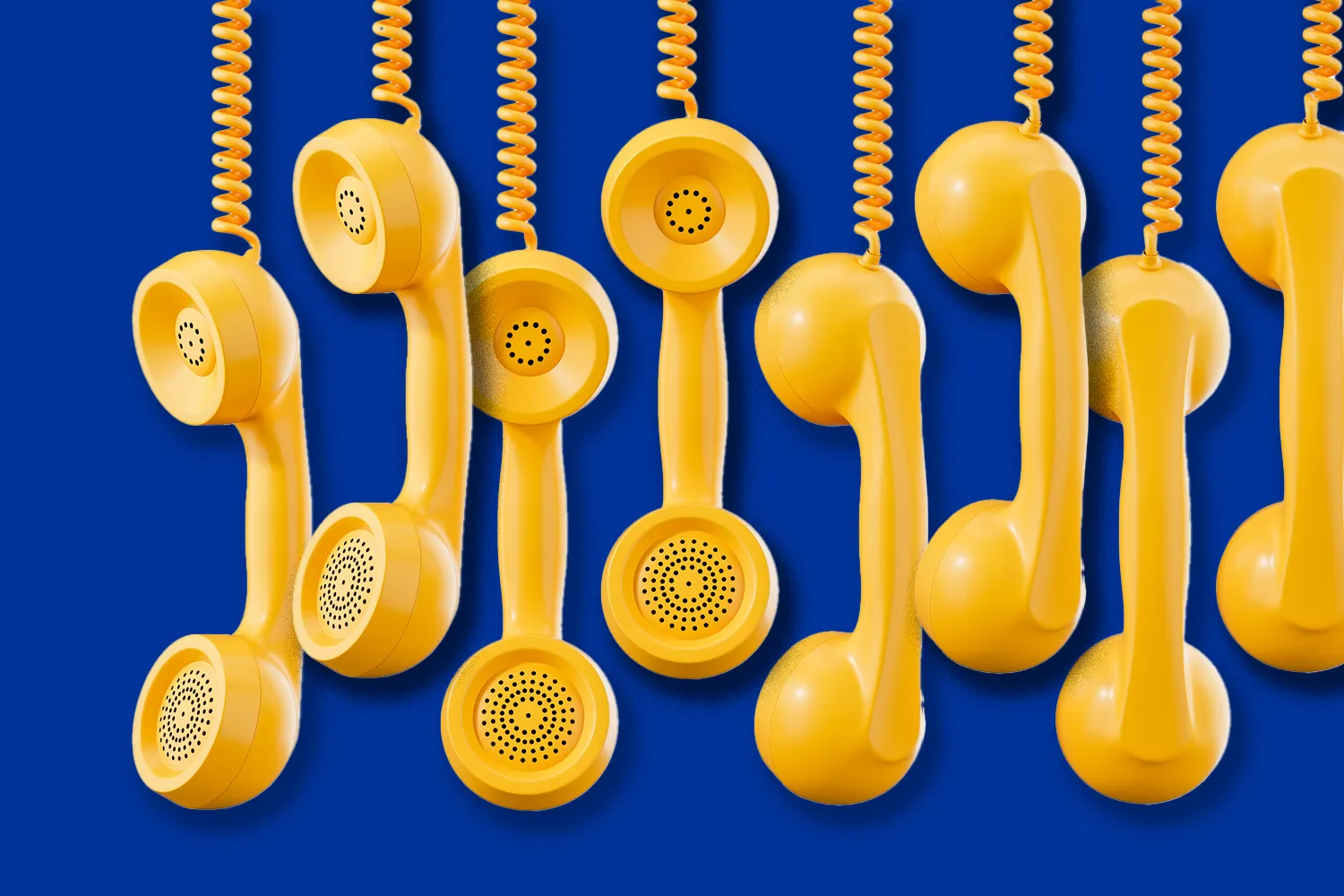
“Why don’t you just have a single phone number we can use when we want to call Europe?” Recently, in a small gathering of Americans and Europeans on the sidelines of a conference on trans-Atlantic relations, one of the American participants again brought up this question. The man—a conservative policymaker from Washington who shall remain anonymous—explained that it was awkward for Americans when they want something from Europe but don’t know what number to call on the other side of the Atlantic. Should they call the European Commission? The European Council? The European Parliament? Or do they start by phoning Berlin, then Paris, and so on? “Everything in Europe is complicated and confusing,” he complained to me. “You should get your act together!”
What often stands out in such situations is that the Europeans’ response is even more silly than the question itself: They immediately start apologizing. They sheepishly mumble that Europe is “divided,” and that things on the old continent are not as clearly organized and streamlined as in the United States.
“Why don’t you just have a single phone number we can use when we want to call Europe?” Recently, in a small gathering of Americans and Europeans on the sidelines of a conference on trans-Atlantic relations, one of the American participants again brought up this question. The man—a conservative policymaker from Washington who shall remain anonymous—explained that it was awkward for Americans when they want something from Europe but don’t know what number to call on the other side of the Atlantic. Should they call the European Commission? The European Council? The European Parliament? Or do they start by phoning Berlin, then Paris, and so on? “Everything in Europe is complicated and confusing,” he complained to me. “You should get your act together!”
What often stands out in such situations is that the Europeans’ response is even more silly than the question itself: They immediately start apologizing. They sheepishly mumble that Europe is “divided,” and that things on the old continent are not as clearly organized and streamlined as in the United States.
Their real answer should be that this state of affairs is something to be proud of: Those multiple phone numbers reflect the simple fact that Europeans have a strict institutional separation of powers and that they have various institutions representing various levels of governance and interests. All this may be hugely confusing to outsiders, but it also does something very important: It serves to minimize the chance that a potentate—a power-hungry autocratic figure like U.S. President Donald Trump, for instance—could ever come to power there.
Of course, the entire rigmarole involving European institutions often produces a cacophony of different voices and opinions. The fact that everyone deserves to be heard and, to a certain extent, be accommodated too often severely delays decision-making on crucial issues and waters down good proposals to compromises that are sometimes half-baked.
But this system has been set up precisely because Europeans do not want to have a superstate in Europe, let alone a leader who decides the fate of millions of people with a snap of his fingers.
A good number of Americans in high political positions—like the ones I met at the conference—who keep asking for that one telephone number are, moreover, fairly hypocritical: On the one hand, they say they want a single point of contact in Europe, but on the other hand, they work for or with a regime that does everything it can to undermine a more centralized, top-down Europe that could perhaps one day have one phone number. They actively seek to dismantle European rules that happen to be the result of (many) years of debate and negotiation between all those institutions, following a careful balancing of the interests of the 27 member states (the council), representatives of 451 million citizens (the parliament) and the European interest (the commission). Moreover, by forking out subsidies to far-right nationalist groups in Europe, they hope to wreck the few areas where matters are actually regulated centrally in Europe—trade and agriculture, for example.
Europeans are completely familiar with ambiguity, including when it comes to power. They have no other choice. The Czech writer Milan Kundera once characterized the continent as “a maximum of diversity on a minimum of territory.” To some extent, sharing power and seeking compromise has always been the only way to avoid war. There is nothing new about this multilayered nature of power in Europe, even if history proves that the right balance was often hard to find. On Sept. 7, 1949, just a few years before European integration formally began with the European Coal and Steel Community, the Spanish philosopher and essayist José Ortega y Gasset gave a lecture to university students. His main message was that Europe inherently embodies both homogeneity and diversity.
Yes, homogeneity and diversity, at the same time. Homogeneity because “Europeans have been forming a society for a very long time.” And diversity because within that society, there are different identities and cultures with varying interests, histories, religions, languages, geographies, and taboos. These deeply rooted differences explain why Europeans are constantly arguing and disagreeing. But they also explain why Europeans never cease the search for the overarching mechanism that can steer these disputes toward a peaceful resolution—so as to be united while still retaining their diversity. Because of this historical antagonism, Europeans are totally accustomed to, according to Ortega y Gasset, always “living in two spaces at once, in two societies: one further afield and broader, Europe; and the other closer at hand and more territorially limited, the nation.”
Again, Europeans are constantly grappling with this dualism. Every day in Brussels, you see how difficult it is to balance all the different wishes, interests, and demands, as well as to find compromises that everyone can (more or less) agree on—just look at the mudslinging over the European multiannual budget or yet another package of sanctions against Russia. But they always find a way, because they know that if they don’t, then they will fall off the cliff together. During all the crises that Europe went through in the last 20 years—the banking crisis, eurocrisis, refugee crisis, Brexit, the COVID-19 pandemic, Russia’s invasion of Ukraine—people predicted that the European Union would fall apart. But each time, it did not, and it got stronger instead. National leaders all defend national interests when they negotiate in Brussels. But when push comes to shove, they realize that they must move forward together, and so they compromise. Do they love it? No. But none of them wants to be alone in this harsh world.
The more that Washington seems to have just one phone number—namely that of the Trump family—the more Europeans should cherish their multiple numbers. They are a sign of moderation—and therefore, of civilization.
