


- The Tropical Forest Forever Facility (TFFF) aims to reach $10 billion in sponsor capital by the end of 2026, a step toward a larger $25 billion fundraising goal.
- If the target is not reached, the initiative could lose a $3 billion pledge made by Norway.
- Reports state that some countries are waiting for the results of the Brazilian presidential elections in October before pledging funds.
The Tropical Forests Forever Facility (TFFF), a new investment fund launched at COP30 by Brazil, has attracted about $7.3 billion in initial sponsor capital. The initiative aims to compensate tropical forest countries for preserving forest areas. But despite recent pledges, the fund remains short of its $10 billion fundraising goal for the end of 2026.
After the 2025 U.N. Climate Change Conference in Belém, TFFF received a wave of political support, with over 60 nations endorsing its launch declaration and five countries announcing investments.
Since then, the pace of financial commitments has been slower. Only Luxembourg and the U.K. have made government pledges this year, totaling around $600 million, while the nonprofit The Nature Conservancy committed another $5 million.
The fund has now less than four months to raise $2.7 billion and meet its target. The $10 billion benchmark is especially important because Norway’s $3 billion pledge — part of that total — will only be released once the goal is met.
“I’m in a period of anticipation right now, but also optimistic that we’ll get there,” Carlos Rittl told Mongabay. Rittl is the director of public policy at the Wildlife Conservation Society (WCS) and has contributed to TFFF’s environmental design. “There is no indication that the system itself is in doubt. But for countries to sign checks, the rules need to be very clear.”
Those rules are still being worked out. In May, an investor meeting in the Netherlands brought together more than 50 representatives from global financial institutions to discuss the facility’s financial structure. Soon after, Luxembourg was announced as host of the Tropical Forest Investment Fund (TFIF), the fund’s investment entity.
In July, an interim board, composed of countries including Brazil, Norway, the Netherlands and the Democratic Republic of the Congo agreed on a “governance Charter,” a framework for how the facility will run. That charter has now been published.
But as of August, the TFFF website said its “structure and operational parameters” were still being discussed by stakeholders, which include how risks and returns would be shared among investors.

“Part of this process is listening to the countries that have already committed capital and those with which the conversation is moving forward,” Rittl said. “Once you have clarity on how things are going to work, I think some of these dialogues will lead to new announcements.”
In a statement sent to Mongabay, TFFF co-chairs said they are having conversations with potential investors but cannot disclose details of ongoing negotiations.
“The USD 10 billion capitalization target by the end of 2026 has our full focus, and we continue to view it as achievable. More importantly, we see the current fundraising effort as part of a broader pathway toward the ambitious TFFF’s long-term objective of mobilizing USD 25 billion in sponsor capital,” TFFF said in the statement.

Norway’s conditions
In June, Norway’s parliament confirmed a pledge of up to $3 billion to the TFFF. The amount, part of the country’s budget for 2026, represents the fund’s largest contribution to date.
However, lawmakers reinforced strict conditions for the loan. Beyond the $10 billion benchmark, Norway would only release its full pledge once total sponsor capital reaches at least $15 billion — meaning it cannot exceed 20% of the total.
Torbjørn Gjefsen, acting head of policy at the Rainforest Foundation Norway NGO, said it would be difficult to change those terms if TFFF falls short on fundraising. “It’s challenging for the government to push the deadline,” he told Mongabay. “And there are no indications that they are considering changing their conditions.”
What’s more, an effort to change those terms could lead to increased criticism for the initiative at home. During parliamentary debates earlier this year, opposition lawmakers already questioned the fund’s sustainability and whether their nation was taking on too much financial risk.
Despite these challenges, Gjefsen says Norway is fully committed to TFFF. The country has recently become co-chair of the initiative alongside Brazil. The nation’s Ministry of Climate and Environment also hired former Oil Fund executive, Knut N. Kjær, to advise on the fund’s financial model.
Gjefsen believes the country’s conditions stem from the need to ensure the TFFF has enough financial support. “I think they are making sure that TFFF is a viable mechanism before they start transferring money. That includes reaching a certain level of financial commitments from other countries,” he said.
The caution could also come from Norway’s experience with other forest-finance programs in the Global South, including jurisdictional REDD+ (JREDD+). The nation has concentrated most of the financial responsibility for these initiatives.
“To date, Norway has been one of the few countries to contribute an essential amount of funding to tropical forest conservation,” he said. “They know it’s important to get other donor countries involved in these initiatives from the start.”

Last-minute contributions
Felix Finkbeiner, founder of Plant-for-the-Planet, believes other countries will step up at the last minute and help TFFF reach its goal. His environmental organization, based in Germany, has created a website to track contributions.
“Typically things never happen without a deadline, right? So I think we’re going to see a rush to the finish line at the end of this year, and not a huge amount announced before then,” he told Mongabay.
A late British announcement on Sept. 3 alleviated some of this pressure. In a letter to the House of Commons International Development Committee, the government stated plans to lend up to $540 million to TFFF. But emphasized that the investment is subject to “TFFF’s final size, crediting arrangements, structure and the terms of the loan.”
The announcement had long been expected. British officials said in December that “wider fiscal circumstances” prevented the country from committing funds. But by June, reports indicated that the government was considering a pledge. The change came after it was decided the contribution would be a loan rather than a grant, so as not to compete with domestic priorities.
The Brazilian government has also stated it continues to negotiate with the Netherlands, China, Japan, South Korea and Canada.
The Dutch government, for instance, has already contributed $5 million to support the fund’s implementation. But the country has yet to make a sponsor contribution. Recently, the Minister of Foreign Trade and Development Cooperation, Sjoerd Sjoerdsma, expressed positive views about TFFF, but said its success “is not guaranteed” because of the fund’s “scale and ambition.”
Media reports indicate that other countries could be waiting for Brazil’s presidential election in October before committing funds.
President Luiz Inácio Lula da Silva, who has championed TFFF, is running for re-election this October. Under his latest term, which began in 2023, deforestation in the Amazon Rainforest has fallen sharply.
However, his main opponent is Senator Flávio Bolsonaro, a far-right candidate who has argued for expanding mining and cattle ranching in the region. When his father Jair Bolsonaro was president between 2019–2022, he left a trail of devastation and destruction in the forest and froze grants from the Amazon Fund, another initiative backed by international donors. Now, grantees fear another shutdown if Flávio Bolsonaro wins.

Is $10 billion enough?
German policy analyst Max Alexander Matthey, who has been following TFFF closely, warns that even if the fundraising reaches $10 billion by year-end, that might not be enough for the fund to operate.
“If they start a $10 billion fund, it will not even be able to cover its own cost for the first few years,” he said. “There are administration costs and financial fees that will rack up tens of millions of dollars.”
He also notes that many sponsors plan to release their contributions over several years. Germany, for instance, has recently confirmed a roughly $1.15 billion pledge, but the money would be provided over a decade.
At the local level, this raises a question of whether a smaller fund will produce enough money to encourage countries to protect forests. “Right now we’re looking at a maximum of approximately $400 million reaching forest countries if markets hold rather than $4 billion initially announced,” he calculated. “This means $0.40 per hectare protected, which is negligible.”
Per TFFF’s design, at least 20% of that amount would go directly to Indigenous peoples and local communities, while the remainder to national conservation programs.
“This fund was designed to encourage actions against deforestation. But that comes with political and financial risks to implementing nations,” he said. “You have to offer something to counter that risk, and a couple of hundred million dollars potentially distributed over time doesn’t really do the job.”
However, Finkbeiner with Plant-for-the-Planet argues that a smaller TFFF could still provide incentives for forest preservation. “While potential payments would be lower, the penalties for forest loss would remain high,” he said. He believes countries would still work to achieve the maximum payout available.
Whether those incentives are enough will depend on each country. “It’ll be very different from place to place.”

How the fund works
The concept for TFFF was first launched at COP28 in Dubai, with a plan to attract $25 billion in sponsor capital in the form of long-term loans from countries and organizations. These funds would function as a safety net to attract an additional $100 billion from private investors.
The combined $125 billion would then be invested in assets largely in emerging markets. The returns would repay investors and reward tropical forest countries for keeping forests standing.
But last year at COP30 in Belém, the Brazilian government established an interim fundraising goal of $10 billion by the end of 2026. Former Brazilian Finance Minister Fernando Haddad called it a challenging but “possible” target, saying that contributions from only a “few G20 countries” would reach that goal, Reuters reported in 2025.
During the climate conference, the initiative received strong support from other nations. A total of 66 countries endorsed the TFFF Launch Declaration, including the U.K., Canada, China, Japan, Australia and the UAE. But many have not translated that support into financial pledges.
At the time, Australian nonprofit Minderoo Foundation also committed $10 million, a move aimed at helping “catalyse support from other philanthropies, family offices, and private investors.” However, aside from The Nature Conservancy, no other organization has announced a contribution.
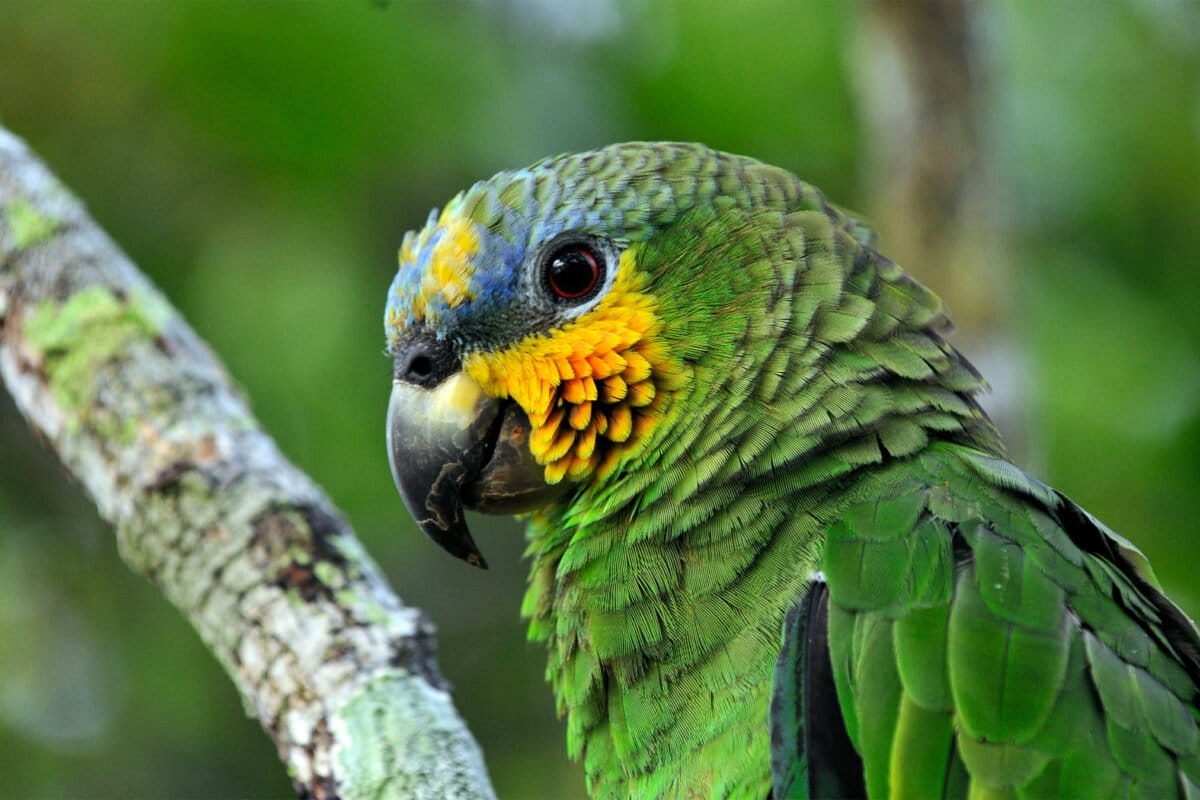
Banner image: Orange-winged amazon (Amazona amazonica). Image by ©2011CIAT/Neil Palmer via Flickr (CC BY-SA 2.0).
Tight Brazil election challenges fragile gains for Amazon conservation
‘We have to bring trust’ into funding talks: Valéria Paye on Indigenous-led funds
FEEDBACK: Use this form to send a message to the author of this post. If you want to post a public comment, you can do that at the bottom of the page.
Cite this article
Carla Ruas (2026). Brazil’s tropical forest fund races to raise $2.7 billion before deadline. Mongabay Conservation news. DOI: https://doi.org/10.66709/news-330616

