


I was sitting on a rooftop in Athens at sunset looking up at Filopappou hill. Athens in August is burning hot. Not so much hotter than London or Paris any more, but the sort of hot that makes it foolish to step out into sunlight before 6pm. Emerging from the air conditioning at dusk, I saw a dense line of silhouettes on the ridge above me. Almost every one of these shadows had its arm raised, holding a cameraphone towards the sunset.
Of all the pretty hills in the Greek capital, Filopappou arguably has the best view. The Acropolis stands directly to its north. To its south, where I sat, the city sprawls out towards the sea and a dark horizon of islands – Aegina, Salamina, Agistri.
Looking up, the wall of tourist photographers reminded me of something: war zones.
I worked as a correspondent covering conflicts and disasters for the Guardian and other newspapers for more than a decade. Over time, every new disaster came to resemble the last: another catastrophic tableau of buildings and bodies with a dense ring of telephoto lenses pointed at it.
Print reporters like me could stay at a distance from the gore and the horror because we could describe it. The photographers had to get as close as possible because they needed a clean shot.
Later, when I asked them about their work over beers at the American Colony hotel bar or tea at Gaza’s now-destroyed Al Deira hotel – how could they do it? Spend their days gazing at suffering? – most said the same thing. The lens was a buffer, a sort of protective forcefield. They weren’t looking at the fatally injured child, they were looking at the image of one.
The illustrious war photographer Don McCullin was wise to the danger in this distance. “I operate not as a photographer but as a human being,” he said in 1983, 16 years before the first cameraphone. “I try to balance what I photograph not as a photographer but as a person, a man, and photography has got nothing to do with it. It is just something I have learned, it is just a way of communicating.”
Now it’s 2026 and almost every one of us – bar the kooks and the luddites – clutches a distancing device.
I was late to Instagram, but it quickly became second nature. Now, when an attractive dish is put in front of me, an animal does something cute, a fight breaks out on a ferry, a helicopter lands to race some poor person to hospital, I pull out my phone and record it alongside everyone else.
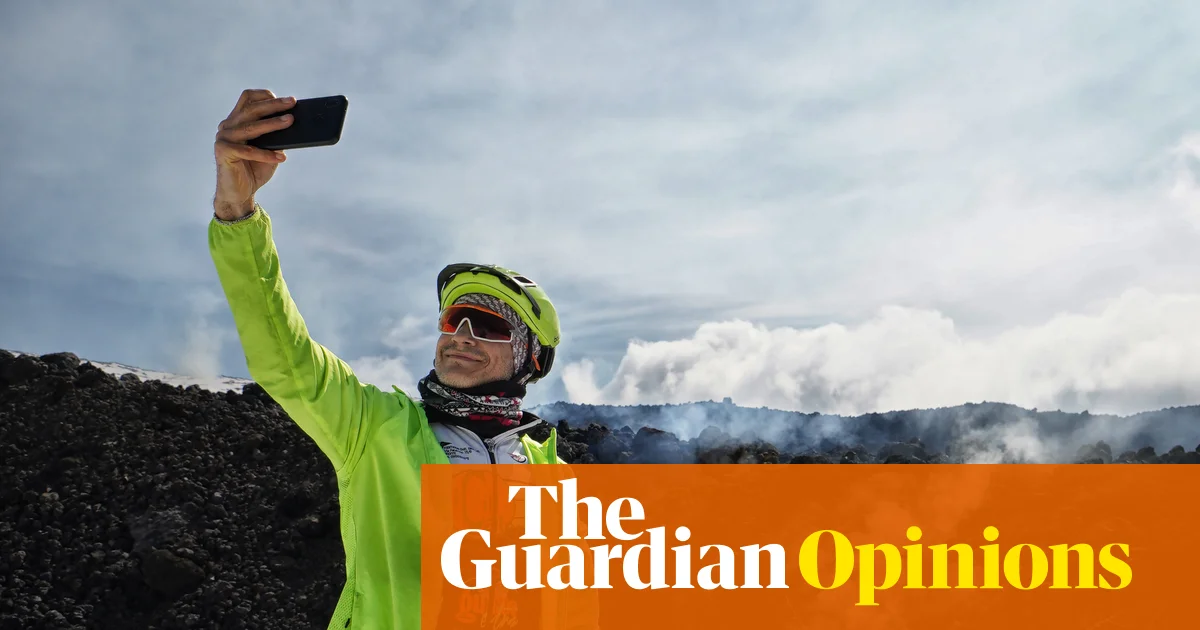
Like the people on the hill, most of us live our lives through lenses: camera first.
And they aren’t always pointing outwards. Multi-billion-dollar industries have been built on people photographing themselves. Much has been written about the psychological perils of our narcissistic age, but increasingly, the danger is more than psychological.
Earlier this month, five teenagers were killed in a car driving the wrong way down a motorway in Ireland. They crashed into another car carrying four members of a family, all of whom were seriously injured. It seems they died taking part in an online trend in which masked young men film themselves driving recklessly at high speed, baiting police into giving chase. The camera is not incidental to the danger: the danger is created for the camera.
Forensic cyberpsychologist Mary Aiken describes this as “hybrid behaviour”: filming and driving simultaneously, with “one foot in the real world and one foot in cyberspace”. While the physical car accelerates down a motorway, part of the driver’s mind is watching the finished video, the audience, the likes from other picture-sharers around the globe.
This could also explain the fatal selfie phenomenon. A study identified 332 selfie-related deaths between 2014 and 2021, most commonly caused by drowning, falling or some form of transport. These tragedies can’t all be blamed on vanity meeting the smartphone – people have always taken stupid risks – but phone cameras have changed how we perceive danger: a cliff edge becomes a backdrop, death is content.
In Afghanistan in 2009, Associated Press photographer Julie Jacobson took nine frames over two and a half minutes of 21-year-old US L/Cpl Joshua Bernard lying fatally wounded after a Taliban ambush as he was treated by his fellow marines. Jacobson didn’t help them, she photographed.
The resulting image of Bernard’s dying face and horrific injuries provoked bitter debate. His family asked for it not to be published. The then US defence secretary, Robert Gates, called AP’s decision to release it “appalling”. The news agency argued that the photograph performed an essential public function: it forced people at home to see the reality of a war being fought in their name.
after newsletter promotion
Jacobson’s defence was that in the moment she couldn’t help him and she decided the most helpful thing she could do as a photographer was to document a painful truth.
I suspect that for the average smartphone user, their cameras serve the opposite purpose. The world has become too difficult to look at directly.
Every day, those same screens show us bombed homes in Gaza, burning forests everywhere, celebrities in psychological anguish, self-harming in front of millions of TikTok followers. After reels of influencers slurping “the best cacio e pepe ever”, we are shown executions, assaults, maimed and dying children. Phone users are exposed to more suffering than a human nervous system is built to absorb, and we keep scrolling.
We’re addicted to our cameras because they have the magical capacity to turn much of what is frightening, painful or just intensely beautiful into something we can frame, edit, caption and share. They allow us to be present but absent.
It’s this sort of moral confusion I tried to explore in my novel, Vulture. Its protagonist is a British correspondent in Gaza who finds that documenting other people’s suffering gives her not only purpose but somewhere to hide. Horror becomes a picture byline; every dead body a pull quote. Bearing witness becomes absolution.
Not that we should, can or will stop recording. In Gaza, Palestinian journalists filming on their phones have provided an indispensable record of a war foreign reporters have largely been prevented from entering. There, picking up a camera is an act of extraordinary courage.
“Photography for me is not looking, it’s feeling,” the great McCullin said, an approach that has produced some of the most affecting images ever taken in conflict zones.
The rest of us may just have to work to remain human behind the lens; to remember to engage with reality once the image is posted.
-
Do you have an opinion on the issues raised in this article? If you would like to submit a response of up to 300 words by email to be considered for publication in our letters section, please click here.
