


For a generation, the United States has relied on large military bases across the Persian Gulf to project power, confident that they were beyond the reach of groups such as the Islamic State and that Iran, despite its growing missile arsenal, would not risk a sustained attack on them. The Iran war has shattered that assumption, with Iranian missiles and drones repeatedly striking those bases and forcing the U.S. military to empty facilities it has operated for decades.
Now the Pentagon is weighing whether to rebuild and harden those bases or shift its force presence westward, including to Jordan and Israel, farther from Iran’s reach. It should do neither. Both approaches assume that projecting power in the Middle East requires large, permanent bases, even as the war has shown otherwise.
The United States waged one of its largest air campaigns in decades, flying more than 10,200 sorties and conducting more than 13,500 strikes, in the first 38 days of Operation Epic Fury, despite Iran’s repeated strikes on key sites. The campaign never paused, however, because U.S. forces quickly shifted operations elsewhere when bases came under attack.
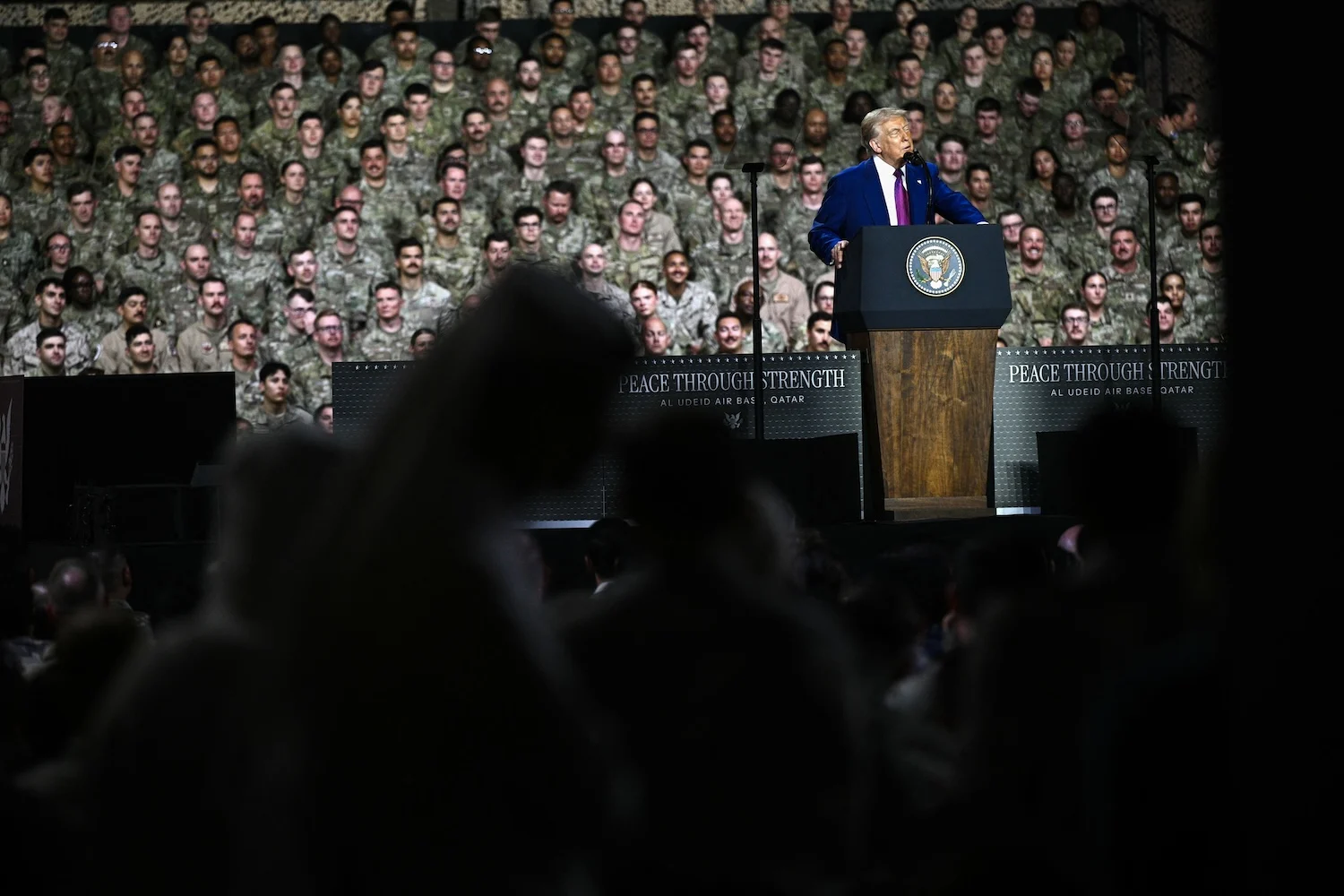
For instance, anticipating an attack on Al Udeid Air Base in Qatar, the largest U.S. military facility in the Middle East, the United States pulled its personnel and ran the air war from Shaw Air Force Base in South Carolina instead. When Iran struck Al Udeid’s Combined Air Operations Center, which had run U.S. air campaigns in the region since 2003, it was already empty. Equipment moved, too. In the days before the war, the Air Force began sending aerial refueling tankers to Ben Gurion, Israel’s main civilian airport, where they operated using existing airfield infrastructure, supported by specialized maintenance personnel and equipment brought in as needed.
That ability to keep fighting even as forward bases were evacuated or damaged may be the war’s most important lesson for U.S. force posture in the Middle East. What mattered was not large, permanent bases but access to a range of airfields, including civilian ones, and the capacity to move aircraft, personnel, equipment, and munitions among them when bases came under attack. Instead of pouring billions of dollars into repairing bases or building new ones farther west, Washington should use this opportunity to rethink its approach, trading its permanent sites for a lighter, more modular posture that better aligns with the future of warfare in the Middle East and beyond.
Neither rebuilding Gulf bases nor moving them west would fix the fundamental problems, which have been painfully exposed in recent months: These bases are easy for an adversary to find, expensive to defend, and not always available when Washington needs them.
Simply put, there is no hiding a permanent base. An adversary has years to study its layout, and Iran has used that time to determine where and when to strike. For instance, on March 27, Iran destroyed an E-3 Sentry, one of the few command-and-control planes in the U.S. Air Force’s inventory, at Prince Sultan Air Base in Saudi Arabia. Iran has also targeted operations centers, hangars, barracks, and fuel depots across multiple U.S. bases, suggesting detailed knowledge of their layouts and operations.
Defending these fixed positions against missile and drone attacks has come at a high, asymmetric price. In the war’s first six weeks, the United States burned through more than 1,000 interceptors, including more than 40 percent of its prewar Patriot stocks and about half of its THAADs.
Hardening bases would not solve the problem, nor would it come cheap. Reinforced shelters and buried fuel tanks can protect some assets, but tankers and early-warning aircraft are too large for anything but the largest and most expensive shelters. Whether Washington spends billions of dollars hardening bases or burns through costly interceptors defending them, it will be paying far more than Iran does to attack them.
Shifting bases west to Jordan and Israel would merely relocate the problem, as both are still within range of Iranian missiles. Additional permanent U.S. facilities in either country would give Tehran another set of targets to map and more reason to expand its medium-range missile and long-range drone stocks.
A westward shift would also come with added political risks. Israel in particular has repeatedly engaged in risky military behavior that puts it at odds with Washington. In August, it bombed an air base in northern Syria near the Turkish border without warning the United States—an attack the U.S. ambassador to Turkey called an “unnecessary escalation” and suggested could be meant to bait Turkey, a NATO ally, into a wider war. The United States already incurs entanglement costs from its alliance with Israel, but a large, permanent basing presence would compound them, exposing U.S. forces to retaliation for Israeli actions, potentially pulling the United States into Israel’s next war, and further straining relations with Arab partners.
Nor do permanent bases guarantee that a host country will let the United States use them when it needs them most. In May, as the United States began an operation to escort commercial ships through the Strait of Hormuz, relying heavily on aircraft flying from Gulf countries, Saudi Arabia and Kuwait temporarily restricted U.S. access. Saudi officials were reportedly alarmed that Washington was downplaying Iranian attacks on Gulf states and doubted the United States would protect them if the fighting escalated. Not long after, in July, Israel capped the number of U.S. tankers at Ben Gurion to avoid crowding out summer tourist traffic, forcing the Air Force to move jets elsewhere.
Both episodes show how quickly the United States can lose access when a host decides its interests lie elsewhere, even where Washington has long-standing bases or close strategic ties.
Washington has a rare opportunity to reevaluate its basing strategy, and instead of doubling down on permanent bases, it should work to secure access to a wide variety of airports and host-country air bases across the Gulf, in Europe, and around the edges of the Middle East. Some of these airfields would be major hubs, with the ramp space, fuel, and cargo-handling equipment to support large logistical movements. Others might offer little more than a lit runway, parking space for aircraft, fuel, and a place to store munitions, with U.S. personnel deployed only in a crisis. This is a more resilient posture because no single host government’s refusal would be enough to ground U.S. air operations and Iran would have far more locations to track and target.
Think of access as buying options on the stock market: For a relatively small premium, Washington can preserve choices for a crisis without paying the political, economic, and military costs of maintaining forces at every deployed location in peacetime. Keeping most forces at home would also leave them better prepared, with deeper technical and personal support that deployed units must do without. While forces train and gain readiness at home, much of what they need for contingencies could be stationed forward in the region. The United States could preposition weapons, equipment, and fuel at select sites; keep other supplies afloat; and rehearse surging forces into the region, dispersing them among multiple locations and shifting them when threatened.
That hedge is as much political as technological. Today, against adversaries with limited surveillance and long-range strike capacity, dispersal has a significant advantage because it complicates targeting. As surveillance improves and long-range arsenals grow, that advantage will diminish. In a world of ubiquitous sensors, there will be fewer places to hide, and the balance could eventually swing back to a few heavily fortified strongholds. That uncertainty is reason enough to hesitate before committing resources to a single posture.
This approach could also strengthen deterrence. If Iran has learned anything from this war, it is that large U.S. bases are likely to be emptied once fighting begins. That knowledge weakens the deterrent signals those bases once sent and, in turn, undercuts the strategic case for maintaining them. Deterrence requires Washington to credibly demonstrate that it can bring enough military power to bear to deny Iran its political and military objectives, but that does not mean keeping tens of thousands of U.S. forces permanently forward.
Still, a lighter posture designed to surge is not without trade-offs. Forces based outside the region would take longer to arrive and would increase demands on strategic airlift, aerial refueling, and other logistics at the start of a crisis. Keeping a wide network of airfields ready would also require continuous attention, from maintaining agreements with hosts to managing prepositioned stocks.
But the posture would come with readiness gains as well. Units rotating in for regular exercises would train more often with partner militaries and practice the same kinds of operations U.S. forces expect to rely on in the Indo-Pacific, flowing reinforcements into the theater in a crisis and then operating from dispersed locations under threat. Ultimately, whatever speed is lost matters less in the Middle East than it would elsewhere.
Tehran is not trying to rapidly seize and hold territory, making the current war a different military problem from the one Washington faces in Europe or the Pacific, where the fear is that Russia or China could present the United States with a territorial fait accompli. Instead, Tehran wields missiles, drones, proxies, and threats to Gulf shipping to pressure its neighbors into making political concessions. Coercion of this kind takes time to work, meaning Washington can respond from farther away, whether by sending forces into the region, supporting partners, or striking, without exposing U.S. troops to unnecessary risks within range of Iran’s missiles.
Offshore balancing is not a new idea. What is new is the wartime evidence that it can work. U.S. bases in the Middle East once served a deterrent purpose, but they are now less a symbol of strength than a collection of fixed targets Iran knows how to attack. Now is a good time for Washington to ask whether continuing its current posture still serves U.S. interests or is simply inertia.
