


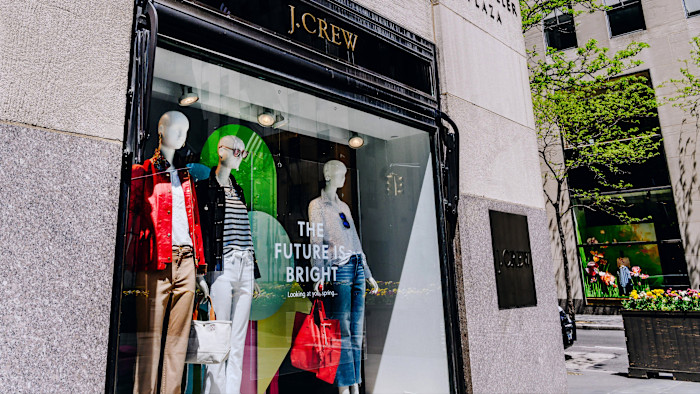
J Crew rented a pier near New York Harbour in September 2023 to celebrate its 40th anniversary. It was a festive night: Diane Keaton was among the party guests, who were treated to a concert by The Strokes.
There was much to celebrate for the American “heritage” brand, known for roll-neck sweaters and slim-cut suits. It weathered a 2020 bankruptcy to find a far more stable financial and strategic footing as the US economy soared.
The unofficial host of the evening was Kevin Ulrich, a Canadian-born hedge fund tycoon whose Anchorage Capital had taken over J Crew in bankruptcy. Under Ulrich’s leadership, the fashion brand appeared to have turned a corner.

But J Crew’s prospects have dimmed in the past two years. Sales have fallen as the retailer raised prices in response to tariffs. Its debt load from the restructuring weighs on the company’s finances, while confusion over strategy has led to turmoil in its executive ranks.
“Morale is bad,” said one executive.
Its 2025 full-year adjusted operating earnings before depreciation and amortisation fell 30 per cent to just $180mn, relative to the prior year. President Donald Trump’s tariffs on Indian and Chinese imports contributed to an estimated annual burden of more than $230mn, adding to costs, according to internal presentations reviewed by the FT.
The company’s same-store sales dipped by 8 per cent last year, even as arch-rival Ralph Lauren has seen its share price jump by 30 per cent in the last year as its revenues are growing.
J Crew carries a $500mn debt load, including a $430mn term loan that fell this year to as low as 74 cents on the dollar. (S&P now rates the loan as CCC+ after the company burned $100mn in 2025.)
The company has also been plagued by management turnover, including departures of Brendon Babenzien, its well-known menswear director, and Lisa Greenwald, chief merchandising officer.
Multiple current and former high-ranking J Crew executives and investors told the FT that they were proud of the legacy of the company but were anguished by its recent mis-steps.

When it took over J Crew, Anchorage reorganised the company at an enterprise value of $1.75bn, a figure that now is believed to be lower.
“There is a lack of strategic direction of where Anchorage wants to go with this,” the executive said. “We want to do cool things, but it’s mismanaged and there is no room for error.”
J Crew launched in 1983 as a catalogue merchant, with its first physical location later opening in Manhattan’s South Street Seaport, adjacent to where the 2023 party was held. The company reached its cultural zenith in the decade-plus that followed, culminating with Michelle Obama prominently wearing the brand as US first lady.
Two fashion legends led the company’s success. First, Mickey Drexler, credited with the 1990s revival at Gap, came to J Crew in 2003 as chief executive. And in 2010, Jenna Lyons, who started as a J Crew designer in 1990, became president and executive creative director.
Private equity titan TPG first acquired control of J Crew in 1997, taking it public a decade later and then reacquiring it in 2011.


By the 2010s, J Crew had strayed from its classic aesthetic. At the same time, “fast fashion” brands were suddenly favoured by consumers. High leverage after the buyout — and subsequent dividend payout — led to financial distress and, in 2017, the company became infamous for initiating a novel debt refinancing. That gambit kicked off the “creditor on creditor violence” era in US financial markets.
In 2020, Anchorage, as an existing lender, took control in the bankruptcy alongside Davidson Kempner and Blackstone, which held smaller stakes.
Anchorage quickly installed Libby Wadle, a J Crew veteran who joined the company in 2003, as chief executive. J Crew insiders told the FT that Wadle appeared to be distant at times from critical decision-making.
One current executive argues that Wadle failed to offer a coherent strategy across the three distinct J Crew business units and sometimes seemed surprised in meetings to learn of major new business initiatives.
Another executive said Ulrich — who worked as a Goldman Sachs trader before co-founding Anchorage in 2002 — was “very involved in the brand side” where he reviews marketing, advertising and merchandising decisions.
Ulrich helped clinch a J Crew apparel partnership with the US Olympic ski team. (He separately wrote and directed a 15-minute short film called Ski Dawgs that debuted last year).

Ulrich became a Hollywood player after Anchorage swapped debt in the MGM movie studio for a controlling equity position. Anchorage eventually flipped the studio to Amazon for nearly $10bn. J Crew has similarly made Ulrich a power player in New York fashion circles.
Several current and former J Crew executives reserved their harshest criticism for Eric Wang, an Ulrich deputy at Anchorage, who became the company’s finance chief in 2024 — the third CFO in the past four years. When he was appointed, he had spent virtually his entire career at Anchorage.
Operating executives told the FT that Wang’s lack of retail experience made him difficult to work with. Amid the tariff chaos of 2025, J Crew decided to raise prices in line with their higher input costs, largely passing on the impact to customers.
Total units sold at J Crew in 2025 fell by one-tenth year over year. Revenue of nearly $3bn remained flat, however, due to higher sales prices and new store openings.
One J Crew executive said Wang told her she would have met a profit target by simply raising the list price on an item by $7. But the executive was surprised by Wang’s analysis because it did not consider the product’s broader positioning or how customers might react to the price rise.
“Eric runs the company as a spreadsheet,” said another person who has worked closely with him.
There is also a debate about how to position the J Crew brand to consumers. The company has three segments: main J Crew, J Crew Factory and Madewell.
Madewell, a women’s concept acquired and expanded by Drexler, has disappointed since the Covid-19 pandemic amid competition from upstart fashion brands popular with Gen Z.


Some executives told the FT the legacy J Crew brand had become overly dependent on promotions and had not demonstrated to customers that the quality of its materials was worth the rising price.
Anchorage has also pushed new openings of off-price factory stores, which have risen by a third, to more than 400 in less than two years.
“Over the past five years, J Crew Group has taken proactive steps to upgrade its leadership team and invest in our brands. Today, J Crew Group has a strong balance sheet, momentum across our brands and extraordinary opportunities for global growth,” the company said in a statement.

Insiders say Anchorage would like to exit soon, but the company’s recent results would not attract a premium takeover price, even as the company’s term loan has recently rallied above 80 cents.
A former longtime executive believes another J Crew comeback is possible.
“The brand is not broken,” this person said, adding that longtime chief operating officer Mike Nicholson is a “terrific” executive. The company has also just named Kathleen Van Nest Pierce as president for the J Crew brand.
But at a moment when J Crew’s biggest rivals are thriving despite tariff drama and inflation-weary consumers, the stalwart of classic style is off its game.
“How is heritage doing so well but the brand that invented it is struggling?” asked a former senior J Crew executive.
Additional reporting from Haley Zimmerman
