


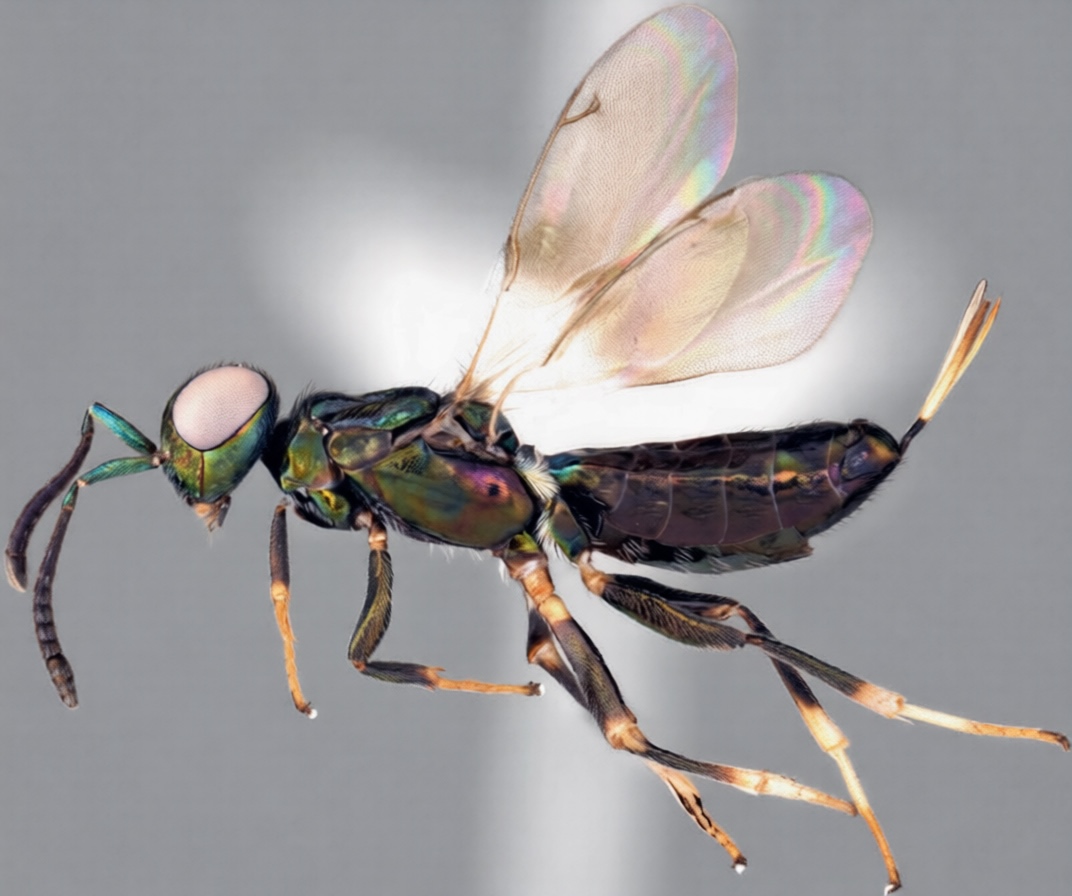
Photos of a striking, iridescent wasp posted on social media by wasp enthusiasts in Japan have led to an unexpected discovery: The images are the first record of the species in Japan. The footage also helped scientists describe a male of the species for the first time.
The images and a video of the wasps were posted by two citizen scientists on Twitter (now X) in 2018 and 2021. The video showed a female wasp depositing her eggs onto a hard egg case of a praying mantis.
Taisuke Kawano, a wasp expert at the Kyushu University Museum, Japan, noticed the footage and contacted the wasp enthusiasts who then sent him a few specimens of the wasp. The citizen scientists are also co-authors of a study, published in June, that details the scientists’ findings.
Kawano and his colleagues identified the wasp as Eupelmus curvator. It’s a parasitoid wasp that lays its eggs in the egg cases of mantises. The larvae of the wasps feed on the mantis eggs as they develop.
The researchers said the photos posted on social media are the first known record of Eupelmus curvator in Japan. The species was previously known only from China.
The researchers were also able to scientifically describe the E. curvator male for the first time. Only the female of the species was previously described.
The wasp was, for the first time, recorded targeting the eggs of the narrow-winged mantis (Tenodera angustipennis). In one mantis egg case, the scientists found 77 wasps and just a few uneaten mantis babies.
In an email to Mongabay, Kawano said only five known species of Eupelmus wasps parasitize mantis egg cases.
Entomologists have estimated that there could be up to a million parasitoid wasp species, many of them not yet described or detected.
Social media can become an increasingly important tool for biodiversity research, said Kawano. “Social media can be particularly useful for detecting unusual behavior, host associations, or records from previously undocumented regions,” he said. “In our case, the discovery began with a social media post reporting an unfamiliar wasp emerging from a mantis ootheca.”
But social media is not a replacement for field surveys, Kawano added: “Photographs and videos provide only limited information, and specimens are often essential for accurate identification, especially in very small insects. I therefore see social media not as a replacement for field surveys and taxonomic research, but as a way of greatly expanding the range of clues and starting points available to researchers.”
Michael Ohl, a wasp expert at the Natural History Museum of Berlin who was not affiliated with the study, said digital observations like the E. curvator social media posts cannot replace collecting specimens required for formal species descriptions.
“Digital collecting should therefore complement, rather than replace, museum collections. One of its greatest strength lies in helping taxonomists identify promising material for further study,” he said in an email to Mongabay.
Banner image of a female Eupelmus curvator, courtesy of Taisuke Kawano.
