


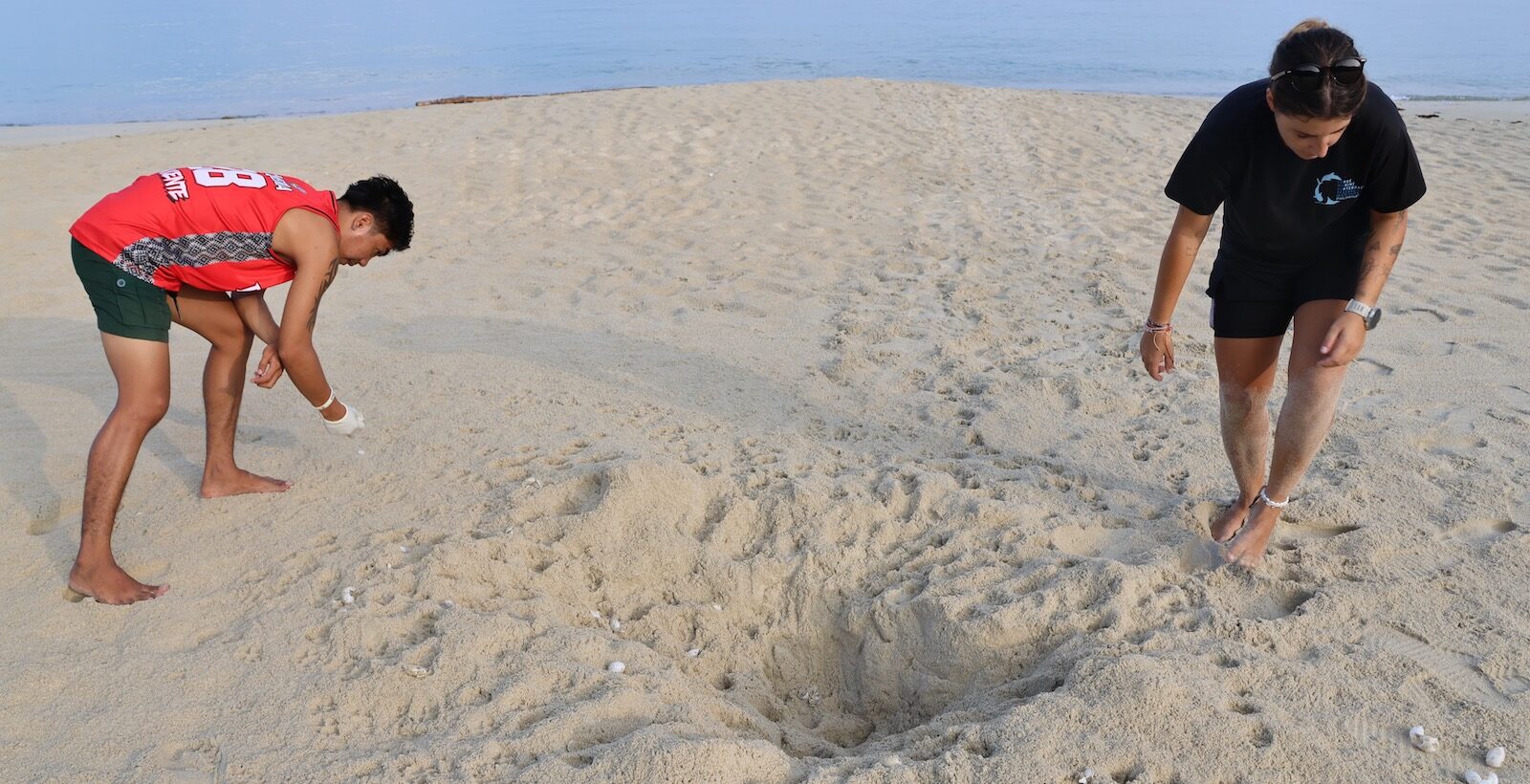
Beaches in San Vicente municipality in the Philippines’ Palawan province are crucial nesting grounds for olive ridley sea turtles. But the turtles and their babies face perilous journeys on those beaches — from dogs, tourism, and increasingly severe storms and high tides.
To counter these threats, the NGO Large Marine Vertebrates Research Institute Philippines (LAMAVE) has partnered with residents to patrol the beaches and rescue turtle eggs, reports contributor Rachel Duckett for Mongabay.
In Santo Niño village, volunteers and patrollers conduct intensive night patrols covering more than 8 kilometers (5 mile) of the beach in five shifts.
When the patrollers find a nesting turtle, they protect her from dogs. When she’s done nesting, they measure her and take photographs of her before she reenters the water. These help them identify her in the future.
Then they relocate the eggs to protected hatcheries, a move researchers say is vital because nests left on the beach are almost always lost to stray dogs or flooding. Sometimes, they encounter dead nesting mothers or turtles mortally wounded by dogs. They remove eggs from those nests as well.
“In the end, even though she’s dead, at least her babies survive,” said researcher Klara Simon at LAMAVE.
In the hatcheries, the eggs are placed in nests in the sand, which the researchers check on every few hours. Baby olive ridleys (Lepidochelys olivacea) start emerging two months after the eggs are laid.
According to LAMAVE data from last season and preliminary data from this season, their hatcheries achieve a hatching success rate of approximately 75%. For comparison, on beaches untouched by predators, hatching success rates of 80% or higher are common for olive ridley nests.
Local patrollers like Jerald Mahusay, who once viewed turtle eggs as toys during his childhood, now serve as research assistants and patrol leaders. LAMAVE also engages directly with residents to manage free-roaming dogs, such as building enclosures for pets that might otherwise attack turtles and eat the eggs.
Despite the current reliance on hatcheries, project leader Kalei Suza said relocation is a temporary measure necessitated by human-induced pressures. “We still want the turtles to nest in their regular, natural place where they want to nest, because mama knows best,” Suza said, noting that the ultimate goal is for the community to take full ownership of turtle protection.
San Vicente has seen a rise in tourism over the last few years. Luxury developer Century Properties purchased 56 hectares (138 acres) of land in the municipality with plans to build a beachfront resort. Another major developer, Megaworld Corporation, has begun construction of a resort expected to cover 462 hectares (1,142 acres).
Read the full story by Rachel Duckett here.
Banner image: LAMAVE patrollers find a predated nest in Santo Niño, San Vicente, Palawan, April 2026. Image by Rachel Duckett for Mongabay.
