


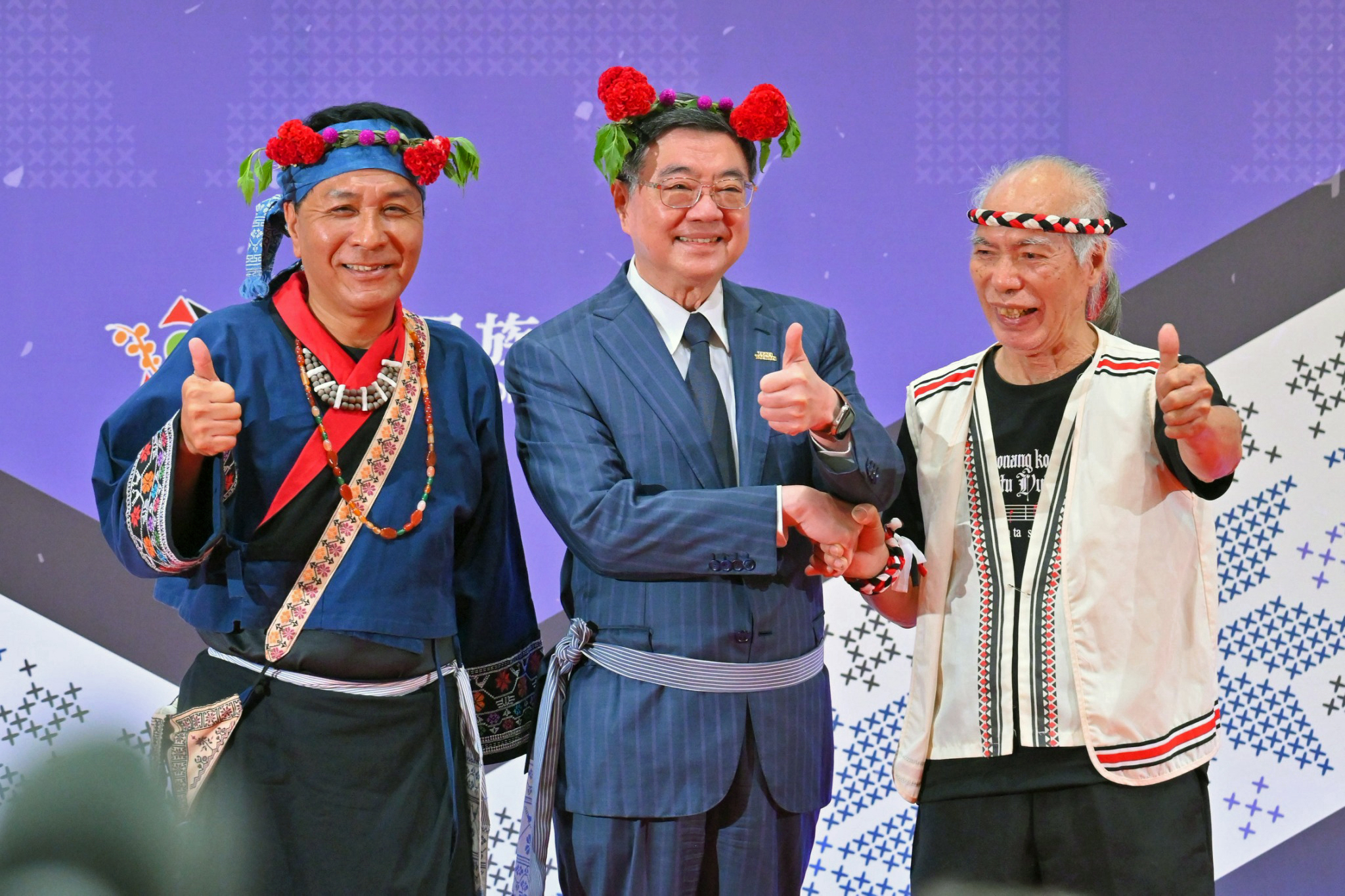
- On July 30, the Siraya became the first Indigenous group from Taiwan’s lowland plains, or Pingpu, to gain official status under the Pingpu Indigenous Peoples Identity Act, which offers pathways to redress the erasure of their Indigenous identities.
- The designation also encapsulates the Siraya’s decades-long fight for legal recognition after centuries of forced assimilation by various colonial powers.
- The Siraya, a traditionally matrilineal people residing mainly in the southern city of Tainan and its surroundings, are considered to be the largest of the Pingpu Indigenous groups.
- Seen to be “well assimilated” with the Han Chinese population, the Pingpu communities have been largely denied not only official Indigenous status but also legal protections, resources, and other benefits.
In a significant milestone, the Siraya people of Taiwan have won legal recognition from the government as the island’s 17th officially designated Indigenous group.
In late July, the Siraya were the first Indigenous people from Taiwan’s lowland plains, or Pingpu, to gain official status under the Pingpu Indigenous Peoples Status Act. The law, passed in October 2025, offers pathways to redress their erasure as Indigenous peoples.
The designation also encapsulates the Siraya’s decades-long fight for legal recognition after centuries of forced assimilation by various colonial powers.
“I’ve officially announced in a Cabinet meeting that the Siraya are a legally recognized Indigenous group in Taiwan,” Premier Cho Jung-tai said on July 30 to cheers from Siraya community members.
Wan Cheng-hsiung, activist and founder of the Tainan Siraya Cultural Association, shouted in Siraya, “We’ve finally come home!”
President Lai Ching-te, who backed the Siraya’s fight for cultural and legal recognition during his previous tenures as mayor of the city of Tainan and later as vice president, welcomed the news. “This is a historic moment for the Siraya people and an important milestone in the pursuit of historical and transitional justice for Indigenous peoples,” he wrote on Facebook on Aug. 1, Taiwan’s Indigenous Peoples’ Day.
Jolan Hsieh, an Indigenous studies scholar at National Dong Hwa University in Taiwan, who’s also known by her Siraya name, Bavaragh Dagalomai, said the impact of the recognition “could be profound, but recognition itself is only the beginning.”
“I see official recognition primarily as a process of restoring a relationship between the state and a people whose identity was denied or administratively erased, rather than granting us an identity that we did not previously possess,” she told Mongabay.
“At the same time, recognition matters because state recognition has very concrete consequences. It affects political representation, cultural rights, education, language revitalization, land and resource questions, and access to institutional support.”
Matrilineal society
While Taiwan has a predominantly Han Chinese population, it is also home to Austronesian-speaking Indigenous communities. According to the Ministry of the Interior, there are 629,000 people registered as being of Indigenous descent, or around 2.7% of Taiwan’s total population.
The Siraya are a traditionally matrilineal society residing mainly in the southern city of Tainan and its surroundings. They’re considered the largest of the Pingpu groups, the Indigenous inhabitants of Taiwan’s lowland plains and coastal areas. As of 2016, Tainan recorded more than 11,800 people successfully registered as Siraya.
Other Pingpu Indigenous groups include the Kavalan, Ketagalan, Taokas, Pazeh, Papora, Babuza, Hoanya, and Makatau.
Under a succession of colonial powers, including the Qing dynasty, the Japanese, and the Kuomintang, Pingpu communities faced greater pressure and coercion to assimilate into Han Chinese culture and identity than their highland Indigenous counterparts, who traditionally inhabited Taiwan’s mountain ranges.
Seen to be “well assimilated,” the Pingpu communities have been largely denied not only Indigenous status but also legal protections, resources, and other benefits accorded to other Indigenous groups, such as support for ancestral languages and reclaiming land rights.
The Kavalan gained limited recognition as Taiwan’s 11th Indigenous group in 2002. The status is not automatically granted to everyone of Kavalan descent but only to those who registered decades ago under certain timeframes and their descendants.
Siraya activists and academics estimate there are around 250,000 to 350,000 people who claim Indigenous status but are not recognized as such by the government, Hsieh said.

Protests and legal challenges
The Pingpu peoples began fighting for legal recognition following the end of martial law in 1987 and the subsequent democratic reforms.
The government’s reconciliation efforts began 10 years ago, when Tsai Ing-wen was elected president. During her inauguration speech in May 2016, she promised Indigenous rights reforms.
Months later, on Aug. 1, Tsai issued an apology to Indigenous peoples on behalf of the government for “the four centuries of pain and mistreatment” they had endured. The watershed moment came after hundreds of Indigenous community members staged a two-day protest in front of the presidential office, demanding justice and real reforms.
In May 2017, Taiwan’s legislature passed the Indigenous Languages Development Act, which recognizes Indigenous languages as national languages and provides measures to ensure their preservation, development, and use in private and public spaces.
There have also been more than a decade of legal fights. In 2010, Siraya activist Uma Talavan filed an administrative lawsuit seeking recognition of the Siraya as Indigenous. After a series of rejections by lower courts, and appeals by Siraya groups, the Constitutional Court finally ruled in November 2022 that it was unconstitutional for the government to exclude the Pingpu communities from official Indigenous status and gave the legislature three years to draft legislation on the matter.
The parliament finally passed the long-awaited law in October 2025, and it took another nine months before the executive branch of the government conferred official status on the Siraya.
According to the Council of Indigenous Peoples, a ministry-level body, it’s expected that eligible Siraya can begin registering their Indigenous status in mid-August.

Long fight ahead
“The Siraya experience demonstrates that Indigenous identity cannot be determined simply by asking whether a community has remained culturally ‘pure’ or whether its language and traditions have survived unchanged,” Hsieh said.
She added that recognition should be “followed by substantive rights and resources” to rebuild “a people after centuries of colonial assimilation.”
“We need resources, institutions, language revitalization, community capacity, and, most importantly, the ability to define our own priorities.”
Premier Cho called the Siraya’s official recognition “an important historical moment and a significant step” for Taiwan to continue “protecting the rights of indigenous peoples and respecting multiculturalism.”
He vowed that the Cabinet would work closely with local governments, academics, and Indigenous organizations to advance the review of applications by other Pingpu Indigenous groups.
For Siraya activists, there is still a long fight ahead.
“We know there are over 400 legal provisions from 100-200 laws concerning Indigenous peoples. So far, only amendments to three laws have been passed,” Talavan told journalists after the July 30 ceremony. “[We hope] to revise the laws thoroughly and make sure they reflect our due rights.”
While the recent development is a cause for celebration, Hsieh said it’s also a time for reflection.
“Taiwan has often been celebrated as a place where Indigenous peoples have gained constitutional recognition and where Indigenous rights have developed significantly,” she said. “That history is important. But it also means that Taiwan has to confront the unfinished parts of its own Indigenous justice project.”
Banner image: Taiwan Premier Cho Jung-tai, center, celebrates with Siraya activists Wan Cheng-hsiung, right, and Alak Akatuang in Taipei on July 30, 2026, after announcing the recognition of the Siraya people as the island’s 17th officially designated Indigenous group. Image courtesy of Taiwan’s Executive Yuan.

