


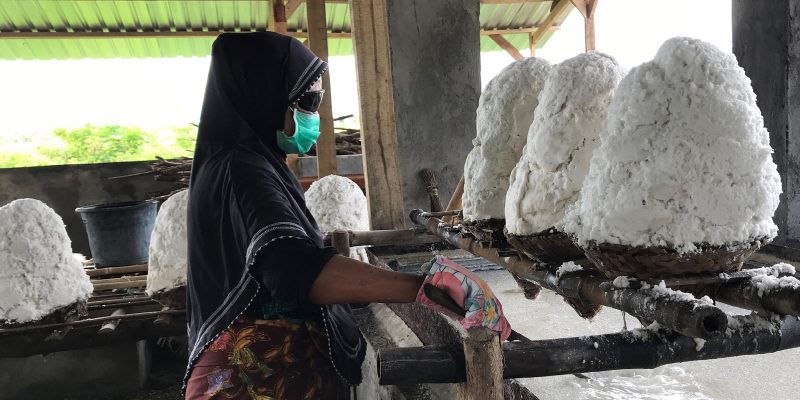
Sea salt sold in markets across Lombok Island, Indonesia, is contaminated with microplastics, according to a recent study.
Microplastics are small plastic particles less than 5 millimeters in length that form when larger plastic waste breaks down. Microplastics have been found everywhere scientists have looked for them, including seafood and table salt, raising concerns for public health.
Much of the plastic waste generated on land ends up in the ocean where it can break down into microplastics. Because sea salt is created by evaporating salt water, it is particularly vulnerable to microplastic contamination when the source water contains suspended microplastics. Scientists estimate that there are millions of tons of plastic pollution in the ocean, by far the largest form of marine pollution.
The research team lead by Anna Ida Sunaryo Purwiyanto collected 20 salt samples from vendors at 10 markets across Lombok Island. They extracted potential microplastic particles from the samples and identified the particles using a stereo microscope.
Every salt sample contained microplastics, “indicating widespread contamination across the surveyed markets,” the study notes. The researchers found some variation in microplastic contamination levels in different markets and in crystal versus fine sea salt. However, the results consistently showed that the source material for the salt, the ocean surrounding Lombok Island, is contaminated with microplastics.
The researchers note that crystal sea salt had higher levels of microplastics than fine salt, likely because fine salt is washed and filtered, which removes some microplastic particles. They conclude that additional washing and filtering of salt could further reduce microplastic contamination levels.
“From a regulatory perspective, the absence of standardized guidelines for microplastics in salt products remains a key limitation [to reducing microplastic contamination],” the study notes. “Integrating microplastic monitoring into national food safety and salt quality standards would provide a more consistent framework for assessment and control.”
Tamara Galloway, a microplastics researcher at Exeter University in the U.K. who was not involved with the study, told Mongabay in an email that the presence of microplastics in sea salt has been known and reported on for some years, and that the findings from Lombok Island confirms previous work.
“Given the low density of plastic compared to seawater, its tendency to float near the surface is highly likely to lead to accumulation hotspots in certain locations,” Galloway said. “The risk to human health from ingestion of microplastics in sea salt is very low, especially when compared to the many other sources of microplastics and associated contaminants in our diets and daily lives.”
Banner image: Women in Lombok harvesting sea salt. Image courtesy of the Millenium Challenge Corporation (public domain).
