


Welcome back to World Brief, where we’re looking at a litmus test on domestic support for Russia’s war, massive pro-government rallies in Iran, and calls for Irish reunification.
Expected Results
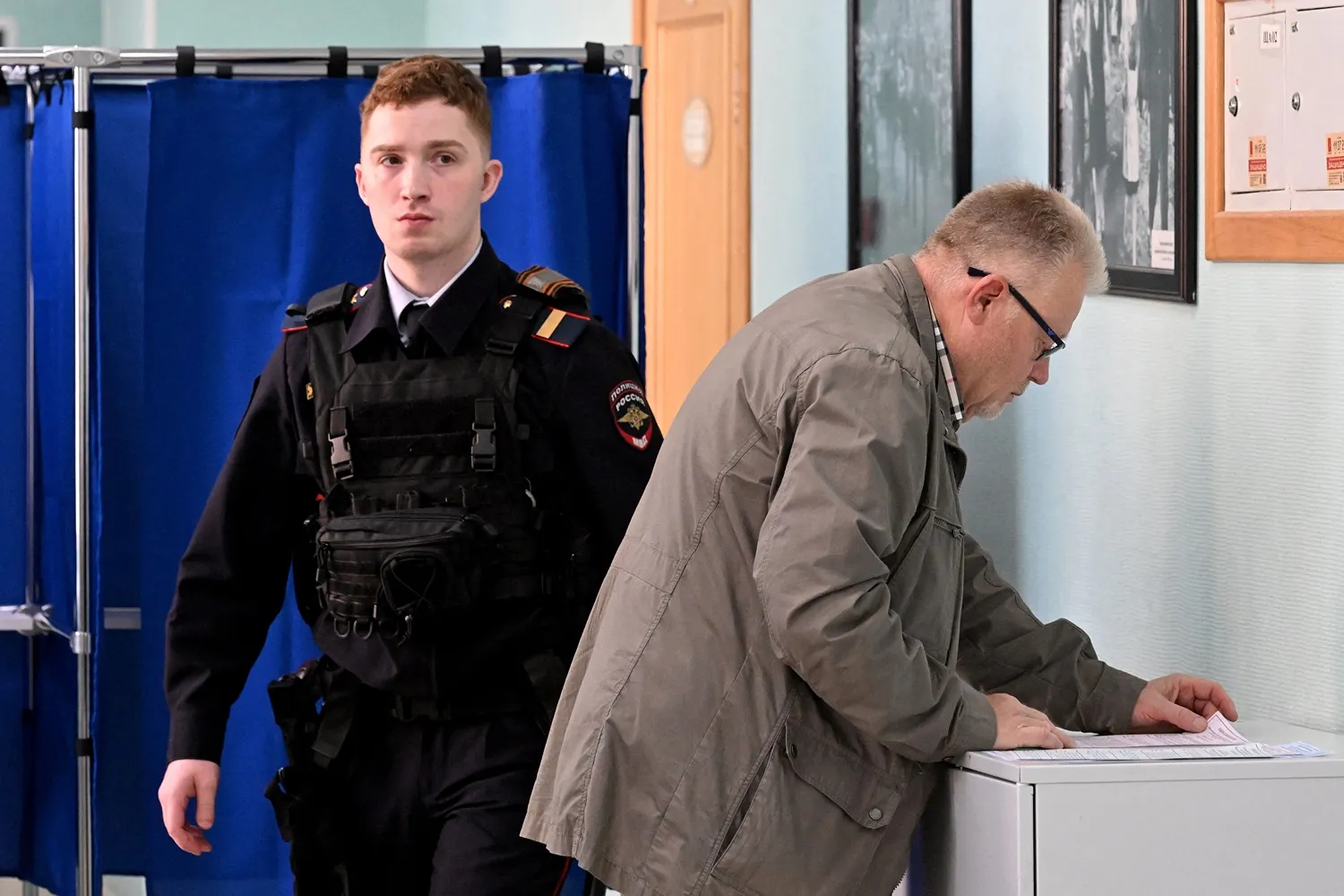
“Millions of people stand behind our fighters.” That is the message that the Kremlin is hoping to send as Russia kicks off its first State Duma elections since the Russia-Ukraine war erupted in February 2022. The results are all but certain; support for United Russia, the party most closely associated with President Vladimir Putin, is polling at nearly 40 percent. But experts argue that the outcome matters less for Moscow than the veneer of holding a vote.
Welcome back to World Brief, where we’re looking at a litmus test on domestic support for Russia’s war, massive pro-government rallies in Iran, and calls for Irish reunification.
Expected Results
“Millions of people stand behind our fighters.” That is the message that the Kremlin is hoping to send as Russia kicks off its first State Duma elections since the Russia-Ukraine war erupted in February 2022. The results are all but certain; support for United Russia, the party most closely associated with President Vladimir Putin, is polling at nearly 40 percent. But experts argue that the outcome matters less for Moscow than the veneer of holding a vote.
According to the Kremlin, this weekend’s three-day election is an opportunity for Russians to signal their loyalty to the war effort. “Your choice and resolve will once again demonstrate that millions of people stand behind our fighters, that we are a united people, bound by shared values, historical memory, and love for the Motherland,” Putin said in a nationwide address.
But actual democratic choice is little more than a charade. Moscow has banned independent opposition groups from seeking office, no foreign election observers were invited to oversee the process, and the country’s only nonstate election monitoring group shut down last year after its leader was jailed. Of the few participating parties outside of United Russia, all are polling below 14 percent. And despite technically being separate entities, they have a history of voting in tandem with United Russia’s agenda.
Even the candidates appear unconcerned about the results. Six individuals running for Russia’s 158th district skipped two days of televised debate ahead of this weekend’s vote, and only one person seeking office in Udmurtia bothered to show up for the event there.
Still, the Kremlin has made a show of this weekend’s proceedings, with Russian state media releasing a video of Putin casting his ballot online on Friday. The highly orchestrated election is important for the Russian leadership, as it provides a facade of legitimacy. That is particularly useful now, amid poor public opinion toward the economic costs of the war, which has plodded on for nearly five years despite few recent battlefield gains on either side.
According to a Levada Center poll published on Thursday, a third of Russians now believe that unemployment will rise in the next 12 months. Fuel shortages across the country have exceeded 30 percent, including for diesel in some areas. And the Moscow Times reported this week that continued Ukrainian drone strikes on Russian warehouses are estimated to have cost the country’s e-commerce industry around $4.74 billion this year.
Meanwhile, as Moscow tries to signal a united populace, Kyiv marked the occasion by highlighting its close ties to seven Central and Eastern European countries, including former Soviet satellite states. The inaugural Carpathian Eight Summit, held in Ukraine on Friday, “has become one of the strongest foundations of our defense,” Ukrainian President Volodymyr Zelensky wrote on X. “It is about strength that is here to stay.”
Today’s Most Read
What We’re Following
Regime loyalty. Hundreds of thousands of Iranians gathered in Tehran on Friday as part of a government-organized demonstration against U.S. and Israeli strikes. Wearing combat uniforms, wielding guns, and waving flags, attendees signaled their loyalty to the Iranian regime while also showing off the country’s advanced military hardware. Participants reportedly chanted “Death to America” and “Death to Israel,” and some of them pledged to volunteer for limited training to defend their country as part of the “Janfada-e Iran” (or the “ones who sacrifice their lives for Iran”) campaign. The event was the largest such march in Iran since war broke out in late February.
Also on Friday, Iran claimed to have struck a Togo-flagged oil tanker in the Strait of Hormuz. According to the Islamic Revolutionary Guard Corps, the vessel was attempting to illegally pass through the critical waterway, which Tehran has kept effectively closed for months in a bid to establish total control over the thoroughfare. The United Kingdom Maritime Trade Operations also reported an attack on an oil tanker near Oman, though it is unclear if the two reports were about the same incident.
Continued Iranian attacks in recent days have pushed the White House toward a crossroads. “Do I want to go in and annihilate them [the Iranian regime], or do I not?” U.S. President Donald Trump told Axios on Thursday, adding that he has a “big decision coming up.” He is expected to meet with Gulf leaders from Bahrain, Kuwait, Oman, Qatar, Saudi Arabia, and the United Arab Emirates in New York next Tuesday on the sidelines of the United Nations General Assembly.
A united Ireland? British Prime Minister Andy Burnham welcomed Irish Taoiseach Micheal Martin to Manchester on Friday, making the Irish premier the first foreign leader to visit Burnham’s newly unveiled No. 10 North. The two discussed ways to bolster bilateral trade and security ties, support for Ukraine, and their shared commitment to the Good Friday Agreement.
Notably absent, though, was any conversation about recent calls for Irish reunification. “We discussed a wide range of issues, and I don’t think at this stage that the British government is at that position,” Martin told reporters when asked whether the topic was addressed. Burnham had previously told the BBC that a referendum on this issue was “off the table.”
Last week, Trump said that he’d “love to see” Northern Ireland rejoin Ireland while visiting his golf course in the latter’s County Clare. Within 48 hours, the leaders of Northern Ireland, Scotland, and Wales had also issued a joint statement expressing support for independence from the United Kingdom. “Brexit has damaged our economies, and limited opportunities for our people,” they wrote. “Europe is our common home, and we believe the future of our nations belongs in the European Union.” Burnham has repeatedly also dismissed bids for Scottish and Welsh secession.
High-stakes elections. German Chancellor Friedrich Merz faces growing pressure ahead of state elections in Mecklenburg-Western Pomerania and the city-state of Berlin on Sunday. Following a disappointing election result last week and suffering record-low approval ratings, Merz’s center-right Christian Democrats and their coalition partners could once again be ousted by the far-right Alternative for Germany (AfD) party.
This month, the AfD—known for its xenophobic policies and ties to neo-Nazism—swept regional elections in Saxony-Anhalt, marking the closest instance that a far-right German party has come to commanding outright state control since World War II. Fueled by worsening anti-immigrant sentiment, the AfD’s victory injected new hope for the party’s other regional ambitions while also foreshadowing a tumultuous rest of the year for Merz.
Analysts suggest that Merz could be forced out of office before his term is up in 2029 if his coalition suffers a second (or third) state election defeat. Current polling has the AfD expected to perform strongly but fall short of outright victory. Still, calls for Merz to step aside are mounting, and as John Kampfner argued in Foreign Policy last week, “The battle for the soul of Germany is on.”
What in the World?
Ahead of next month’s election, Brazilian President Luiz Inácio Lula da Silva signed a decree on Thursday that did what?
A. Opened an investigation into election rival Flávio Bolsonaro
B. Ordered immediate one-time payments of $1,000 to all Brazilians
C. Increased the benefits of his welfare program by 15 percent
D. Suspended gas taxes for 30 days
Odds and Ends
South Korea’s men’s field hockey match against Bangladesh kicked off with a rocky start on Friday. As the players lined up before taking the pitch at Japan’s Green Stadium, Asian Games officials accidentally played the national anthem of South Korea’s biggest adversary: North Korea. “We are really sorry, terribly sorry,” the stadium’s announcer said before correcting the mistake; the North Korean national anthem is banned across South Korea, as the two countries are still technically at war. The mix-up doesn’t appear to have rattled Seoul’s team, though. South Korea beat Bangladesh 5-0.
And the Answer Is…
C. Increased the benefits of his welfare program by 15 percent
Neither Lula nor rival Flávio Bolsonaro is likely to solve Brazil’s core issues of anemic long-term growth and entrenched corruption, Adam Goldsmith argues.
To take the rest of FP’s weekly international news quiz, click here, or sign up to be alerted when a new one is published.
