


- The Philippines’ new critical-minerals policy targets at least 9 million hectares (22 million acres) of prospective mineral areas, more than 11 times the land currently covered by approved mining projects, according to an environmental legal group.
- Environmental and Indigenous rights advocates warn that expanded mineral development could increase pressure on forests and ancestral domains.
- Critics say that by rolling out the simultaneous processing of mining permits and clearances, the new policy could undermine meaningful free, prior, and informed consent (FPIC) if Indigenous communities are pushed to make decisions without adequate time and information.
- The mining industry has welcomed faster and more predictable permitting, while advocates are calling for stronger community participation and safeguards for Indigenous rights and ecosystem health before large-scale critical-mineral development proceeds.
The Philippines is moving to accelerate critical-mineral development across millions of hectares of land, raising concerns that expanded mining and faster permitting could put pressure on forests, ancestral domains, and Indigenous communities’ ability to give or withhold consent.
In an executive order signed on Aug. 18, President Ferdinand Marcos Jr. established a national framework for developing the country’s critical-minerals industry. The order identifies at least 9 million hectares (22 million acres) of prospective areas that could host mineral resources, and calls for policies that promote downstream processing, investment, and “responsible and sustainable mining practices.”
Executive Order No. 122 directs the Department of Environment and Natural Resources (DENR), through its Mines and Geosciences Bureau, to implement a national exploration and mineral reservation program. It also orders mining applications streamlined through a virtual one-stop shop that will allow national and local permits and clearances to be processed simultaneously rather than sequentially.
The Legal Rights and Natural Resources Center (LRC), an environmental and Indigenous rights legal group, says the policy could expose a much larger area to mineral exploration and development.
The 9-million-hectare figure represents about 30% of the country’s land area, and is more than 11 times the 813,575 hectares (2.01 million acres) currently covered by approved mining projects, according to the LRC. EO 122, however, describes the 9 million hectares as prospective areas with potential mineral resources, rather than as approved mining projects.
Rogelio Andrada II, a forestry professor and director of the Institute of Renewable Natural Resources at the University of the Philippines Los Baños, said mineral exploration may be less disruptive but is not without impacts, while extraction can damage forests depending on the mineral, location, and technology used.
“Mining, whatever technology is used, is essentially disruptive to any ecosystem where it is done, whether forest, freshwater or grassland, because it is an extractive industry,” Andrada told Mongabay by email.
Pressure on ancestral lands
The LRC estimates that 424,830 hectares (1.05 million acres), or 54% of the country’s existing approved mining area, potentially overlaps with ancestral domains.
Victor Colili, a Pala’wan Indigenous leader from Brooke’s Point on the island of Palawan, said further expansion would intensify pressures communities already experience. Colili’s community have for years opposed a nickel mining operation in their ancestral territory, which they say has damaged their environment.
“In Palawan, there is practically nowhere you can mine that is not forest and ancestral land,” Colili told Mongabay in a phone interview.
He added Indigenous families living within ancestral domains depend directly on forests and other natural resources for farming and subsistence.
“If their territory becomes smaller, the land they depend on for their daily livelihood also becomes smaller,” Colili said. “Their farms become smaller too, and that will lead to poverty.”
He also warned that mining can deepen divisions within Indigenous communities, particularly where royalty payments create competing interests over ancestral lands.

Faster permits raise consent concerns
LRC has also questioned EO 122’s simultaneous processing of permits and clearances, warning that the processes of obtaining affected communities’ free, prior, and informed consent, or FPIC, and public consultations could take place before communities have sufficient information about the impacts.
“Communities cannot give informed consent to a mining project if they have yet to see and understand the full environmental impacts of that project,” said LRC executive director E.M. Taqueban.
Colili raised a similar concern, saying communities need sufficient time to assess the potential impacts and complex agreements involved in mining projects before deciding whether to give their consent.
“If a decision is obtained through a process that is rushed, we Indigenous peoples could consider that a form of deception,” he said.
Mongabay sought comment from DENR through the agency’s press relations office, asking how it would ensure simultaneous permitting doesn’t weaken environmental assessment, public participation, or FPIC processes. The department had not responded by the time this story was published.
The mining industry, meanwhile, has welcomed streamlined permitting. The Philippine Nickel Industry Association called simultaneous rather than sequential processing “particularly encouraging,” saying its implementation should result in faster, clearer, and more predictable processes for investors.

Mining while protecting ecosystems
Andrada said mining remains necessary because some important minerals have no available alternatives, but extraction should preserve ecosystem health and ensure that economic benefits reach local communities.
“Our survival as a species depends on a well-functioning ecosystem, nothing else,” he said.
Where mining proceeds, Andrada said, some environmental impacts are inevitable, so safeguards should anticipate them and prevent irreversible ecosystem damage.
“Listen to the local people and follow their advice when they express concerns and warnings regarding mining activities,” he said, adding that local governments should prioritize the welfare of affected communities.
The Marcos administration says critical-mineral development should proceed alongside environmental protection and the social, cultural, and economic development of host communities. EO 122 also seeks to move the Philippines beyond raw extraction toward refining, manufacturing, and mineral recycling.
The LRC called on Congress to first pass the Alternative Minerals Management Bill, which seeks to reform mining policy by strengthening community participation and rights and incorporating ecosystem protection, before pursuing large-scale critical-mineral development.
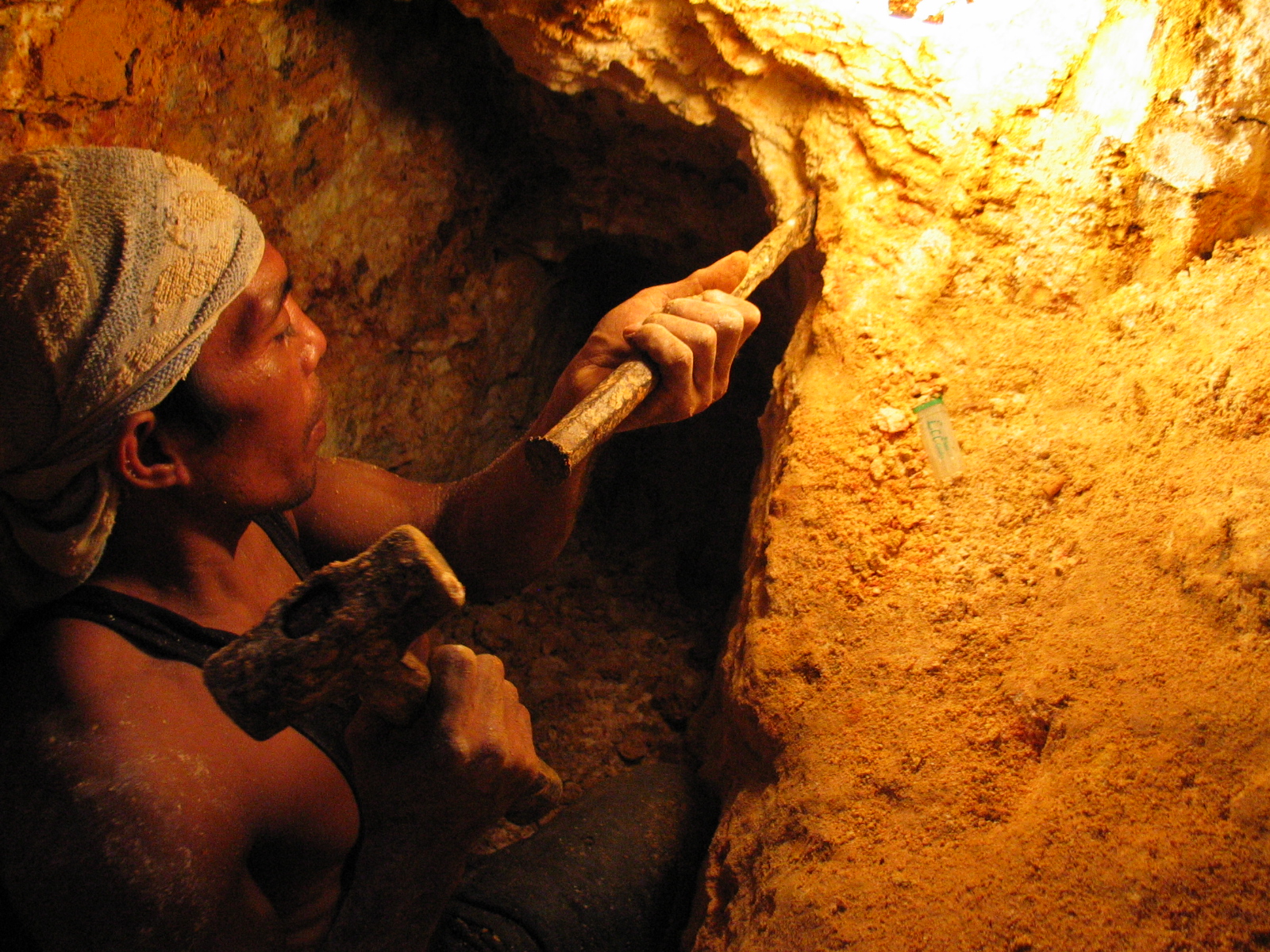
Banner image: A man working in a mine in Bicol. Image by ILO/Joseph Fortin, ILO Asia-Pacific via Flickr (CC BY-NC-ND 2.0).
‘Green’ energy transition leaves a dirty trail in the Philippines’ nickel belt
Philippine tribes revive reforestation to defy coal mining expansion
Nickel mining damage near UNESCO site stirs outrage in southern Philippines
FEEDBACK: Use this form to send a message to the editor responsible for this story. If you want to post a public comment, you can do that at the bottom of the page.
Cite this article
Keith Anthony Fabro (2026). Philippines fast-tracks critical minerals, raising Indigenous, environmental concerns. Mongabay Conservation news. DOI: https://doi.org/10.66709/news-328354

